If you have received a message containing “TM” and wondered what it means, you are not alone. Short forms and abbreviations have become a normal part of digital communication, especially in text messages, social media comments, and online chats.
The meaning of “TM” can change depending on the sentence, conversation, and subject being discussed. In casual texting, it may refer to “tomorrow,” “text message,” or sometimes “trust me,” while in professional or technical contexts, it can have completely different meanings.
People commonly search for what TM mean in text because abbreviations are often written without explanation.
Someone might write “See you tm,” for example, where the meaning is easy to understand from context. In another conversation, “TM” could refer to a trademark or a technical term.
This guide explains the meaning of TM in text, its background, common uses, social-media meanings, professional interpretations, and related terminology.
Understanding the context will help you determine exactly what the sender intended.
Meaning & Definition of TM
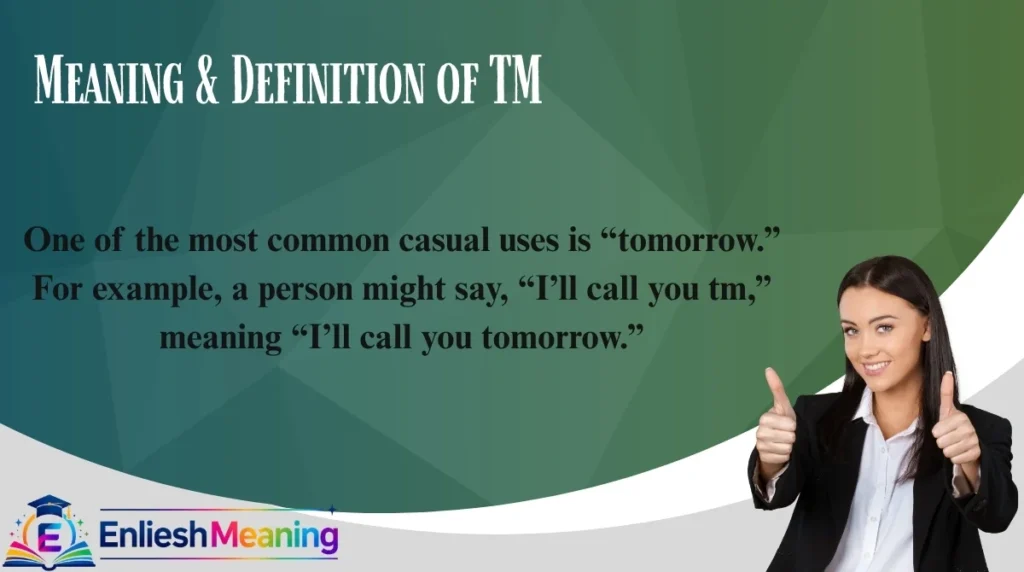
The abbreviation TM does not have one universal meaning in texting. Its interpretation depends heavily on the words surrounding it. One of the most common casual uses is “tomorrow.” For example, a person might say, “I’ll call you tm,” meaning “I’ll call you tomorrow.”
Another possible interpretation is “text message” when people are discussing messages or mobile communication. For instance, someone could say, “Send me a tm when you arrive,” although this usage is less common than simply saying “text.”
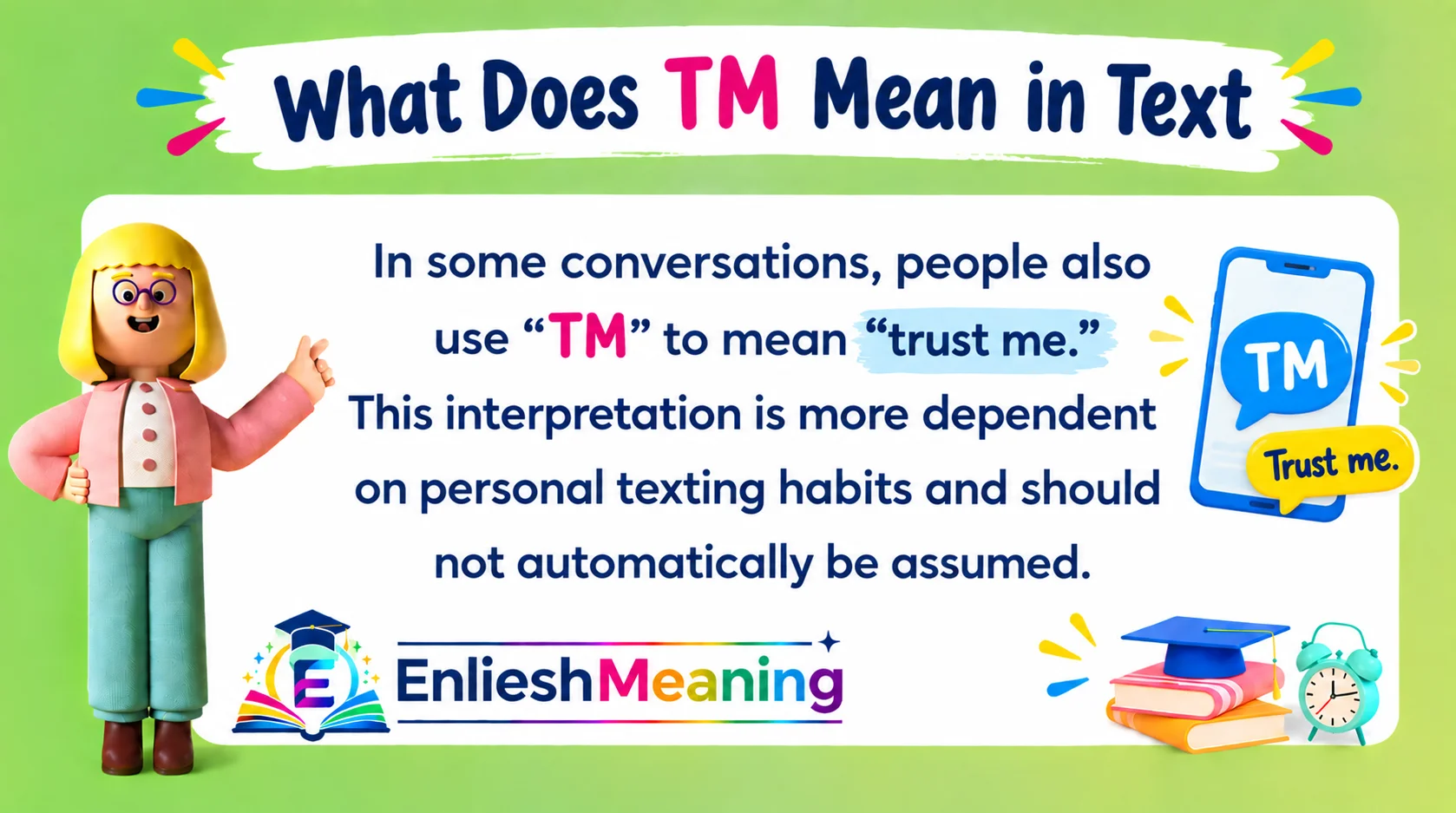
In some conversations, people also use “TM” to mean “trust me.” This interpretation is more dependent on personal texting habits and should not automatically be assumed.
Outside casual conversations, TM is widely recognized as an abbreviation for “trademark.” It can appear after a brand name, slogan, product name, or phrase to indicate that the name is being claimed as a trademark. The trademark symbol is normally written as ™, but people may type “TM” when they do not have easy access to the symbol.
Therefore, when someone asks, “what do TM mean in text,” the safest answer is: TM has multiple meanings, and the surrounding context determines which one is intended.
Examples of TM in Everyday Messages
- “Can we talk tm?” → likely tomorrow
- “I’ll send you a tm later.” → possibly text message
- “TM, everything will be okay.” → possibly trust me
- “This is BrandName TM.” → likely trademark
The best approach is to examine the entire sentence instead of interpreting the abbreviation by itself.
Background and Development of TM
Abbreviations such as TM became increasingly popular as digital communication developed. Early mobile phones and text messaging encouraged people to shorten words because typing long messages could be inconvenient. As texting became faster and more common, users developed informal shortcuts for frequently used words and phrases.
Words such as “tomorrow” were often shortened to “tm,” “tomm,” or other variations. These forms were particularly useful when people wanted to send quick messages. Over time, different online communities developed their own abbreviations, meaning the same combination of letters could acquire several interpretations.
The development of social media further increased the use of short forms. Platforms that encourage quick comments and short posts made abbreviations convenient. Younger users, gaming communities, online groups, and messaging communities also developed specialized vocabulary.
However, TM is not exclusively a modern texting abbreviation. The letters have long been used in professional and technical contexts. The most recognizable example is TM as an abbreviation for trademark. The symbol ™ is associated with identifying a word, name, logo, or phrase as a trademark.
This creates an important distinction. When someone types “TM” in a casual conversation, they may be using informal internet language. When it appears next to a brand name, it is much more likely to refer to a trademark.
Because abbreviations evolve naturally, there is no single dictionary-style interpretation that works in every conversation. Context, capitalization, sentence structure, and the relationship between the people communicating can all influence the intended meaning.
Why Context Matters
Consider the sentence:
“I’ll see you TM.”
Here, “TM” most likely means tomorrow.
Now consider:
“CompanyName TM.”
In this situation, the intended meaning is almost certainly trademark.
The letters have stayed the same, but the context changes the meaning completely.
Usage in Different Contexts
TM appears in several types of communication, but its meaning can vary significantly according to the setting.
TM in Casual Chat
In everyday texting, TM can mean tomorrow. This is especially likely when it follows a verb associated with future plans.
Examples include:
- “Talk to you tm.”
- “Are you free tm?”
- “I’ll finish it tm.”
- “Let’s meet tm.”
In these examples, the meaning is understood because the sentence refers to a future event.
TM on Social Media
Social-media users may use TM as a casual abbreviation, although its meaning depends on the community and conversation. A person discussing plans may use it for “tomorrow,” while someone discussing a brand could use TM in relation to trademarks.
TM in Professional Fields
In professional communication, abbreviations should be interpreted more carefully. TM may refer to trademark, technical manual, team member, traffic management, or another field-specific term.
Because professional abbreviations can be industry-specific, assuming that TM means “tomorrow” could cause confusion.
TM in Business
Business and branding are particularly important contexts because TM can refer to a trademark. A company may use the ™ symbol to indicate a claimed trademark that has not necessarily been registered in the same way as a registered trademark symbol.
TM in Education
In educational material, TM could represent a specialized term, course abbreviation, measurement, or technical concept. The surrounding material should be examined before deciding what it means.
The key lesson is simple: never interpret TM based only on the letters. Look at the entire communication.
Meaning of TM in Chat, WhatsApp, Instagram, and TikTok
Digital platforms do not give TM one fixed meaning. The platform may influence the style of communication, but the context remains the most important factor.
TM Meaning in Chat
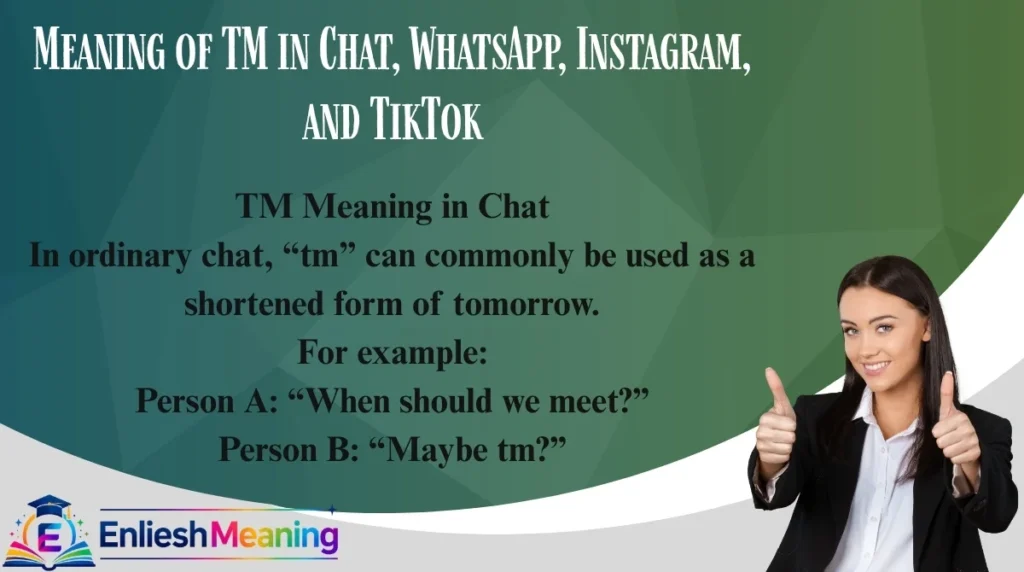
In ordinary chat, “tm” can commonly be used as a shortened form of tomorrow.
For example:
Person A: “When should we meet?”
Person B: “Maybe tm?”
Here, tm clearly refers to tomorrow.
TM Meaning on WhatsApp
WhatsApp conversations often contain informal abbreviations because users tend to type quickly. Someone might write:
“Call me tm.”
The likely meaning is “Call me tomorrow.”
However, if the conversation is about a business name or brand, TM could instead refer to a trademark.
TM Meaning on Instagram
On Instagram, the meaning depends on whether TM appears in a direct message, comment, caption, username, or branding discussion.
For example:
“Let’s talk tm.”
Here it probably means tomorrow.
But:
“Our new logo is TM protected.”
Here TM is associated with trademark terminology.
TM Meaning on TikTok
TikTok users frequently use shortened words, slang, and community-specific expressions. TM may therefore appear as an informal abbreviation. Nevertheless, there is no universal TikTok definition that applies to every use.
How to Identify the Intended Meaning
Ask yourself:
- Is the message discussing a future event?
- Is it talking about a brand or product?
- Is the conversation about texting?
- Is the abbreviation part of a technical discussion?
- Does the surrounding sentence provide a clear clue?
These questions usually make the intended meaning obvious.
TM Meaning in Physics, Medical, and Aircraft Terminology
The meaning of TM can change substantially when it moves from texting into specialized fields. This is why it is important not to apply a texting definition to technical material.
TM in Physics
In physics and scientific contexts, Tm can be used as the chemical symbol for thulium, a rare-earth element. The capitalization matters: the chemical symbol is written Tm, not simply “tm” as casual texting shorthand.
In technical formulas and scientific writing, abbreviations can also be defined specifically by the author or field. Therefore, TM should always be interpreted according to the relevant scientific context.
TM in Medical Terminology
In medicine, TM can have several meanings depending on the specialty and document. It may be used as an abbreviation for particular medical terms, anatomical references, treatments, or other concepts.
Medical abbreviations should not be interpreted casually because the same abbreviation can have different meanings across medical specialties. If TM appears in a medical report, prescription, or clinical document, the surrounding terminology is essential for determining its meaning.
TM in Aircraft and Aviation Terminology
Aviation uses many abbreviations because pilots, engineers, technicians, and air-traffic professionals need concise communication. TM may therefore appear as part of a specialized aviation term, manual reference, operational abbreviation, or organizational terminology.
Its exact meaning depends on the aviation document or communication system in which it appears.
Why Technical Context Is Different
The same two letters can mean different things in different disciplines. A person texting “see you tm” is using informal language, while a scientist writing “Tm” may be referring to an element.
This distinction is particularly important when reading technical documents. Capitalization, surrounding terminology, and the field of study can completely change the interpretation.
Common Misconceptions About TM
One of the biggest misconceptions about TM is that it always means one specific thing. In reality, abbreviations are highly dependent on context.
Misconception 1: TM Always Means Tomorrow
“Tomorrow” is a common interpretation in casual texting, but it is not the only one. If TM appears next to a company or product name, trademark is a much more likely meaning.
Misconception 2: TM Always Means Trademark
The opposite assumption can also be incorrect. In a sentence such as “Are you coming tm?” the person almost certainly means tomorrow rather than trademark.
Misconception 3: Capitalization Never Matters
Capitalization can provide clues. “Tm” in scientific writing may represent thulium, while “tm” in a casual message can be an informal abbreviation.
Misconception 4: Everyone Uses TM the Same Way
Online communication changes rapidly. Different groups may use the same abbreviation differently. A phrase that is obvious to one group may be confusing to another.
Misconception 5: Abbreviations Are Always Appropriate
Short forms are useful in casual conversations, but they may not be appropriate in formal emails, academic writing, legal documents, or professional reports. Clear language is usually preferable when the audience may misunderstand the abbreviation.
The safest rule is to interpret TM based on context rather than assumption.
Similar Terms and Alternatives
Several abbreviations can have meanings close to the common texting interpretation of TM.
Alternatives for “Tomorrow”
If TM means tomorrow, other informal forms may include:
- tomo
- tmrw
- tmr
- tom
- tomorrow
The exact abbreviation varies from person to person.
Alternatives for “Trust Me”
If someone uses TM to mean “trust me,” the complete phrase is clearer and less ambiguous. Other informal expressions might include:
- “Believe me”
- “Honestly”
- “I promise”
- “You can trust me”
Alternatives Related to Texting
If TM is being used to refer to a text message, clearer alternatives include:
- text
- message
- SMS
- text message
- DM, when referring to a direct message on social media
Trademark-Related Terms
When TM means trademark, related terminology includes:
- ™ — trademark symbol
- ® — registered trademark symbol
- trademark
- brand name
- service mark
These terms are related but should not automatically be treated as identical.
Understanding the alternatives can help you determine what the sender means when TM appears without explanation.
How to Respond to TM
How you respond to TM depends entirely on what the sender intended.
If TM Means Tomorrow
If someone writes:
“Can we meet tm?”
You can simply respond:
“Sure, tomorrow works for me.”
Or:
“Yes, what time?”
If TM Means Trust Me
If the sender says:
“TM, you’ll love this.”
You might respond:
“Okay, I trust you!”
Or:
“Sounds good. I’ll give it a try.”
If You Are Unsure
When the abbreviation is unclear, asking for clarification is perfectly normal.
You could say:
- “Do you mean tomorrow?”
- “What does TM mean here?”
- “Do you mean the trademark?”
- “Are you referring to a text message?”
There is no need to guess when the meaning could affect the conversation.
When a Simple Response Is Enough
Sometimes the context is obvious. If a friend says:
“See you tm!”
You do not need to ask what TM means. A natural response would be:
“See you tomorrow!”
The best response is therefore based on the intended meaning, relationship, and tone of the conversation.
Differences Between TM and Similar Words
Understanding the difference between TM and similar abbreviations can prevent misunderstandings.
TM vs. TMR
Both can be used informally to mean tomorrow, but TMR is generally more recognizable as a shortened form of the word itself.
TM vs. TMRW
TMRW is another common shortened spelling of tomorrow. Unlike TM, it more directly resembles the original word, making its meaning easier to identify.
TM vs. BTW
BTW normally means “by the way.” It is unrelated to the common meanings of TM.
For example:
“BTW, I’ll call you tm.”
Here, BTW introduces additional information, while tm refers to tomorrow.
TM vs. TY
TY usually means “thank you.” It should not be confused with TM.
TM vs. DM
DM generally means “direct message.” On social media, this distinction is especially important. A DM refers to a private message, while TM may have several unrelated meanings.
TM vs. TMI
TMI usually means “too much information.” It is another common internet abbreviation but has a completely different meaning.
The main difference is that TM is context-dependent, while some other abbreviations have much more standardized meanings.
Relevance in Online Conversations and Dating Apps
Abbreviations can be especially important in online dating because people often communicate quickly and informally. A short message such as “talk tm?” may simply mean “talk tomorrow?”
For example:
Person A: “Are you free tm?”
Person B: “Yes, I should be.”
Here, TM clearly refers to tomorrow.
In another conversation, someone might write:
“TM, this is the best place.”
If the person means “trust me,” the interpretation depends on the tone and surrounding messages.
Dating apps also contain usernames, bios, profile descriptions, and references to brands. In these settings, TM might potentially refer to a trademark or another personal abbreviation rather than a texting shortcut.
Why Context Is Especially Important
Online dating conversations can involve unfamiliar people, so assumptions can easily lead to confusion. If someone uses an unusual abbreviation, it is better to ask rather than misunderstand the person’s intention.
A friendly clarification such as:
“By TM, do you mean tomorrow?”
is simple, natural, and avoids unnecessary confusion.
TM and Communication Tone
Short abbreviations can make messages feel casual and relaxed. However, excessive abbreviations may sometimes make communication difficult, especially when people do not share the same texting habits.
Using straightforward language is often the best choice when communicating with someone new.
FAQs
What does TM mean in text?
In casual texting, TM can commonly mean “tomorrow.” Depending on context, it can also mean text message, trust me, trademark, or another specialized term.
Does TM mean tomorrow in texting?
Yes, TM can mean tomorrow, especially when the sentence discusses plans or an event in the future. For example, “See you tm” usually means “See you tomorrow.”
What does TM mean on WhatsApp?
On WhatsApp, TM may commonly be used as a shortened form of tomorrow. However, its meaning depends on the surrounding conversation.
What does TM mean on Instagram or TikTok?
There is no single platform-specific meaning. On Instagram or TikTok, TM may mean tomorrow or another abbreviation depending on the context, caption, comment, or direct message.
What does TM mean besides tomorrow?
TM can mean several things besides tomorrow. Common possibilities include trademark, text message, and sometimes trust me. Technical fields may give the abbreviation additional meanings.
How can I know what TM means in a message?
Look at the words surrounding TM and consider the subject of the conversation. If the message discusses future plans, it probably means tomorrow. If it concerns branding, TM may mean trademark.
Conclusion
The meaning of TM in text depends on context. In casual messages, one of the most common interpretations is “tomorrow,” particularly when someone is discussing plans, appointments, or future activities.
However, TM can also represent other phrases, including text message, trust me, or trademark.
The same abbreviation can have specialized meanings in scientific, medical, aviation, business, and technical environments.
For this reason, it is important to consider the complete sentence, capitalization, subject, and communication platform before deciding what TM means.
If someone writes “see you tm,” the intended meaning is usually easy to understand as tomorrow. On the other hand, TM appearing beside a brand name is much more likely to refer to a trademark. When the meaning is unclear, asking the sender for clarification is the simplest solution.
Ultimately, understanding abbreviations is less about memorizing one definition and more about recognizing context. Once you examine how TM is being used, its intended meaning is usually straightforward.