
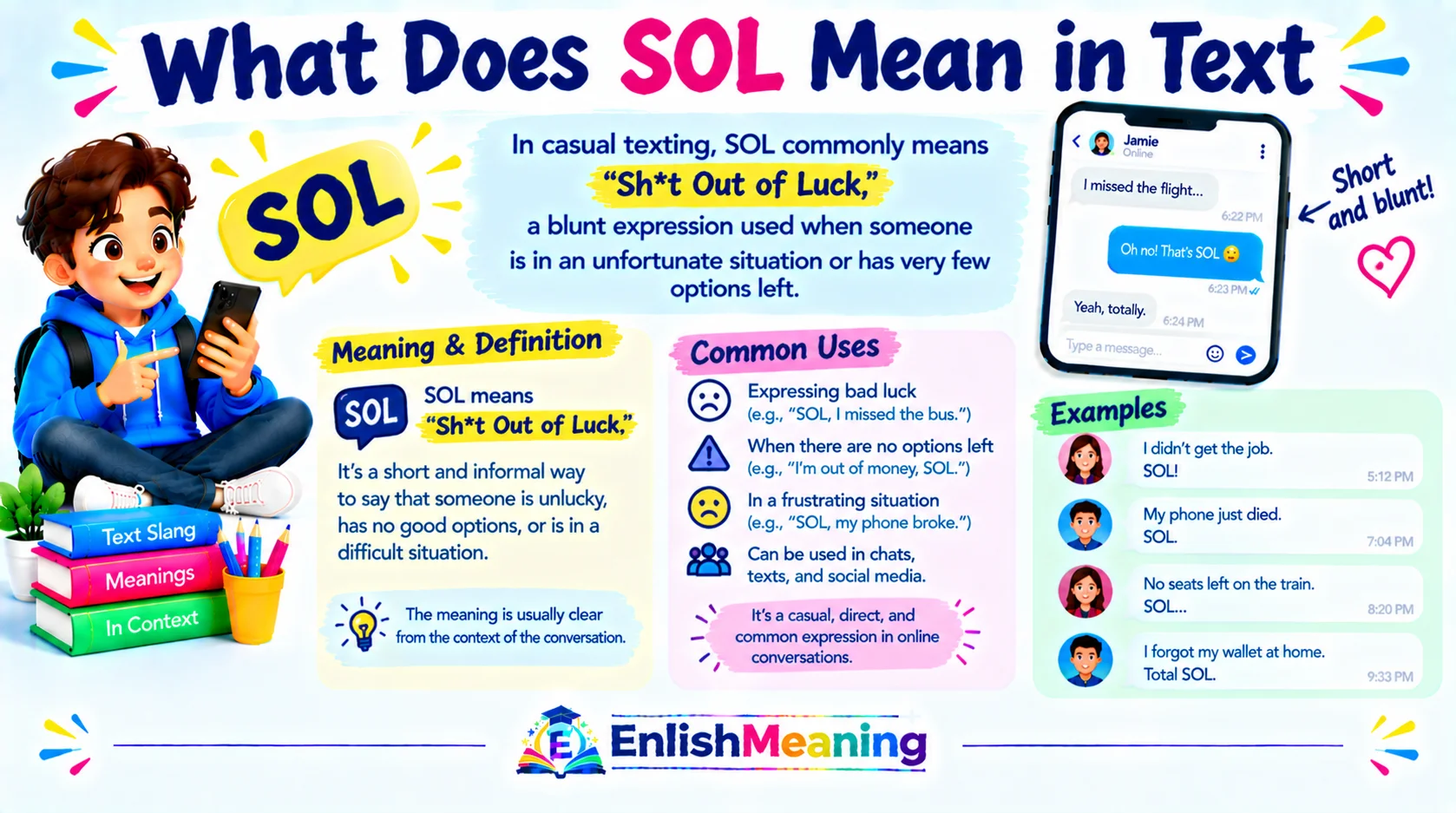
If you have received a message containing “SOL” and were unsure what the person meant, you are not alone. Texting abbreviations can have several meanings depending on the conversation, relationship, and platform where they appear.
In casual texting, SOL commonly means “Sh*t Out of Luck,” a blunt expression used when someone is in an unfortunate situation or has very few options left.
However, SOL can also have completely different meanings in science, medicine, aviation, technology, and other professional fields.
People often search for the meaning of SOL in text because abbreviations can be difficult to understand without context.
A short three-letter expression may communicate frustration, humor, disappointment, or sympathy. Understanding the surrounding conversation is therefore important before deciding what SOL means.
This article explains the common meanings of SOL, how people use it in messages and social media, and how its meaning changes across different fields.
Meaning & Definition Of SOL
In texting and casual online communication, SOL most commonly means “Sh*t Out of Luck.” It is an informal phrase describing a situation where someone is unlucky, has missed an opportunity, or has no practical solution available.
For example, imagine someone forgets to submit an important application before the deadline. A friend might say:
“You missed the deadline? Looks like you’re SOL.”
Here, SOL communicates that the person is unfortunately out of options.
The abbreviation is generally considered informal and somewhat vulgar because its expanded form contains profanity. For this reason, it is more appropriate in casual conversations among people who are comfortable with that type of language. It may not be suitable for professional emails, formal messages, or conversations with someone you do not know well.
The exact tone depends on context. Someone may use SOL seriously when discussing a difficult situation, while another person may use it jokingly to tease a friend.
SOL can also have other meanings. For example, someone discussing astronomy or physics might use “Sol” to refer to the Sun, particularly in scientific or science-fiction contexts. In other situations, SOL may be an acronym for an organization, technical term, medical expression, or professional phrase.
Therefore, the safest approach is to look at the surrounding words before interpreting it.
Background
The expression behind SOL comes from the informal phrase “Sh*t Out of Luck,” which has been used in English as a way to describe being stuck in an unfavorable situation. Like many conversational expressions, it eventually became shortened into an acronym that could be typed quickly.
Texting culture encouraged the growth of abbreviations because people often wanted to communicate ideas using fewer characters. Expressions such as LOL, OMG, BRB, and similar shortcuts became common in digital communication. SOL developed within this broader culture of shortening familiar phrases.
The abbreviation is especially useful when the writer wants to communicate that there is little that can be done about a problem. Instead of writing a complete sentence such as “Unfortunately, you are out of options,” a person can simply write “SOL.”
However, SOL is not limited to texting slang. Capitalization and context can change its interpretation. “SOL” in a casual message may represent the slang expression, while “Sol” in astronomy can refer to the Sun. In technical or professional environments, the same letters may represent an entirely unrelated abbreviation.
This is why dictionary-style definitions are not always enough when interpreting short internet expressions. Context provides important clues.
When you encounter SOL in a message, consider what the conversation is about, what the other person said immediately before it, and whether the topic is casual or professional. These clues can usually reveal the intended meaning.
Usage in Different Contexts
SOL appears most often in informal communication, but its meaning can change substantially depending on the setting.
Casual Chat
In ordinary conversation, SOL usually communicates bad luck or a lack of options.
Example:
“The store closed before we arrived. We’re SOL.”
The speaker means that they are stuck because the store is no longer available.
Social Media
On social platforms, users may use SOL in comments, captions, replies, or memes. It can describe an unfortunate event in a humorous or exaggerated way.
Example:
“Forgot my charger at home. SOL today.”
The expression adds a casual, conversational tone.
Gaming
Gamers may use SOL when a player is facing a difficult situation with little chance of recovery.
Example:
“You lost all your equipment? SOL.”
The meaning remains connected to being unlucky or having limited options.
Professional Fields
In professional settings, SOL should not automatically be interpreted as slang. It may represent a specialized abbreviation.
For example, a technical document could use SOL as an acronym for a particular process, organization, system, or scientific concept. The surrounding terminology usually provides the necessary clue.
Formal Communication
Because the common slang interpretation contains profanity, it is generally better to avoid SOL in formal workplace communication unless the abbreviation has a specific professional meaning.
The key lesson is simple: the context determines the meaning. A casual text and a technical document can use exactly the same three letters while referring to completely different things.
Meaning in Chat, WhatsApp, Instagram, and TikTok
On messaging and social media platforms, SOL is most commonly understood as the slang abbreviation “Sh*t Out of Luck.” Its purpose is usually to express that someone has encountered bad luck or has run out of options.
SOL in Chat
In a personal conversation, a friend might write:
“You forgot your wallet? SOL 😂”
The phrase may be teasing rather than genuinely harsh.
SOL on WhatsApp
WhatsApp conversations frequently contain informal abbreviations. If someone says:
“No tickets left. We’re SOL.”
they are saying that there are no tickets available and they cannot easily solve the problem.
SOL on Instagram
On Instagram, SOL may appear in comments or direct messages. A user could respond to an unfortunate story with:
“SOL 😭”
depending on their relationship with the person.
SOL on TikTok
TikTok comments often use slang humorously. Someone might describe an unfortunate situation in a video and commenters may use SOL to react to it.
However, social media abbreviations are highly dependent on communities and trends. Some users may use SOL with another meaning, particularly if the content involves a specialized subject.
Another important point is capitalization. “Sol” can mean something completely different from “SOL” in certain contexts. For example, Sol may refer to the Sun, a solar day on Mars, or a name.
Therefore, when you see SOL on WhatsApp, Instagram, TikTok, or another platform, read the entire message instead of interpreting the abbreviation in isolation.
Meaning in Physics, Medical, and Aircraft Terminology
SOL can have meanings beyond texting slang, especially in specialized fields.
Physics and Astronomy
In astronomy, Sol is commonly used as a name for our Sun, particularly when distinguishing it from other stars. In discussions involving Mars, a sol also refers to approximately one Martian solar day.
For example:
“The rover has operated for 500 sols.”
Here, “sols” refers to Martian days rather than the texting expression.
In scientific or science-fiction writing, “Sol” can therefore have a completely different meaning from the casual texting abbreviation.
Medical Context
Medical abbreviations can vary between institutions and specialties. SOL may appear as an abbreviation for terms such as “space-occupying lesion” in some medical contexts. A space-occupying lesion is an abnormal mass or process that takes up space within the body.
However, medical abbreviations should always be interpreted within the specific document and clinical context. The same abbreviation can have multiple meanings, and healthcare professionals generally rely on surrounding information to determine the intended term.
Aircraft and Aviation
Aviation uses many abbreviations, but SOL does not have one universal meaning that should automatically be assumed whenever it appears in an aircraft-related context. Its interpretation depends on the specific manual, organization, system, or operational document.
For instance, an aviation document may define SOL as a specialized term within its own abbreviation list.
This illustrates an important rule: never assume that a technical abbreviation has its texting meaning. If SOL appears in a scientific, medical, or aviation document, examine the terminology surrounding it before interpreting it.
Common Misconceptions
One common misconception is that SOL always means “Sh*t Out of Luck.” While this is a very common interpretation in casual texting, it is not the only possible meaning.
Another misconception is that capitalization always determines the definition. Although capitalization can provide clues, context remains more important. “Sol,” “SOL,” and “sol” can appear in different fields with different meanings.
Some people also assume SOL is always offensive. The slang expansion does contain profanity, but the abbreviation itself may be used casually and humorously between friends. Its appropriateness depends on the audience and setting.
Another misunderstanding occurs when people see SOL in a technical article and interpret it as internet slang. This can produce a completely incorrect interpretation. For example, an astronomy discussion involving Mars may use “sol” to describe a Martian day.
It is also important not to confuse SOL with other three-letter abbreviations simply because they look similar. Online language contains thousands of abbreviations, and small differences in spelling can create completely different meanings.
Finally, SOL does not necessarily communicate anger. In many conversations, it simply expresses unfortunate circumstances. The tone may be serious, sarcastic, sympathetic, or humorous depending on the message.
Similar Terms & Alternatives
Several expressions can communicate ideas similar to the common texting meaning of SOL.
Out of Luck
This is the closest non-profane alternative. It describes someone who has encountered bad circumstances.
Example:
“You’re out of luck because the tickets are sold out.”
No Luck
This is shorter and softer.
Example:
“No luck finding the keys.”
Out of Options
This expression emphasizes that there is nothing practical left to do.
Example:
“We’ve tried everything. We’re out of options.”
Tough Luck
“Tough luck” can express sympathy or, depending on tone, mild teasing.
Example:
“You missed the last bus? Tough luck.”
Too Bad
This is another simple alternative often used in everyday conversation.
Example:
“You can’t join us tonight? Too bad.”
The advantage of these alternatives is that they are generally easier to understand and, in many cases, more appropriate for mixed or professional audiences.
How to Respond to SOL
The best response depends on what the sender means and how seriously they are using the abbreviation.
If someone uses SOL to describe an unfortunate situation, you can respond naturally with sympathy:
“Yeah, unfortunately. I guess there’s nothing we can do.”
If the person is joking, you can respond humorously:
“Yep, definitely my luck today 😂.”
If you are unsure what they mean, simply ask:
“What do you mean by SOL?”
There is nothing wrong with asking for clarification, especially because SOL can have different meanings.
If someone says:
“The event is completely sold out. We’re SOL.”
you could reply:
“That’s unfortunate. Maybe we can find another event.”
In a professional conversation, avoid copying the slang unless you are certain it is appropriate. A neutral response such as “That’s unfortunate” or “It looks like we’re out of options” is usually safer.
The most important factor is tone. Consider your relationship with the sender and whether the original message sounds serious, sarcastic, or playful.
Differences From Similar Words
SOL can overlap with several expressions, but the meanings are not exactly identical.
SOL vs. Unlucky:
“Unlucky” describes bad fortune, while SOL often suggests that someone is both unlucky and stuck without an easy solution.
SOL vs. Tough Luck:
“Tough luck” can sound sympathetic or sarcastic. SOL is generally more direct and informal.
SOL vs. No Chance:
“No chance” focuses on impossibility. SOL focuses more on an unfortunate situation.
SOL vs. Out of Options:
“Out of options” is neutral and emphasizes the lack of solutions. SOL carries a stronger casual or slang tone.
SOL vs. Too Bad:
“Too bad” expresses disappointment but does not necessarily suggest that the person is completely stuck.
The choice of expression depends on what the speaker wants to emphasize. If they want casual slang, SOL may fit. If they want a polite or professional expression, “unfortunately,” “out of options,” or “out of luck” may be more suitable.
Relevance in Online Conversations & Dating Apps
SOL can occasionally appear in dating-app conversations, particularly when people are discussing plans, missed opportunities, or unsuccessful attempts to meet.
For example:
“I forgot to make the reservation. SOL 😭”
The person is saying that their mistake has left them in an unfortunate situation.
Another person might respond:
“No worries, let’s try another place.”
In dating conversations, tone is especially important because short abbreviations can sometimes sound harsher than intended. A person who writes “SOL” jokingly may simply be trying to keep the conversation light, while someone unfamiliar with the abbreviation might interpret it negatively.
Dating-app users also frequently use abbreviations to keep messages short and conversational. However, not every person knows the same slang. If SOL causes confusion, asking what the sender means is better than assuming.
It is also worth remembering that dating apps can contain conversations about many different subjects. If the discussion involves astronomy, medicine, technology, business, or another specialized topic, SOL might have a technical meaning rather than a slang meaning.
Therefore, in online conversations and dating apps, the surrounding message, tone, and topic are the strongest clues to interpretation.
Frequently Asked Questions
What does SOL mean in text?
In texting, SOL commonly means “Sh*t Out of Luck.” It is an informal expression used when someone is in a difficult situation and has little or no luck or options left.
Is SOL a bad word in texting?
SOL contains profanity in its full form, so it can be considered informal or mildly vulgar slang. It is generally more appropriate for casual conversations than professional communication.
What does SOL mean on WhatsApp?
On WhatsApp, SOL usually means “Sh*t Out of Luck.” Someone may use it when describing an unfortunate situation, problem, or lack of available options.
What does SOL mean on Instagram?
On Instagram, SOL can be used as slang for “Sh*t Out of Luck.” Its meaning depends on the surrounding caption, comment, or direct-message conversation.
What does SOL mean on TikTok?
On TikTok, SOL may be used to describe being unlucky or stuck in a difficult situation. It generally carries the same slang meaning used in texting.
What does SOL mean from a girl?
If a girl uses SOL in a text, she may be saying that someone is unlucky or has run out of options. The exact meaning depends on the context of the conversation.
What does SOL mean from a guy?
When a guy uses SOL, he may be referring to an unfortunate situation or telling someone that they are out of luck. It is usually used casually or humorously.
Is SOL a slang word?
Yes. SOL is commonly used as informal internet and texting slang. It is an abbreviation of a phrase containing profanity and is mainly used in casual communication.
What does SOL mean in a conversation?
In a conversation, SOL generally means that someone is in an unfortunate situation with few options available. For example, if someone misses an important deadline and cannot fix the problem, a friend might say, “You’re SOL.”
What does “You’re SOL” mean?
“You’re SOL” means “You’re Sh*t Out of Luck.” It tells someone that they are in a difficult situation and probably cannot do much to change the outcome.
Is SOL the same as unlucky?
They are closely related, but not exactly the same. Unlucky simply describes having bad luck, while SOL is a stronger informal expression suggesting that someone is stuck in an unfavorable situation.
Can SOL be used jokingly?
Yes. SOL is often used humorously or playfully between friends. The seriousness depends on the situation and the tone of the conversation.
What should I reply when someone says SOL?
Your response depends on the context. If someone is joking, you can respond humorously. If they are describing a genuine problem, you can acknowledge the situation or offer help.
Is SOL appropriate for professional messages?
Generally, SOL is better avoided in formal or professional communication because it is informal slang and its full expression contains profanity. A more neutral phrase such as “out of luck” is more appropriate.
What are some alternatives to SOL?
Common alternatives include “out of luck,” “unlucky,” “no luck,” “stuck,” and “out of options.” These expressions can communicate a similar idea without using profanity.
Does SOL have other meanings?
Yes. SOL can have different meanings outside texting, depending on the subject or industry. In casual text conversations, however, “Sh*t Out of Luck” is one of its common slang meanings.
Conclusion
SOL in text commonly means “Sh*t Out of Luck,” an informal expression used when someone is unlucky, stuck in an unfavorable situation, or has few options remaining.
It is most likely to appear in casual chats, social media conversations, gaming discussions, and messages between friends.
However, SOL does not always have this meaning. In astronomy, Sol can refer to the Sun, while sol can describe a Martian solar day.
Medical, scientific, aviation, and other professional fields may also use SOL as a specialized abbreviation.
The best way to understand SOL is therefore to consider the context before interpreting it. Pay attention to the surrounding words, subject matter, capitalization, and relationship with the person who sent the message. If the meaning remains unclear, asking for clarification is the simplest solution.
Whether you encounter SOL on WhatsApp, Instagram, TikTok, a dating app, or in a technical document, context will usually reveal what the writer intended.