
If you have received a message containing CC, you might wonder what the sender is trying to communicate. The abbreviation is commonly used in text messages, social media conversations, emails, and online discussions.
However, its meaning can change depending on the situation and the words surrounding it.
In everyday texting, CC can mean “Carbon Copy,” “Cute Couple,” or “Closed Captioning,” depending on the context. People also use it when talking about relationships, sharing information, or referring to someone in a conversation.
In professional communication, CC has a more established meaning, especially in emails, where it indicates that another person has been included in a message for informational purposes.
Understanding this abbreviation can help you avoid confusion and respond appropriately. Whether you encountered it on WhatsApp, Instagram, TikTok, Snapchat, or in a workplace email, knowing its different interpretations will make online communication easier. Let’s explore its meanings, examples, and common uses.
1. Meaning & Definition of CC
CC is an abbreviation with several possible meanings, but its most recognized definition is “Carbon Copy.” This expression originally comes from the traditional process of making duplicate documents using carbon paper. Today, it is widely used in digital communication, particularly in emails and messaging.
In casual conversations, however, CC may have different interpretations depending on the people involved and the subject being discussed.
Here are some common meanings:
- Carbon Copy: Including another person in a message so they can receive the same information.
- Cute Couple: Describing two people who look good together or share a sweet relationship.
- Closed Captioning: Text displayed on a screen to represent spoken dialogue and important sounds.
- Creative Commons: A type of copyright license that allows creators to share their work under specified conditions.
- Credit Card: A payment card used to purchase products and services.
- Cubic Centimeter (cc): A measurement of volume commonly used in science and medical settings.
Example 1:
Person A: “I sent the project details to our manager.”
Person B: “Did you CC the design team?”
Here, CC means including the design team in the email.
Example 2:
Person A: “Look at those two! They are such a CC.”
Person B: “Honestly, they look adorable together.”
In this informal example, CC is being used to mean Cute Couple, although this is not a universally established texting abbreviation.
The important thing to remember is that CC does not have one fixed meaning in every conversation. Always consider the surrounding message before deciding what someone means.
2. Background and Origin of CC
The abbreviation CC has an interesting history that began long before smartphones, social media, and instant messaging existed.
Its most established origin comes from the expression Carbon Copy, which developed from an old method of duplicating written documents. Before digital communication became common, people used special carbon paper between two sheets of paper. When someone wrote or typed on the first sheet, the pressure transferred the same information onto the second sheet.
This allowed people to create multiple copies of letters, business documents, invoices, and other written materials without rewriting everything.
Over time, the abbreviation CC became a familiar way to refer to these additional copies.
When email technology developed, the term was adopted into digital communication. Email services introduced a CC field that allowed senders to include additional recipients in a message. Everyone listed in that field could receive the same email, and recipients could generally see who else had been copied.
As internet communication expanded, CC started appearing in different online environments. Its use became associated with sharing information, including people in conversations, and referring to different technical terms.
Today, CC is recognized across several fields:
- Email communication: Sending a copy of a message to additional recipients.
- Social media: Used in certain communities with informal meanings.
- Entertainment: Refers to closed captions displayed in videos.
- Copyright: Creative Commons licensing.
- Science: Cubic centimeters as a measurement of volume.
- Technology: Different technical abbreviations depending on the application.
Although its original meaning remains widely recognized, the interpretation of CC continues to depend on context.
3. Usage of CC in Different Contexts
CC appears in many forms of communication. Understanding where it is being used can help you identify its intended meaning.
In everyday chat
Friends may use CC when discussing relationships, sharing information, or referring to something they have seen online. However, informal meanings are not always standardized.
On social media
People sometimes use CC when discussing couples, videos, captions, or creative content. The meaning depends on the platform and the community.
In professional communication
CC most commonly means Carbon Copy. It allows someone to include additional people in an email without making them the primary recipient.
For example:
“Please CC the HR department when sending the updated documents.”
This means the HR department should receive a copy of the email.
In education
Students and teachers may encounter CC when discussing assignments, video captions, copyright permissions, or online learning materials.
For example:
“Please turn on CC before watching the lecture.”
Here, CC means Closed Captioning.
In business
Businesses use CC to keep employees, managers, clients, and other relevant individuals informed about ongoing discussions.
For example:
“Keep the finance team CC’d on all payment-related emails.”
This means the finance team should receive copies of relevant messages.
In entertainment
CC is commonly displayed as an option on streaming platforms and video players. It provides written representations of dialogue and relevant audio information.
As you can see, the same two letters can serve several purposes. The topic of conversation is the best clue to understanding them.
4. What Does CC Mean in Chat, WhatsApp, Instagram, and TikTok?
The meaning of CC can vary across messaging applications and social media platforms. Unlike widely recognized abbreviations such as LOL or BRB, CC does not have one universally accepted meaning in casual texting.
Let’s look at how it may appear on popular platforms.
CC in chat messages
In general chat, CC might refer to Carbon Copy when people discuss emails or sharing information. In some informal conversations, it may refer to a Cute Couple.
Example:
“Those two are CC.”
Possible meaning: Those two make a cute couple.
However, because this usage is not universal, it is better to check the surrounding conversation.
CC on WhatsApp
WhatsApp users may encounter CC when discussing forwarded information, work-related messages, or email communication.
Example:
“Send the report and CC the supervisor.”
Meaning: Send the report and include the supervisor as an additional recipient.
WhatsApp does not have a standard email-style CC field for ordinary personal messages, so the meaning usually comes from the conversation rather than a built-in messaging feature.
CC on Instagram
On Instagram, CC can appear in comments, captions, direct messages, or discussions about videos.
Depending on the content, it might refer to:
- Carbon Copy in a work-related discussion.
- Cute Couple in a relationship conversation.
- Closed Captioning when discussing video accessibility.
- Creative Commons when talking about content permissions.
Example:
“Turn on CC because the audio is difficult to understand.”
Meaning: Enable Closed Captioning.
CC on TikTok
TikTok users frequently encounter CC in videos and accessibility settings. It commonly refers to Closed Captions, which display spoken words as text on the screen.
Example:
“This video has CC available.”
Meaning: The video provides captions.
Creators may also discuss CC when talking about video editing, subtitles, and content accessibility.
Remember: On social media, context matters more than the platform itself. The surrounding words usually reveal which interpretation makes sense.
5. Meaning of CC in Physics, Medical, and Aircraft Terminology
Although CC is common in everyday digital communication, it also has technical meanings in different professional fields.
CC in physics
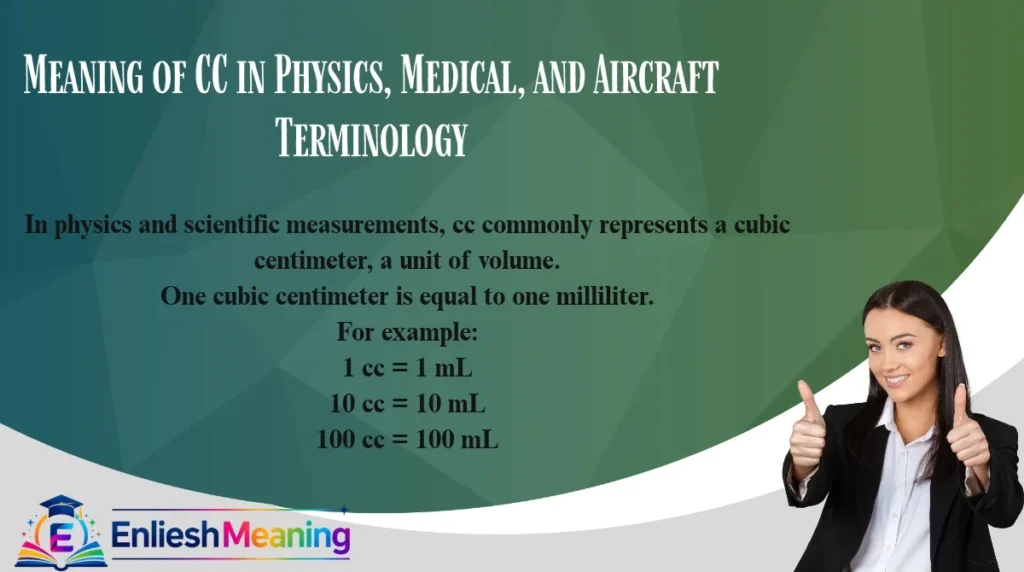
In physics and scientific measurements, cc commonly represents a cubic centimeter, a unit of volume.
One cubic centimeter is equal to one milliliter.
For example:
- 1 cc = 1 mL
- 10 cc = 10 mL
- 100 cc = 100 mL
Scientists may use this measurement when discussing the volume of liquids, laboratory samples, or physical objects.
CC in medical terminology
In medical settings, cc generally refers to cubic centimeters. Healthcare professionals may encounter this abbreviation when discussing fluid measurements, laboratory procedures, or certain medication-related volumes.
For example:
“A sample of 5 cc was collected.”
This means that five cubic centimeters of material were collected.
Although cc is a familiar abbreviation, medical professionals generally prefer using mL for many liquid-volume measurements because it is clearer and helps reduce measurement confusion.
CC in aircraft terminology
In aviation, CC does not have one universal meaning across every aircraft system or document. Its interpretation depends on the specific technical context.
It may appear as an organization-specific abbreviation, an aircraft-related code, or a reference to a technical concept.
In discussions about aircraft engines, engine capacity is sometimes expressed in cubic centimeters, particularly when describing smaller piston engines or comparing engine displacement.
For example:
“An engine has a displacement of 500 cc.”
This describes the volume displaced by the engine’s cylinders.
Important: Do not automatically assume that CC means Carbon Copy in scientific, medical, or aviation documents. Technical abbreviations should always be interpreted according to their specific subject.
6. Common Misconceptions About CC
Because CC has several meanings, people sometimes misunderstand it when reading messages or online content.
Here are some common misconceptions worth avoiding.
Misconception 1: CC always means Carbon Copy.
Although Carbon Copy is its most established meaning, CC can also refer to Closed Captioning, Creative Commons, cubic centimeters, and other terms.
Misconception 2: CC is always romantic slang.
Some people interpret CC as Cute Couple in informal conversations. However, this is not a universal texting definition. The sender’s intention should be considered before assuming a romantic meaning.
Misconception 3: CC and BCC are identical.
Both terms are used in email communication, but they work differently. CC recipients are generally visible to other recipients, while BCC recipients are hidden from them.
Misconception 4: CC is only used on social media.
CC has a long history in traditional paperwork and professional communication. Its use extends to business, education, science, entertainment, and technology.
Misconception 5: CC always refers to video subtitles.
CC can mean Closed Captioning when discussing videos, but it does not automatically have that meaning in ordinary messages.
The easiest way to avoid these misunderstandings is to examine the complete sentence and identify the subject being discussed.
7. Similar Terms and Alternatives to CC
Several abbreviations are related to CC or may appear in similar situations. Learning the differences can make digital communication easier.
| Abbreviation | Full Form | Meaning |
|---|---|---|
| CC | Carbon Copy | Sends a visible copy of an email |
| BCC | Blind Carbon Copy | Sends a hidden copy of an email |
| FYI | For Your Information | Shares information with someone |
| FWD | Forward | Sends an existing message to someone else |
| IMO | In My Opinion | Introduces a personal viewpoint |
| BTW | By The Way | Adds another point to a conversation |
| DM | Direct Message | A private message on a platform |
| LOL | Laughing Out Loud | Expresses amusement |
These abbreviations are not interchangeable.
For example, CC is used to include someone in an email, while FYI simply indicates that information is being shared for someone’s awareness.
Similarly, BCC is useful when sending an email to recipients whose email addresses should remain private from other recipients.
Understanding these distinctions can help you communicate more clearly in both professional and casual situations.
8. How to Respond to CC in a Text Message
Your response should depend on what the sender means by CC. If someone uses it in a work-related conversation, a straightforward acknowledgment is usually appropriate.
If CC refers to a Cute Couple in an informal conversation, you can respond in a friendly or playful way.
Here are some possible responses.
If someone means Carbon Copy:
- “Sure, I’ll include them.”
- “Okay, I’ll CC the manager.”
- “Thanks for letting me know.”
- “I’ll make sure they receive a copy.”
If someone means Cute Couple:
- “Haha, they really are!”
- “I agree, they look adorable together.”
- “That’s so sweet!”
- “They definitely look good together.”
If someone means Closed Captioning:
- “Thanks, I’ll turn it on.”
- “That’s helpful!”
- “I prefer watching videos with captions too.”
If you don’t understand the meaning:
- “What do you mean by CC?”
- “Are you talking about Carbon Copy?”
- “Can you explain what CC means here?”
Asking for clarification is perfectly acceptable, especially when an abbreviation has multiple interpretations.
You do not need to guess what someone means just to keep a conversation going.
9. Differences Between CC and Similar Words
CC is often confused with other abbreviations because they appear in similar communication situations. However, each one has a different purpose.
CC vs. BCC
CC means Carbon Copy and allows additional recipients to receive an email with their addresses visible to other recipients.
BCC means Blind Carbon Copy. It allows additional recipients to receive an email without revealing their addresses to the other recipients.
CC vs. FYI
CC is an email recipient feature, whereas FYI means For Your Information. FYI is used when someone wants to share something that another person may find useful.
CC vs. FWD
CC includes another recipient in an email, while FWD means Forward. Forwarding sends an existing message to another person.
CC vs. DM
CC is commonly associated with email communication, while DM means Direct Message. A DM is a private message exchanged through social media or another messaging platform.
CC vs. Caption
CC may refer to Closed Captioning, which displays spoken dialogue and relevant sounds as text. A caption can also refer more generally to descriptive text accompanying a photo or video.
The key difference is that CC has several established meanings, while these alternatives usually have more specific purposes.
10. Relevance of CC in Online Conversations and Dating Apps
Modern communication depends heavily on short expressions, abbreviations, and internet slang. CC is one example of how the same abbreviation can appear in different online environments.
In online conversations, people may use CC when discussing emails, sharing information, or talking about couples. Its interpretation depends on the relationship between the people communicating and the topic being discussed.
In dating apps
On dating platforms, someone might use CC informally when referring to a cute couple or commenting on two people who seem compatible.
For example:
Person A: “Those two would make such a CC.”
Person B: “Definitely! They seem perfect together.”
In this example, CC is intended to mean Cute Couple.
However, it is important to understand that this is an informal interpretation rather than a standard dating-app abbreviation. Someone using CC in a dating conversation might instead be discussing a copied message, video captions, or another subject.
In online communities
People also encounter CC in gaming groups, creative communities, video discussions, and professional networking spaces.
For example:
- A video creator might use CC to discuss captions.
- A designer might use CC when discussing Creative Commons licenses.
- An employee might use CC when including a colleague in an email.
- A friend might use CC informally when describing a couple.
As online communication continues to evolve, abbreviations can develop new meanings within specific communities. Therefore, understanding the situation is more useful than memorizing just one definition.
FAQs
1. What does CC mean in text messages?
CC most commonly means Carbon Copy when discussing email or sharing information. In informal conversations, it may also mean Cute Couple, depending on the context.
2. What does CC mean from a girl?
If a girl uses CC while discussing two people in a romantic or friendly conversation, she might mean Cute Couple. In other situations, it may refer to Carbon Copy or another meaning.
3. What does CC mean from a guy?
A guy may use CC to mean Carbon Copy, especially in work-related conversations. In casual discussions, it could have an informal meaning such as Cute Couple.
4. What does CC mean on WhatsApp?
On WhatsApp, CC generally appears in conversations about copying information or including someone in communication. Its exact meaning depends on the message.
5. What does CC mean on Instagram?
On Instagram, CC can refer to Carbon Copy, Cute Couple, Closed Captioning, or Creative Commons, depending on whether the conversation involves relationships, videos, or content sharing.
6. What does CC mean on TikTok?
On TikTok, CC commonly means Closed Captioning. It refers to text displayed in videos to represent spoken dialogue and relevant audio information.
7. What does CC mean in an email?
In an email, CC means Carbon Copy. It allows the sender to include additional recipients who should receive a copy of the message.
8. What is the difference between CC and BCC?
CC makes additional recipients visible to other recipients, while BCC hides those recipients’ email addresses from other recipients.
9. Does CC mean Cute Couple?
CC can informally mean Cute Couple in some conversations, particularly when discussing relationships. However, this is not a universally recognized abbreviation.
10. What does CC mean in medical terms?
In medical terminology, cc commonly means cubic centimeter, a unit of volume equivalent to one milliliter.
Conclusion
Understanding what CC means in text becomes easier when you consider the context in which the abbreviation appears. Its most established meaning is Carbon Copy, especially in emails and professional communication.
However, it can also refer to Closed Captioning, Creative Commons, cubic centimeters, and informal expressions such as Cute Couple.
On platforms like WhatsApp, Instagram, and TikTok, the intended meaning depends on the conversation and the content being discussed.
In medical and scientific settings, CC usually represents a measurement of volume rather than an internet abbreviation.
The best way to understand CC is to look at the surrounding words instead of assuming it has only one definition.
If you are ever unsure, simply ask the sender what they mean. Knowing these different interpretations will help you understand messages, avoid confusion, and communicate more confidently online.