Last updated on October 7th, 2026 at 08:13 am
If you’ve ever wondered what does encrypted mean in text messages, you’re not alone. As messaging apps continue to evolve, the word encrypted appears more frequently in conversations about privacy, online security, and digital communication.
Whether you’re using SMS, WhatsApp, Instagram, Messenger, iMessage, or another messaging platform, understanding encryption helps you know how your personal conversations are protected.
People search for what does encrypted mean in text messages because they want to know whether their chats are truly private, who can read them, and how secure their messages are.
With increasing concerns about hackers, identity theft, and data privacy, encryption has become an essential feature of modern communication.
In simple terms, encryption converts readable information into coded data that can only be decoded by authorized recipients.
While the concept may sound technical, it plays a major role in everyday texting.
This guide explains the meaning of encrypted text messages, how encryption works, where it is used, common misconceptions, differences from similar terms, and why it matters in both personal and professional communication.
Meaning & Definition
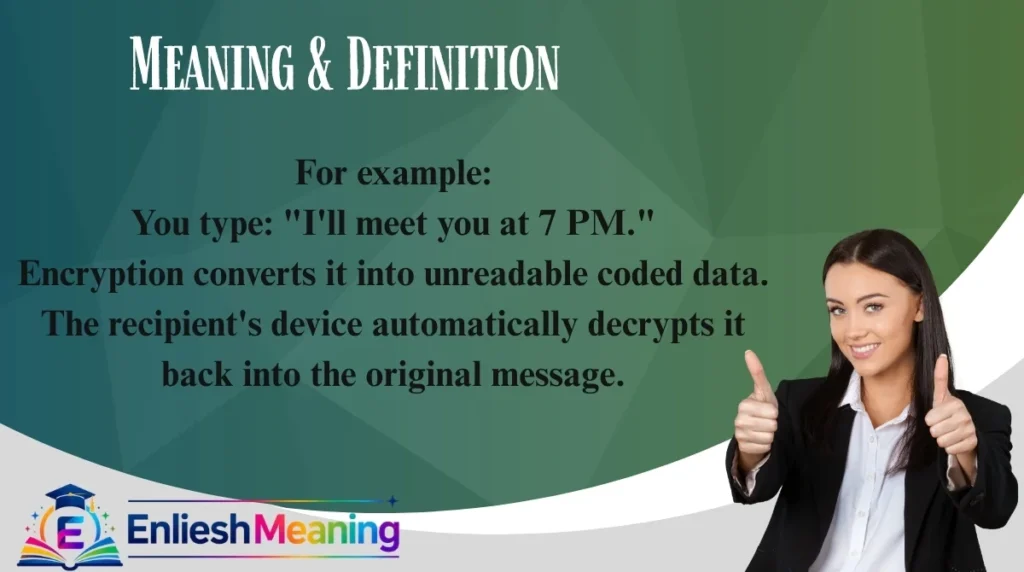
When people ask what does encrypted mean in text messages, they are referring to messages that are protected using encryption technology. Encryption transforms your readable message into a coded format before it leaves your device. The intended recipient’s device then decrypts the message, allowing them to read it.
This process ensures that unauthorized people cannot easily access or understand your conversation, even if the data is intercepted during transmission.
For example:
- You type: “I’ll meet you at 7 PM.”
- Encryption converts it into unreadable coded data.
- The recipient’s device automatically decrypts it back into the original message.
The entire process usually happens within seconds and requires no action from the user.
Simple Definition
Encrypted means information has been converted into a secure code that only authorized users can read.
Why Encryption Matters
Encryption helps protect:
- Personal conversations
- Banking information
- Passwords
- Business communications
- Medical information
- Financial transactions
Without encryption, sensitive information could potentially be intercepted during transmission.
Background
The History of Encryption
Encryption isn’t a modern invention. Humans have used secret codes for thousands of years.
Ancient civilizations created coded messages to protect military strategies and confidential information. One famous example is the Caesar Cipher, used by Julius Caesar to send military commands.
As technology advanced, encryption became increasingly sophisticated.
Today, modern encryption relies on complex mathematical algorithms rather than simple letter substitutions. These advanced methods make encrypted data extremely difficult to crack using current computing technology.
The rise of smartphones and internet messaging significantly increased the importance of encryption.
Popular messaging platforms began introducing:
- End-to-end encryption
- Secure authentication
- Digital certificates
- Encrypted backups
- Private communication protocols
Today, encryption protects billions of conversations every day.
What Affects the Security of an Encrypted Conversation
Understanding what does encrypted mean in text messages is only the first step in understanding digital communication security. The presence of encryption is important, but the overall protection of a conversation can also depend on several other factors. The messaging service, device security, account protection, storage practices, and the type of encryption being used can all influence how well private information is protected.
One important factor is the messaging platform itself. Different services may use different security models and encryption methods. Some may provide end-to-end encryption for particular types of communication, while others may encrypt information during transmission without offering the same level of protection in every part of the communication process. Therefore, users should pay attention to the specific privacy and security features provided by the service rather than assuming that every message marked as encrypted receives identical protection.
The security of the user’s device also matters. Encryption can protect data from unauthorized interception, but it cannot necessarily stop someone who has legitimate access to an unlocked phone or computer. If a device is lost, stolen, shared with another person, or left unlocked, private conversations may still be accessible depending on the device and application settings. Using a strong screen lock and keeping the device’s operating system updated can therefore complement encryption.
Account security is another important consideration. A secure messaging system can still be affected if an unauthorized person gains access to a user’s account. Strong authentication methods can help reduce this risk. Users should also be careful with suspicious login requests, unknown links, unexpected verification codes, and messages asking for private account information.
Storage can also affect privacy. A message may be encrypted while it travels between devices but handled differently when it is stored on a device or backed up through another service. Users who are particularly concerned about sensitive conversations should understand how their chosen messaging platform handles backups, stored messages, linked devices, and account recovery.
The identity of the recipient is another practical consideration. Encryption helps protect the contents of a conversation from certain forms of unauthorized access, but it cannot prevent the intended recipient from copying, forwarding, photographing, or otherwise sharing information they can legitimately view. A private conversation therefore depends partly on trust between the people involved.
Users should also remember that encryption does not automatically make every surrounding detail invisible. Depending on the service, certain information about an account or communication may still exist as metadata. This can include details such as account information, contact information, or other technical records. The exact information collected and retained varies by platform.
These factors explain why the word encrypted should be understood as one part of digital security rather than a guarantee that every aspect of a conversation is completely private. Encryption provides an important technical safeguard, but good security also involves responsible device use, strong account protection, trustworthy communication services, and awareness of how information is stored.
For everyday messaging, the best approach is to consider encryption alongside these other protections. When a messaging service provides strong encryption and the user also protects their device and account, the overall communication environment can become significantly more secure. This broader understanding helps users interpret the word “encrypted” more accurately instead of assuming that the term alone guarantees complete privacy.
Usage in Different Contexts
How “Encrypted” Is Used Across Different Fields
The word encrypted isn’t limited to text messages.
Personal Communication
Friends use encrypted messaging apps to protect private conversations.
Example:
“This app keeps all messages encrypted.”
Business
Companies encrypt emails, documents, customer information, and financial records.
Example:
“The client database is fully encrypted.”
Banking
Banks encrypt online transactions to protect customer accounts.
Example:
“Your payment information is encrypted.”
Government
Governments encrypt classified information to prevent unauthorized access.
Cloud Storage
Many cloud providers encrypt uploaded files before storing them on servers.
Cybersecurity
Security professionals frequently discuss encrypted connections, encrypted drives, encrypted backups, and encrypted networks.
Meaning in Chat, WhatsApp, Instagram, TikTok, and Other Messaging Apps
Encrypted in Chat Applications
Many users searching what does encrypted mean in text messages actually want to know what it means inside their favorite messaging apps.
WhatsApp uses end-to-end encryption by default.
This means:
- Only sender and receiver can read messages.
- WhatsApp itself cannot read message contents.
- Photos, videos, voice notes, and calls are also protected.
Instagram uses encryption during message transmission.
Some conversations may also support enhanced privacy features depending on account settings and platform updates.
TikTok
TikTok messages are protected through secure transmission methods, although encryption features differ from dedicated messaging apps.
iMessage
Apple’s iMessage uses end-to-end encryption between Apple devices.
Signal
Signal is considered one of the most privacy-focused messaging apps because nearly all communication is end-to-end encrypted.
Telegram
Telegram offers encrypted Secret Chats with end-to-end encryption, while standard cloud chats use a different encryption model.
Meaning in Physics, Medical, and Aircraft Terminology
Physics
Encryption itself isn’t a physics term.
However, physicists researching quantum computing and quantum cryptography study future encryption methods that may become even more secure.
Quantum encryption aims to detect unauthorized attempts to intercept data.
Medical Field
Hospitals encrypt:
- Patient records
- Laboratory reports
- Medical images
- Prescriptions
- Insurance information
Medical encryption helps maintain patient confidentiality.
Aircraft and Aviation
Aircraft communication systems sometimes use encrypted channels to protect sensitive operational information.
Military aviation relies heavily on encrypted radio communication.
Commercial aviation also encrypts many digital systems that manage flight operations and passenger information.
Common Misconceptions
Myth 1: Encrypted Means Nobody Can Ever Read It
Not always.
If someone gains access to an unlocked phone, they may still read messages after they have been decrypted.
Myth 2: Every Text Message Is Encrypted
Traditional SMS messages are generally not end-to-end encrypted.
Many modern messaging apps provide stronger encryption than basic SMS.
Myth 3: Encryption Makes You Anonymous
Encryption protects message contents but does not necessarily hide:
- Your phone number
- Your account
- Your contacts
- Metadata
Myth 4: Encryption Is Only for Criminals
False.
Everyone benefits from protecting personal privacy, financial information, and confidential conversations.
Myth 5: Encryption Is Difficult
Modern messaging apps perform encryption automatically without requiring technical knowledge.
Similar Terms & Alternatives
Words Related to Encrypted
You may encounter several similar terms while learning what does encrypted mean in text messages.
These include:
- Secure
- Protected
- Encoded
- Ciphered
- Locked
- Private
- Confidential
- End-to-end encrypted
- Digitally secured
- Cryptographically protected
Although these words are related, they are not always identical in meaning.
How to Respond to It
What Should You Say When Someone Mentions Encryption?
If someone says:
“Our messages are encrypted.”
Possible responses include:
- “That’s good to know.”
- “So our chats stay private?”
- “Does that use end-to-end encryption?”
- “That makes me feel more secure.”
- “Great, privacy is important.”
If someone asks:
“Are these messages encrypted?”
You can reply:
- “Yes, this app uses encryption.”
- “It depends on the messaging service.”
- “Regular SMS may not have end-to-end encryption.”
Differences from Similar Words
Encrypted vs Secure
Encrypted means information has been converted into coded data.
Secure is a broader term that may include passwords, authentication, firewalls, antivirus software, and encryption.
Encrypted vs Password Protected
Password protection restricts access.
Encryption protects the actual data even if someone intercepts it.
Encrypted vs Private
Private refers to confidentiality.
Encryption is one method of achieving privacy.
Encrypted vs Hidden
Hidden information may simply be invisible.
Encrypted information is mathematically encoded and unreadable without the correct key.
How Encryption Protects Messages During Transmission
When people search for what does encrypted mean in text messages, they may understand that encryption makes a message unreadable but still wonder what actually happens while the message travels from one device to another.
The basic purpose of encryption during transmission is to make the information difficult for unauthorized parties to understand if they somehow gain access to the data while it is moving between devices or systems.
Instead of sending the original readable message in a form that can be easily understood, an encryption system transforms the information into coded data.
For example, imagine that you send a message saying, “I will call you tonight.” Before the information reaches its destination, encryption can transform the readable content into a protected form. Someone who intercepts the protected data would not simply see the original sentence.
A compatible decryption process is required to turn the coded information back into readable text for an authorized recipient. In everyday messaging, most of this process happens automatically, so users generally do not need to understand the technical steps involved.
This protection is particularly important because digital messages do not exist only on the sender’s phone. Depending on the service being used, information may travel through networks, servers, internet infrastructure, and other technical systems before reaching its destination.
Encryption adds an important layer of protection by making the contents difficult to interpret without the appropriate means of decryption.
The level and type of protection can vary between communication services. Some platforms support end-to-end encryption, which is designed to protect message contents so that only the communicating users can access them under the service’s supported conditions. Other services may encrypt information while it is being transmitted but use different approaches for storing or processing messages. This is why seeing the word “encrypted” does not automatically mean that every aspect of a conversation is protected in exactly the same way.
Encryption can protect many types of digital communication, not just written messages. Depending on the platform, encrypted information may include photos, videos, voice messages, files, calls, or other forms of communication. This is especially useful when people exchange sensitive information that they would not want unauthorized individuals to easily understand.
It is also important to remember that encryption primarily protects information according to the particular security system being used. It does not automatically protect a user from every possible security problem. For instance, if someone gains direct access to an unlocked device, encryption may not prevent that person from viewing messages that the legitimate user can already read. Similarly, account security, device protection, authentication, and privacy settings can all affect the overall security of a conversation.
Understanding this distinction makes the meaning of encrypted much clearer. Encryption is not simply another word for “private.” Instead, it is a technical method used to protect information by changing readable data into a form that unauthorized people should not be able to understand easily. In modern messaging, this process can happen quietly in the background while users communicate normally.
For everyday users, the most important point is that encryption helps reduce the risk of unauthorized access to message contents during digital communication. It is one part of a broader security system that can help people communicate more safely across modern messaging platforms.
Relevance in Online Conversations & Dating Apps
Why Encryption Matters Online
Modern communication depends heavily on encrypted messaging.
People share:
- Personal photos
- Addresses
- Banking details
- Travel plans
- Medical information
- Relationship conversations
Dating apps also emphasize user privacy.
Many users exchange personal information before meeting in person, making secure messaging increasingly important.
Encrypted communication helps reduce the risk of unauthorized interception while building confidence that conversations remain protected.
As online interactions continue to grow, encryption has become an expected feature rather than an optional one.
FAQs
What does encrypted mean in text messages?
It means messages are converted into coded data so only authorized recipients can read them.
Are normal SMS messages encrypted?
Traditional SMS generally does not provide end-to-end encryption, unlike many modern messaging apps.
Does encryption guarantee complete privacy?
No. Encryption protects messages during transmission, but someone with access to your unlocked device may still read them.
Which messaging apps use end-to-end encryption?
Apps such as WhatsApp, Signal, and Apple’s iMessage support end-to-end encryption under supported conditions.
Can hackers read encrypted messages?
Strong encryption makes intercepted messages extremely difficult to read without the correct decryption keys.
Why is encryption important?
Encryption helps protect personal information, financial data, business communications, and private conversations from unauthorized access.
Conclusion
Understanding what does encrypted mean in text messages is essential in today’s digital world. Encryption is the technology that converts readable information into coded data, ensuring that only authorized recipients can access the original message.
From personal chats and social media conversations to banking transactions and business communications, encryption plays a critical role in protecting sensitive information.
While it does not guarantee absolute anonymity or complete security in every situation, it significantly improves privacy by safeguarding data during transmission.
As messaging platforms continue to prioritize user security, knowing how encryption works helps you make informed decisions about the apps and services you use every day.
Whether you’re chatting with friends, communicating with colleagues, or sharing confidential information, encryption is one of the strongest tools available for maintaining trust, privacy, and digital security in an increasingly connected world.