
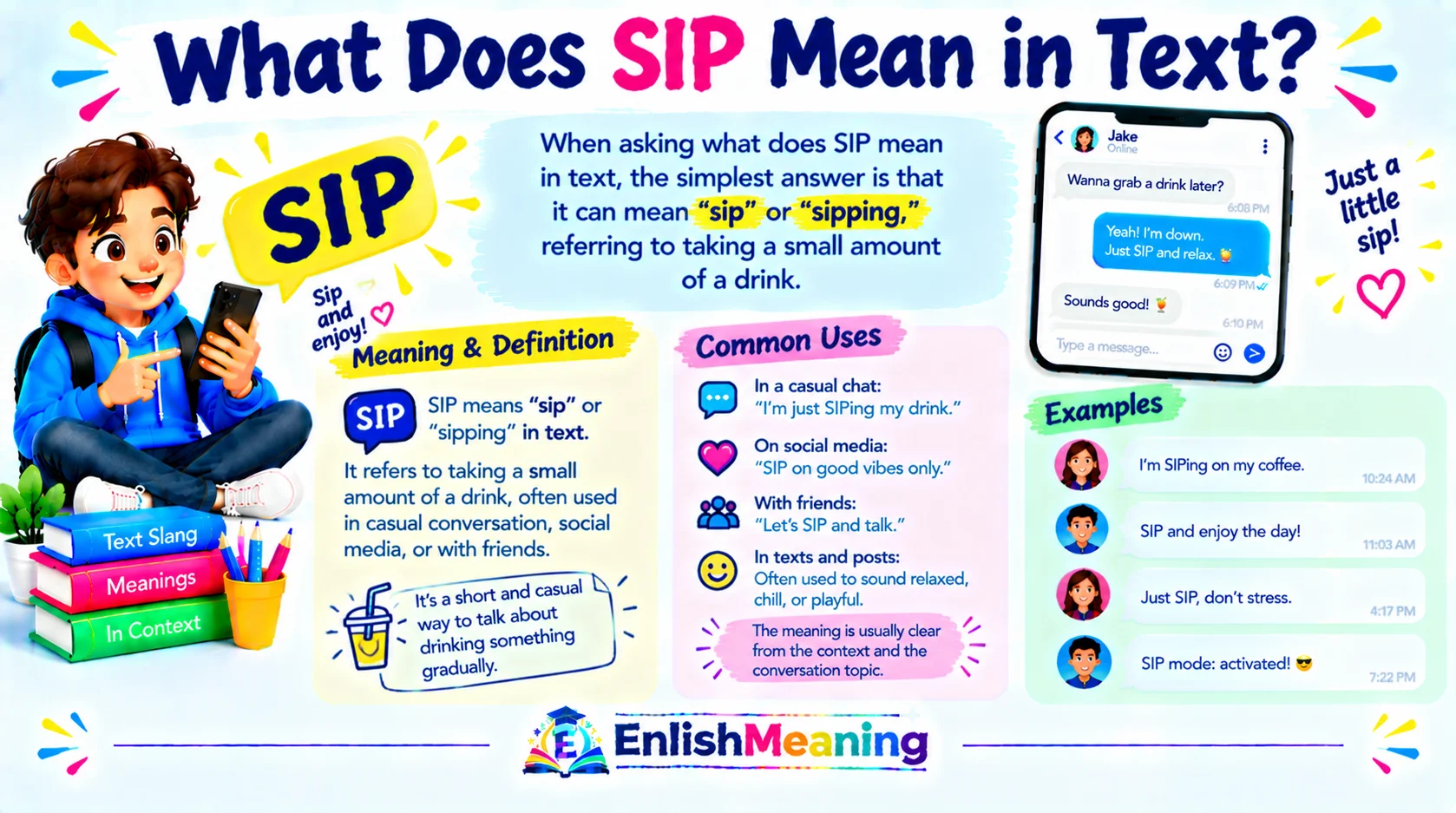
If you have received a message containing “SIP,” you may wonder what the sender actually means. What does SIP mean in text? The answer depends heavily on the conversation, because this short abbreviation can have different meanings in casual messaging, social media, professional communication, and specialized fields.
In everyday texting, SIP most commonly relates to the word “sip,” meaning to drink something slowly or take a small drink.
Someone might write “I’m gonna sip my coffee” or simply use “sip” in a humorous or conversational way. However, uppercase SIP can also represent an abbreviation with a completely different meaning.
People search for this expression because internet slang changes quickly, and abbreviations often have multiple interpretations.
Understanding the surrounding words, the relationship between the people communicating, and the platform being used can help determine the intended meaning.
This guide explains the common meanings of SIP, its use in texting and social media, specialized meanings, possible misunderstandings, and appropriate ways to respond.
Meaning & Definition Of SIP
When asking what does SIP mean in text, the simplest answer is that it can mean “sip” or “sipping,” referring to taking a small amount of a drink. Unlike many internet abbreviations, this usage does not necessarily represent a phrase made from initials. People may simply type the word in lowercase or uppercase for emphasis.
For example:
- “Just gonna sip my tea.”
- “Let me sip this coffee first.”
- “SIP while you watch the drama.”
- “I’m sitting here sipping my drink.”
In casual online communication, “sip” can also have a humorous or figurative meaning. A person may say “sip” when they are watching an argument, controversy, or entertaining situation without wanting to become directly involved. This idea is connected to the popular internet expression “sip tea” or “sipping tea,” where tea represents gossip, drama, or interesting information.
For instance, someone might comment:
“SIP 👀”
The person may not literally be drinking anything. Instead, they could be jokingly communicating, “I’m watching this situation,” or “This is interesting.”
Context is therefore extremely important. If somebody sends “SIP” alongside a photo of coffee, it probably relates to drinking. If it appears underneath an argument or dramatic social-media post, it may be a playful reference to watching the situation unfold.
Another important distinction is capitalization. “sip” is generally an ordinary word, while “SIP” may be an acronym in professional or technical contexts. The same three letters can therefore have completely different meanings depending on where they appear.
Background
The word sip itself is not new internet slang. It has long been used in English to describe drinking a small quantity of liquid at a time. Digital communication simply made the word more flexible and expressive.
As texting became more informal, users began shortening sentences and relying on individual words, emojis, GIFs, and abbreviations to communicate emotions quickly. A single word such as “sip” can now express an action, mood, joke, or reaction depending on the conversation.
The expression “sipping tea” became particularly recognizable in online culture. Tea has long been associated with social conversation, and internet users adopted “tea” as a metaphor for gossip, rumors, personal drama, or interesting information. From this developed expressions such as “spill the tea,” meaning to reveal interesting information, and “sipping tea,” suggesting that someone is observing the situation.
This is why SIP meaning in text can sometimes be difficult to identify. A person may literally mean drinking, while another person may use the term as a humorous reaction.
Capitalization adds another layer of complexity. In technology, SIP commonly refers to the Session Initiation Protocol, a communication protocol used for initiating, modifying, and terminating certain real-time communication sessions. That technical meaning is very different from casual texting.
Consequently, readers should not automatically assume that every appearance of “SIP” represents slang. The surrounding vocabulary usually provides the strongest clue.
In general conversation, food and drink discussions, or social-media comments, the everyday meaning is usually more relevant. In technology, business, medicine, aviation, or academic material, however, the abbreviation may represent a specialized term.
Usage in Different Contexts: Chat, Social Media, and Professional Fields
The meaning of SIP changes according to the environment in which it appears.
In casual chat
In ordinary conversation, “sip” can describe drinking slowly or taking a small drink.
Example:
“Give me a minute, I’m sipping my coffee.”
Here, there is no hidden abbreviation. The sender is simply describing an action.
As a humorous reaction
A person may write:
“SIP 👀”
after someone posts dramatic news. In this situation, the sender may be joking that they are sitting back and observing the situation.
On social media
On platforms where arguments, celebrity news, gossip, and viral discussions are common, “sip” can be connected to the broader “tea” expression.
For example:
“SIP while the comments go control.”
The speaker is probably not giving instructions to drink. They are humorously presenting themselves as an observer.
In professional communication
Professional communication requires more caution. SIP may refer to an established abbreviation rather than casual slang. For example, in telecommunications and computing, SIP commonly means Session Initiation Protocol.
A technical message such as:
“Check the SIP configuration on the phone system.”
has nothing to do with drinking.
In business and organizations
Organizations may independently use SIP as an abbreviation for internal programs, plans, processes, or performance-related terms. Because these meanings vary, the surrounding document or workplace terminology should be checked before interpreting the abbreviation.
The main lesson is simple: SIP in a casual conversation is usually interpreted differently from SIP in a technical or professional document.
What Does SIP Mean in Chat, WhatsApp, Instagram, and TikTok?
The meaning of SIP can vary slightly from platform to platform, but the conversational principle remains the same.
On WhatsApp, someone might write:
“SIP ☕”
This could literally refer to taking a drink, but it can also be a playful reaction to gossip or drama.
Another example:
Friend: “Guess what happened at work today?”
You: “SIP 👀”
Here, “SIP” may humorously suggest that you are ready to hear the story.
Instagram comments often use short expressions because users want to react quickly. A comment such as:
“Just here to SIP ☕”
usually communicates that the commenter is watching the drama or reading the comments rather than participating.
TikTok
TikTok has a highly informal communication style, so short slang expressions can become reaction phrases. “SIP” may appear with tea, coffee, eye, laughing, or shocked emojis to emphasize an entertaining situation.
Private messages
In a private conversation, the intended meaning depends more strongly on the relationship between the people. Someone who regularly jokes with you might send “SIP” as a playful reaction, whereas another person may simply be referring to drinking.
Important point about capitalization
The difference between sip and SIP does not always determine the meaning. People frequently use uppercase letters for emphasis rather than because the word is an acronym.
Therefore, do not assume that uppercase SIP automatically means a technical term. Always look at the surrounding message.
SIP Meaning in Physics, Medical, and Aircraft Terminology
Outside everyday texting, SIP can have specialized meanings. This is one reason an abbreviation should not be interpreted without context.
SIP in physics and technical science
There is no single universal physics definition of SIP that applies to every scientific context. Different research areas may use the same initials for different concepts, instruments, models, or measurements.
For this reason, if you encounter SIP in a physics paper, laboratory manual, equation, or technical lecture, the safest approach is to check the abbreviation list or the definition provided by the author.
This is very different from casual texting, where “sip” commonly refers to drinking.
SIP in medicine
Medical terminology also uses many abbreviations, and SIP can represent different terms depending on the specialty, institution, or document.
A medical abbreviation should therefore never be interpreted solely from the three letters. Doctors, nurses, researchers, and medical organizations may use specialized terminology that is not relevant to everyday internet slang.
If you encounter SIP on a medical document, prescription-related material, clinical report, or research paper, the surrounding terminology should be considered carefully.
SIP in aviation
Aviation also contains numerous abbreviations, and SIP may appear in specialized operational or technical contexts. Its precise interpretation depends on the aviation authority, document, aircraft system, or operational procedure involved.
For example, an aviation manual may define an abbreviation at the beginning of a document and then use it repeatedly.
This demonstrates an important principle: the meaning of SIP in text messages should not automatically be transferred to technical fields.
When dealing with professional aviation, medical, or scientific information, use the definition supplied by the relevant document or organization rather than assuming that the term has its social-media meaning.
Common Misconceptions
One common misconception is that SIP always stands for one specific phrase. In reality, its meaning can change substantially according to context.
Another misconception is that uppercase letters always indicate an acronym. People frequently type ordinary words in uppercase to make them more noticeable. Therefore, SIP may simply be “sip” written for emphasis.
A third misunderstanding occurs when users assume that “SIP” always means drinking. Although this is common in casual communication, technical contexts can use SIP as an abbreviation for entirely different concepts.
Another mistake is interpreting “SIP” without reading the messages around it. For example:
“I’m going to SIP my coffee.”
clearly points toward drinking.
By contrast:
“SIP server is not responding.”
is a technical statement and most likely refers to Session Initiation Protocol.
People can also misunderstand the expression “sip tea.” It does not always mean that someone is literally drinking tea. In online culture, it may be a playful metaphor for observing gossip or drama.
Finally, some people assume that every slang expression has one fixed dictionary definition. Internet language is much more fluid. Users can adapt ordinary words, abbreviations, and emojis creatively.
The best way to understand SIP is therefore to consider the entire conversation, platform, relationship, and subject matter rather than focusing on the abbreviation alone.
Similar Terms & Alternatives
Several expressions can communicate ideas similar to “sip,” particularly when it is used as online slang.
“Sipping tea”
This is a common expression associated with watching or listening to gossip, drama, or interesting information.
Example:
“Just sipping tea and reading the comments.”
“Tea”
In internet slang, “tea” can refer to gossip or interesting information.
Example:
“Tell me the tea.”
“Spill the tea”
This generally means asking someone to reveal the interesting details of a story.
Example:
“Okay, spill the tea!”
“Watching”
Someone may simply say:
“I’m just watching.”
This communicates a similar idea when the person wants to observe rather than participate.
“I’m listening”
This is another straightforward alternative when someone wants to hear the details.
“Popcorn”
Online users sometimes use popcorn as a humorous metaphor for watching entertaining drama.
Example:
“Got my popcorn ready.”
These expressions are not exact replacements in every situation. “Sip” can be literal, while “tea,” “spill the tea,” and “popcorn” often have figurative meanings.
Understanding these related expressions can make online conversations easier to interpret because they frequently appear together.
How to Respond to “SIP”
Your response should depend on what the sender appears to mean.
If they literally mean drinking
You can respond naturally:
- “Enjoy your coffee!”
- “What are you drinking?”
- “Tea or coffee?”
- “That sounds relaxing.”
If they are reacting to drama
You can play along:
- “😂 Same, I’m just watching.”
- “Go ahead, enjoy the show.”
- “There’s definitely a lot happening.”
- “☕👀 Tell me everything.”
If they want gossip
You might say:
- “Wait, what happened?”
- “Okay, now I need the details.”
- “Spill it!”
- “I’m listening.”
If you are unsure
The easiest response is to ask:
“What do you mean by SIP?”
There is nothing wrong with asking for clarification, especially when the abbreviation could have multiple meanings.
In professional conversations
If SIP appears in a technical message, respond according to the technical context rather than treating it as slang. For example, if someone mentions a SIP server, SIP account, or SIP configuration, they are likely discussing telecommunications or networking.
The key is to match your response to the sender’s apparent intention.
Differences From Similar Words
Although “sip,” “drink,” “gulp,” and “swig” are related, they describe different actions.
Sip vs. drink
Sip usually suggests taking a small amount slowly.
Drink is the broader term and can describe consuming a liquid generally.
Sip vs. gulp
A gulp usually involves swallowing a larger amount quickly.
A sip suggests a smaller and often slower amount.
Sip vs. swig
A swig usually means taking a large drink, often directly from a container.
Sip vs. taste
To taste something means trying a small amount to experience its flavor. A sip can involve tasting, but the words are not identical.
Sip as slang vs. literal sip
This distinction is especially important online.
Literal:
“I’m taking a sip of coffee.”
Figurative:
“SIP ☕ while this argument continues.”
The first describes drinking. The second may describe watching a dramatic situation.
Therefore, context determines whether “sip” should be interpreted literally or figuratively.
Relevance in Online Conversations & Dating Apps
Short expressions are especially useful on dating apps because users often communicate with very brief messages. A person may use “sip,” “tea,” or a similar expression to create a playful tone.
For example:
Person A: “You won’t believe the date story I have.”
Person B: “SIP ☕👀”
In this situation, the response can indicate curiosity and amusement. It may essentially communicate, “I’m ready to hear this story.”
On dating apps, tone can be difficult to judge because there is no voice or facial expression. Emojis therefore become important. A ☕, 👀, or laughing emoji can make it clearer that “sip” is being used humorously.
However, users should avoid assuming that every short expression has a romantic or flirtatious meaning. “SIP” itself is not inherently a dating abbreviation. Its interpretation depends on the conversation.
For example:
“I’m sipping coffee right now.”
is simply a statement about what someone is doing.
Meanwhile:
“SIP ☕👀”
after a dramatic story is more likely to be playful.
If someone sends “SIP” and you do not understand the intended tone, responding naturally or asking what they mean is better than making a strong assumption.
In online dating, clear communication is generally more effective than trying to decode every abbreviation as hidden slang.
Frequently Asked Questions
What does SIP mean in text messages?
In casual texting, “sip” usually refers to taking a small drink. It can also jokingly mean watching or listening to drama, especially when associated with “tea.”
What does SIP mean on social media?
On social media, SIP can be a playful reaction suggesting that someone is sitting back and watching an interesting or dramatic situation.
Does SIP mean “sipping tea”?
Not necessarily. It can refer to sipping any drink. However, in online slang, it may be associated with “sipping tea” and observing gossip or drama.
Is SIP a slang word?
It can be used informally as slang, especially in expressions involving tea, gossip, or online drama. However, “sip” is also an ordinary English word.
What does SIP mean in technology?
In technology and telecommunications, SIP commonly means Session Initiation Protocol, a protocol used for establishing, managing, and ending certain communication sessions.
How should I respond when someone says SIP?
Look at the context. If they mean drinking, respond about the drink. If they are joking about drama, you can respond playfully with something like “😂 Same, I’m watching too.”
Conclusion
Understanding what does SIP mean in text requires looking at the context rather than relying on one fixed definition. In ordinary conversations, “sip” commonly refers to taking a small drink. Online, it can also be used humorously to suggest that someone is watching or listening to drama, particularly when connected with the idea of “sipping tea.”
At the same time, uppercase SIP can represent completely different terminology in professional and technical environments. In telecommunications, for example, SIP commonly refers to Session Initiation Protocol. Other industries may use the same letters for their own specialized terms.
When you encounter SIP in a message, examine the words around it, the platform, and the subject being discussed. If the meaning remains unclear, asking the sender is the safest approach.
Ultimately, the flexibility of internet language is what makes abbreviations both useful and sometimes confusing. Understanding context will help you interpret SIP accurately and respond naturally.