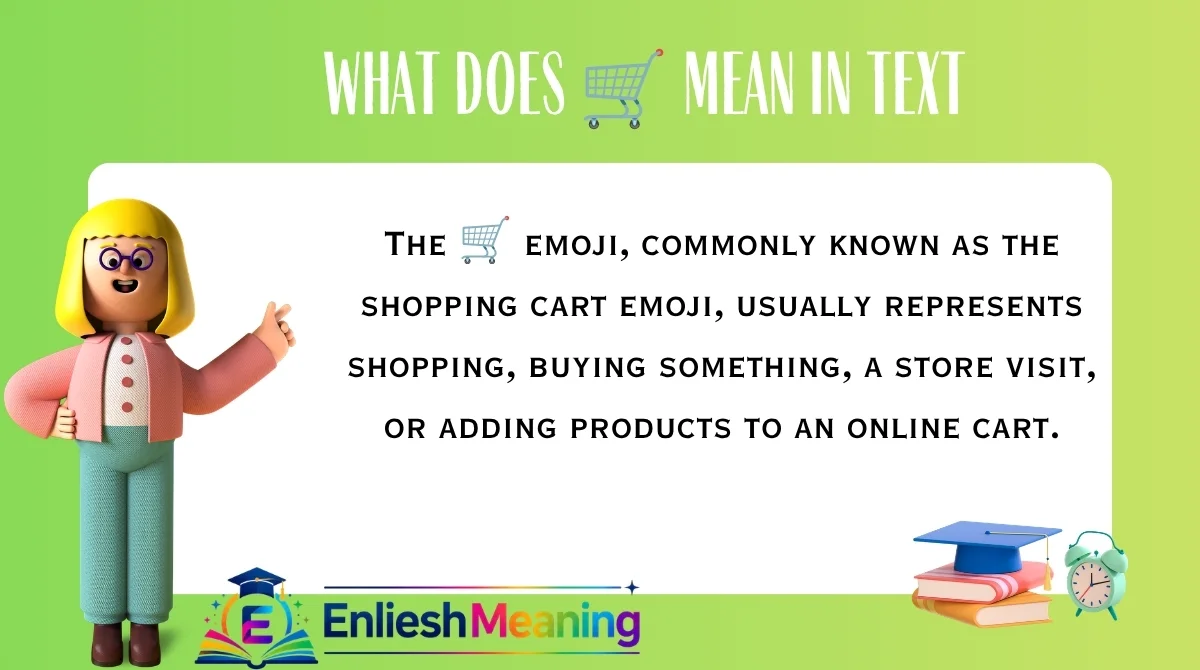
The 🛒 emoji, commonly known as the shopping cart emoji, usually represents shopping, buying something, a store visit, or adding products to an online cart. When someone sends this symbol in a text message, its exact meaning depends on the conversation and the context in which it appears.
In some messages, it can literally refer to shopping, while in others it may be used playfully to suggest that someone is ready to buy, collect items, or go shopping.
People often search for the meaning of 🛒 in text because emojis can communicate ideas without using words, and their meaning may change depending on the situation.
A shopping cart can also appear in social media posts, online stores, advertisements, comments, memes, and casual conversations.
Understanding the context is important. For example, “Going to the mall 🛒” clearly relates to shopping, while “I added it to my list 🛒” may suggest that someone intends to purchase something. The emoji can therefore make a message feel more visual, casual, and expressive.
Meaning & Definition OF 🛒
In texting, 🛒 generally means “shopping,” “shopping cart,” “buying something,” or “items I want to purchase.” It is a visual representation of a cart used to carry products while shopping.
The most direct interpretation is that the sender is talking about purchasing goods. Someone might send “I’m going shopping 🛒” to indicate that they are heading to a store. Similarly, a person might use “Need this 🛒” to show that they want to buy a particular item.
The emoji can also represent the broader idea of online shopping. Many websites use a shopping-cart icon as the place where customers collect products before completing an order. Because of this association, 🛒 may appear in conversations about online purchases, wish lists, product recommendations, clothing, electronics, groceries, or other items.
The meaning can become more playful in casual texting. For example:
- “Let’s go shopping 🛒” = Let’s go shopping.
- “I need a new outfit 🛒” = I’m thinking about buying new clothes.
- “Added to my cart 🛒” = I want to purchase it.
- “My cart is full 😂🛒” = I have selected many things to buy.
- “Shopping day 🛒✨” = Today is a day for shopping.
Sometimes the emoji does not necessarily mean that an actual purchase has happened. It can simply express interest in buying something.
For example, if someone sees an attractive pair of shoes online and comments “🛒,” they may be jokingly saying, “I want these,” or “I’m buying these.”
Therefore, while the basic meaning is connected to shopping and purchasing, the intended message should always be interpreted according to the surrounding words.
Background
The 🛒 emoji developed from the familiar shopping-cart symbol used in physical stores and digital shopping platforms. A traditional shopping cart is something customers push around a supermarket or store while collecting products. Over time, the same visual concept became an important part of online shopping.
When online stores became common, websites needed an easy way to show customers where selected products were stored before checkout. The shopping-cart symbol became a widely recognizable visual shortcut for this function.
The emoji version takes that familiar concept and turns it into a small character that can be used in digital conversations. Instead of describing shopping with several words, a person can simply add 🛒 to a message.
This makes the emoji especially useful in informal communication. Text messages are often short, and people frequently use symbols to add meaning without writing a complete explanation.
The shopping-cart emoji can also represent the emotional side of shopping. For some users, 🛒 can suggest excitement about buying something, browsing products, finding a bargain, or treating themselves.
For example:
“Finally getting those shoes 🛒”
Here, the emoji reinforces the idea of purchasing something.
The symbol may also appear alongside other emojis to create a more specific message. For example, 🛒❤️ might communicate excitement about shopping, while 🛒💸 could jokingly suggest that shopping is costing money.
Its meaning has therefore expanded beyond the physical object. In modern digital communication, 🛒 can represent the entire shopping experience, from browsing and choosing products to purchasing them.
However, there is no hidden universal slang definition attached to the emoji. Unlike abbreviations such as “LOL” or “BRB,” 🛒 does not normally represent a specific phrase. Its interpretation is primarily based on the familiar idea of a shopping cart.
Usage in Different Contexts
The 🛒 emoji can be used in several different situations, and the meaning can change slightly depending on the conversation.
In casual chats
Friends may use 🛒 when discussing shopping plans.
Example:
“I’m heading to the supermarket 🛒.”
Here, it has a literal meaning: the person is going shopping.
When talking about purchases
Someone may use it to show that they are interested in buying something.
Example:
“That jacket is definitely going in my cart 🛒.”
This suggests that the person intends to purchase the jacket.
On social media
The emoji can appear in captions, comments, and posts about products. A fashion creator, for example, might use 🛒 to draw attention to clothing or accessories.
A user commenting 🛒 under a product post could mean:
- “I want this.”
- “I’m buying this.”
- “Adding this to my shopping list.”
- “This is worth purchasing.”
In business and marketing
Businesses may use the symbol to indicate shopping, products, orders, or online purchasing.
For example:
“Shop now 🛒”
In this situation, the emoji is more functional than emotional.
In professional communication
The emoji is less common in formal workplace communication. However, it can appear in informal business chats involving retail, e-commerce, product management, marketing, or sales.
For example, a team member might write:
“Customer added three items 🛒.”
Here, the symbol reinforces the shopping-related subject.
Overall, 🛒 is flexible but remains strongly connected to shopping, purchasing, products, and consumer activity.
Meaning in Chat, WhatsApp, Instagram, and TikTok
The 🛒 emoji can appear on almost any messaging or social media platform, but people may use it differently depending on the platform.
🛒 in text messages
In ordinary texting, it usually means shopping or buying something.
Example:
“Need to get groceries 🛒.”
The meaning is straightforward.
🛒 on WhatsApp
WhatsApp users may use the emoji while making shopping plans with friends or family.
Example:
“Going to the mall later 🛒. Want anything?”
It can also be used humorously when someone is talking about buying too many things.
🛒 on Instagram
On Instagram, 🛒 may be associated with products, fashion, shopping recommendations, or online stores.
A person might comment:
“🛒😍”
This could mean, “I want to buy this,” especially underneath a product or fashion post.
🛒 on TikTok
TikTok content often includes product recommendations, shopping videos, fashion content, beauty products, gadgets, and viral items. In these contexts, 🛒 can suggest that a product is something the viewer wants to purchase.
A comment such as:
“Adding this to my cart 🛒”
means that the person is interested in buying the item.
The emoji can also be used jokingly. Someone might see an expensive product and write “🛒💸” to communicate, “I want it, but it is going to cost me.”
The important point is that the platform does not automatically give the emoji a completely different definition. The surrounding content determines its specific interpretation.
Meaning in Physics, Medical, and Aircraft Terminology
The 🛒 emoji itself does not have a standard scientific definition in physics, medicine, or aviation. It is primarily a digital symbol representing a shopping cart.
However, the shopping-cart concept can sometimes appear in specialized discussions, which may create confusion.
Physics
In physics, a shopping cart can be used as an everyday example when explaining concepts such as force, acceleration, friction, momentum, or motion. For example, a physics problem might describe someone pushing a shopping cart to demonstrate Newtonian mechanics.
That does not mean 🛒 itself is a recognized physics symbol.
Medical contexts
Shopping carts can occasionally appear in healthcare discussions involving mobility, physical activity, ergonomics, or everyday movement. A shopping cart may also be mentioned as an example in discussions about walking or physical support.
Again, the emoji itself does not have a standard medical abbreviation or diagnosis associated with it.
Aircraft terminology
In aviation, aircraft and airport operations use many specialized symbols and abbreviations. The 🛒 emoji is not a standard aircraft terminology symbol.
A cart may, however, refer to various pieces of airport or aircraft-support equipment in ordinary descriptions. Examples can include service carts, food carts, or baggage-related equipment.
Therefore, if someone sends 🛒 in a conversation about physics, medicine, or aviation, it should not automatically be interpreted as a technical abbreviation. The surrounding message should be examined first.
In short, 🛒 has a general digital meaning rather than an established technical meaning in these fields.
Common Misconceptions
One common misconception is that 🛒 always means someone is literally going shopping. Although shopping is its primary meaning, people can use it more broadly.
For example:
“That dress is going straight into my cart 🛒.”
The person may not actually have opened an online shopping cart. They may simply be saying that they really like the dress and want to buy it.
Another misconception is that 🛒 automatically means “buy this.” Sometimes it simply represents shopping as an activity.
For example:
“Saturday = shopping day 🛒.”
This does not necessarily indicate a particular purchase.
Some people may also assume that the emoji has a hidden romantic or sexual meaning. There is no universal standard that gives 🛒 such a meaning. In certain conversations, individuals may create private jokes or personalized meanings, but those interpretations depend on the people involved.
Another misunderstanding occurs when people confuse 🛒 with other shopping-related symbols. The shopping cart is mainly connected with collecting or purchasing products, while other symbols may communicate money, gifts, stores, or specific products.
It is also important not to treat every emoji as a fixed abbreviation. Emojis work more like visual expressions than conventional acronyms. Their meaning can be influenced by the words around them, the relationship between the speakers, and the situation.
When someone sends only 🛒, the safest interpretation is generally shopping, buying something, or wanting something that can be purchased. If the context does not make the meaning clear, asking what they mean is better than assuming a hidden definition.
Similar Terms & Alternatives
Several words and emojis can communicate ideas related to 🛒, although they are not exact replacements.
Shopping
“Shopping” is the broadest word associated with the emoji. It can describe visiting stores, browsing products, or purchasing goods.
Buy
“Buy” focuses specifically on the act of purchasing something.
Cart
“Cart” can refer directly to the physical or digital shopping cart.
Add to cart
This phrase is especially common in online shopping. It means selecting an item and placing it in a virtual cart before checkout.
🛍️ Shopping bags
The shopping-bags emoji is closely related to 🛒 but can suggest completed shopping, carrying purchases, or shopping more generally.
💰 Money bag
The money-bag emoji focuses on money rather than shopping itself.
💸 Money with wings
This emoji can humorously represent spending money or money disappearing after a purchase.
🏪 Store
The store emoji can represent a physical shop or business rather than the act of purchasing.
🎁 Gift
The gift emoji is more closely associated with presents and giving than ordinary shopping.
These alternatives can help explain why context matters. For example, 🛒 may suggest selecting or buying, while 🛍️ may suggest shopping or carrying purchases, and 💸 may emphasize spending money.
How to Respond to 🛒
How you should respond depends on what the sender is discussing.
If someone sends 🛒 while talking about shopping, you can respond naturally:
“What are you shopping for?”
If they are excited about buying something, you could say:
“Nice! What did you find?”
If they send the emoji under a product recommendation, a playful response might be:
“Looks like you’re buying it 😂.”
If someone sends only 🛒 without any context, you can simply ask:
“Shopping?”
or:
“What are you getting?”
If the sender is talking about online purchases, you could say:
“What did you add to your cart?”
When responding, there is no need to overthink the emoji. In most situations, it is simply connected to shopping or purchasing.
If you are unsure whether the person is joking, expressing interest, or actually planning to buy something, look at the preceding messages. The context usually makes the intended meaning obvious.
Differences From Similar Words
Although 🛒, “shopping,” “buy,” “cart,” and “purchase” are related, they are not identical.
🛒 vs. shopping:
🛒 is a visual symbol that can represent shopping, while “shopping” is the actual word describing the activity.
🛒 vs. buy:
“Buy” specifically means completing a purchase. 🛒 may only indicate that someone is considering or preparing to buy something.
🛒 vs. cart:
“Cart” describes the container used for selected products. The emoji represents that object visually.
🛒 vs. purchase:
“Purchase” is more formal and usually refers to an actual transaction. 🛒 is casual and may represent an intention rather than a completed transaction.
🛒 vs. 🛍️:
Both relate to shopping. 🛒 tends to emphasize the cart, product selection, or purchasing process, while 🛍️ can suggest shopping bags, shopping trips, or purchases.
🛒 vs. 💸:
🛒 focuses on shopping, while 💸 emphasizes spending or losing money.
Understanding these differences can make emoji conversations easier to interpret. The same message may carry a slightly different feeling depending on which symbol the sender chooses.
Relevance in Online Conversations & Dating Apps
On dating apps, 🛒 can have a fairly ordinary meaning when people discuss shopping, clothes, gifts, restaurants, groceries, or online purchases.
For example:
“I spent way too much shopping today 🛒😂.”
Here, the emoji simply reinforces the shopping topic.
If someone is discussing fashion with a match, they might say:
“I need a new outfit for our date 🛒.”
The emoji suggests that they are shopping for something to wear.
Someone might also use it while joking about buying something for another person:
“I saw something you’d love 🛒.”
This could simply mean that they found an item they think the other person would like.
However, the meaning can become more personal depending on the conversation. Emojis sometimes take on private meanings between two people. If a person repeatedly uses 🛒 in a particular way, their personal usage may matter more than the general definition.
It is therefore not accurate to assume that 🛒 automatically indicates flirting, attraction, or romantic interest. The surrounding conversation should provide evidence for any such interpretation.
On social and dating platforms, people also frequently use emojis to make messages feel lighter and less formal. The shopping-cart emoji can make a statement about spending or buying something feel playful rather than serious.
For example:
“You’re really making me want to buy it 🛒😂.”
The emoji adds a humorous, casual tone.
Overall, in dating conversations, 🛒 normally retains its basic shopping-related meaning unless the participants have clearly established another meaning between themselves.
FAQs
What does 🛒 mean in texting?
🛒 usually means shopping, buying something, a shopping cart, or adding something to a cart. The exact meaning depends on the surrounding conversation.
What does 🛒 mean from a girl?
If a girl sends 🛒, it generally refers to shopping or wanting to buy something. It does not automatically have a romantic meaning.
What does 🛒 mean from a guy?
When a guy uses 🛒, it usually has the same general meaning: shopping, purchasing something, or wanting an item.
Does 🛒 mean “buy”?
It can suggest “buy” or “I want to buy this,” but it does not always mean that a purchase has actually been completed.
What does 🛒 mean on Instagram?
On Instagram, 🛒 is commonly associated with shopping, products, online purchases, fashion, or wanting something shown in a post.
What does 🛒 mean on TikTok?
On TikTok, it can indicate interest in purchasing a product, adding something to a shopping cart, or liking a product recommendation.
What does 🛒 mean on WhatsApp?
On WhatsApp, it generally means shopping or buying something. Someone might use it while discussing a shopping trip or an online purchase.
Is 🛒 a slang term?
Not usually. 🛒 is an emoji rather than a conventional slang abbreviation. Its meaning comes from the visual representation of a shopping cart.
Does 🛒 have a hidden romantic meaning?
There is no universal romantic meaning for 🛒. If it appears in a romantic conversation, its meaning depends on the specific context.
Does 🛒 mean “I want you”?
No. 🛒 does not have a standard meaning of “I want you.” Such an interpretation would require specific context between the people communicating.
What is the difference between 🛒 and 🛍️?
🛒 represents a shopping cart and often emphasizes selecting or purchasing items. 🛍️ represents shopping bags and can suggest shopping or carrying purchases.
Can 🛒 mean online shopping?
Yes. Because shopping carts are widely used by online stores, 🛒 can easily represent online shopping or an item someone wants to purchase online.
What does 🛒💸 mean?
Together, 🛒💸 often humorously suggests shopping and spending money, especially when someone is joking about an expensive purchase.
What does 🛒😍 mean?
🛒😍 can express excitement about buying something or really liking a product. The exact interpretation depends on the conversation.
Does 🛒 have a meaning in physics?
The emoji itself has no standard physics meaning. A shopping cart can be used as an example when teaching concepts such as force, acceleration, and friction.
Does 🛒 have a medical meaning?
There is no standard medical meaning for the emoji. A shopping cart might appear in everyday medical or mobility-related discussions, but the emoji itself is not a medical abbreviation.
Does 🛒 have an aviation meaning?
The emoji is not a standard aviation symbol or abbreviation. If it appears in an aviation-related message, its meaning should be determined from the surrounding context.
How should I reply when someone sends 🛒?
You can respond naturally with something like “What are you shopping for?”, “What are you getting?”, or “Did you find something you like?”
Can 🛒 mean “added to cart”?
Yes. In an online-shopping context, it can communicate the idea that someone has selected an item or intends to add it to their cart.
Is 🛒 always about buying?
Not necessarily. It can also represent browsing, shopping as an activity, discussing products, or joking about spending money.
Conclusion
The 🛒 emoji is primarily associated with shopping, purchasing, products, and shopping carts. In everyday texts, it can mean that someone is going shopping, wants to purchase something, has selected an item, or is simply talking about shopping.
Its meaning can vary slightly across messaging and social media platforms. On WhatsApp, it may accompany a conversation about shopping plans, while on Instagram or TikTok it can be connected to products, fashion, recommendations, or online purchases.
In dating conversations, it normally retains its ordinary shopping-related meaning and should not automatically be interpreted as flirting or romantic interest.
The emoji does not have a standard technical definition in physics, medicine, or aviation. Context is therefore the most important factor when interpreting it.
In simple terms, when you see 🛒 in a text, think “shopping,” “buying,” “cart,” or “I want this.” The words around the emoji will usually tell you which interpretation fits best.