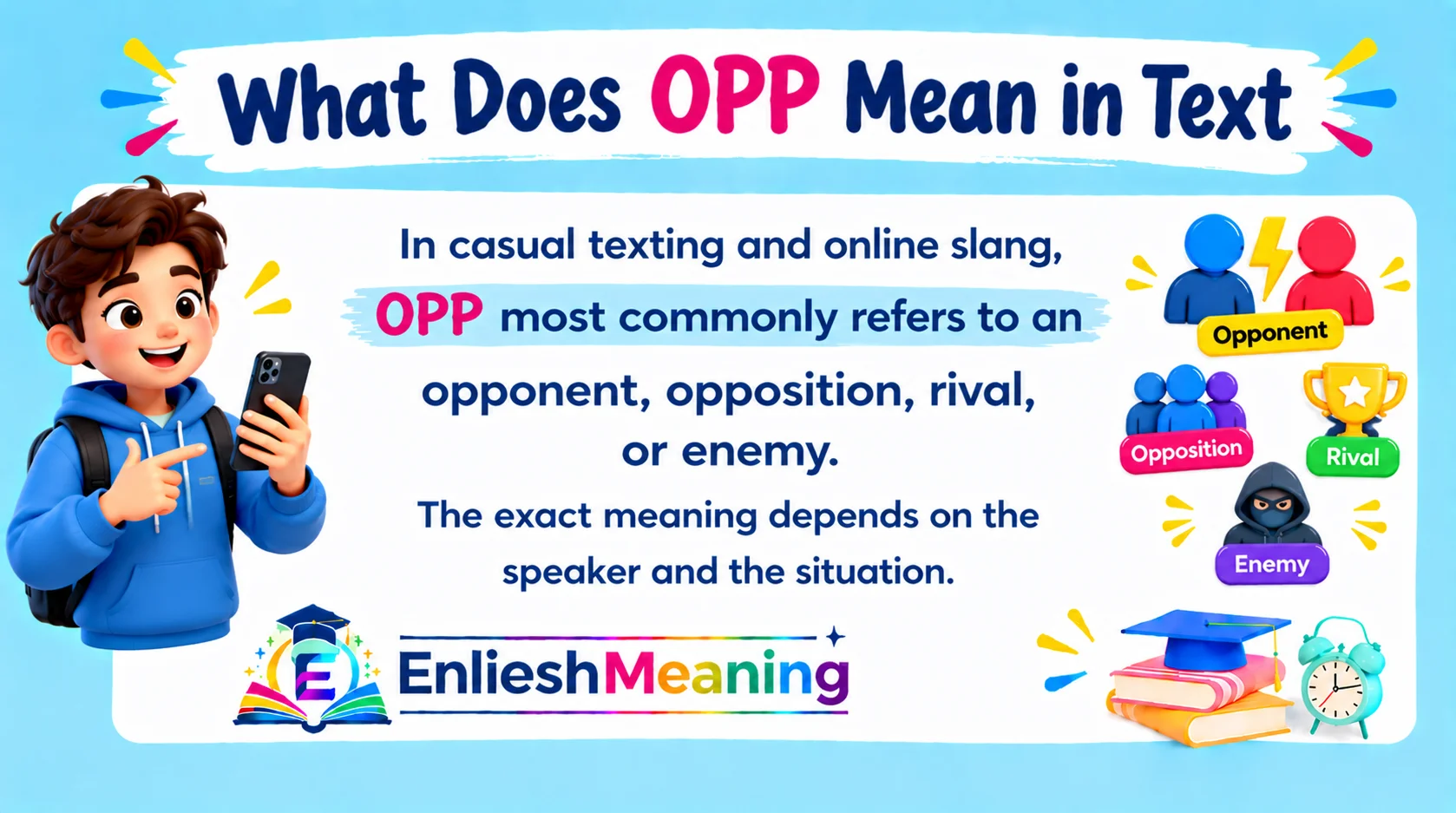
If you have received a message containing “OPP” and wondered what it means, you are not alone. Internet slang and texting abbreviations can be confusing because the same short term may have different meanings depending on the conversation.
In many casual online conversations, OPP refers to an opponent, opposition, or someone considered an enemy or rival. It is closely related to the slang word “opp,” which is commonly used when talking about a person who is against someone or a particular group.
However, OPP can also represent completely different phrases in professional, technical, scientific, or organizational settings.
People search for what does OPP mean in text because abbreviations often appear without explanation on platforms such as WhatsApp, Instagram, TikTok, Snapchat, and other messaging services.
Understanding the surrounding conversation is therefore important before deciding what the sender intended.
This guide explains the common meaning of OPP, its background, social-media usage, technical possibilities, related terms, and appropriate ways to respond.
Meaning & Definition Of OPP
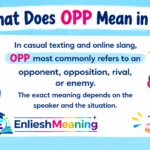
In casual texting and online slang, OPP most commonly refers to an opponent, opposition, rival, or enemy. The exact meaning depends on the speaker and the situation.
For example, someone might write:
“Watch out, the opp is here.”
In this context, the person is referring to someone viewed as an opponent or adversary.
Another person might say:
“I don’t associate with opps.”
Here, “opps” generally means people who are considered enemies, rivals, or people on the opposing side.
The singular form “opp” is particularly common in informal speech, while “opps” is frequently used as the plural. Some people also write “OPP” in capital letters when texting, although capitalization does not necessarily change the meaning.
OPP meaning in slang
The slang interpretation is generally connected with the idea of opposition. Depending on the conversation, an opp may be a personal rival, someone involved in a disagreement, a competitor, or simply somebody perceived as being against the speaker.
Importantly, the word does not always describe a serious enemy. Young people and social-media users sometimes use it jokingly or dramatically to describe someone they dislike or disagree with.
For example:
- “He’s my opp” can mean “He’s my rival.”
- “Don’t tell my opps” can mean “Don’t tell people who are against me.”
- “My opp posted that” can mean “Someone I have a problem with posted that.”
Therefore, when asking what does OPP mean in text, the safest answer is that it often means opponent, opposition, or rival in informal slang.
Background
Where did the slang meaning come from?
The modern slang use of opp is associated with informal speech and expressions referring to opposition or adversaries. Over time, the shortened form became increasingly visible in music, entertainment, online communities, and social media.
Internet communication helped make short expressions especially popular. Users often prefer abbreviated words because they are quick to type and easy to incorporate into captions, comments, memes, and direct messages.
The term can appear as opp, opps, or OPP, depending on the writer’s preferred style. It should not automatically be interpreted as a formal acronym simply because it is written in capital letters.
How the meaning developed online
Social media has also broadened the way people use slang. A word that originally referred to a serious rival may now be used humorously.
For example, someone might jokingly call a friend an “opp” after the friend chooses another person’s side during a harmless argument. In that situation, the expression is more playful than threatening.
The meaning is therefore highly dependent on tone. A serious conversation involving conflict may give the word a stronger meaning, while a meme or humorous post may use it casually.
Why context matters
Abbreviations are especially difficult to interpret because they can have multiple meanings. OPP may be slang in one message and an acronym for a completely unrelated term in another.
For this reason, understanding what does OPP mean in text requires looking at the surrounding words, the relationship between the people communicating, and the platform where the term appears.
Usage in Different Contexts
OPP in casual chat
In everyday messaging, OPP commonly describes someone viewed as an opponent or rival.
Example:
“Don’t let the opp know about our plans.”
The intended meaning is generally that the information should not reach someone considered to be on the opposing side.
Another example is:
“He became an opp after the argument.”
This suggests that the person is now regarded as a rival or adversary.
OPP on social media
On social platforms, the term may appear in captions, comments, memes, videos, and discussions. It can be used seriously or humorously.
A TikTok creator might use “opps” to describe people who disagree with them, while a meme might use “opp” simply as a joke about a friend.
OPP in professional environments
Professional communication is different. If OPP appears in a business report, academic document, technical manual, or workplace email, it should not automatically be interpreted as slang.
Organizations frequently create their own abbreviations. OPP can therefore have a specialized meaning determined by the particular industry or document.
When the term appears in formal writing, checking the surrounding terminology or the document’s abbreviation list is more reliable than applying the slang definition.
OPP in competitive situations
The word can also describe a competitor or opposing side. For example, in an informal discussion about sports or gaming, someone may use “opp” to describe the opposing player or team.
This broader meaning explains why the term can sometimes mean opponent without necessarily implying personal hostility.
Meaning in Chat, WhatsApp, Instagram, and TikTok
What does OPP mean in chat?
In ordinary chat, OPP usually refers to an opponent, rival, or person on the opposing side. The tone can range from serious to playful.
If someone says:
“That’s the opp you’re talking about.”
they may be pointing out that the person being discussed is considered a rival.
OPP meaning on WhatsApp
WhatsApp conversations frequently contain informal abbreviations. If OPP appears in a casual group chat, its slang meaning is often more likely than a technical definition.
For example:
“Don’t send that screenshot to the opps.”
means the sender does not want people considered rivals or opponents to see the screenshot.
However, context remains essential. A workplace WhatsApp group could use OPP as an organization-specific abbreviation instead.
OPP meaning on Instagram
On Instagram, OPP may appear in comments, captions, Reels, Stories, or private messages. It is often connected to internet slang.
A person might write:
“My opps are watching.”
This generally refers to people who are against them, criticize them, or are perceived as rivals.
OPP meaning on TikTok
TikTok has helped popularize many slang expressions, including variations of “opp.” Users may use the term in humorous videos, memes, trends, and comments.
Because TikTok content often exaggerates situations for entertainment, calling someone an “opp” does not necessarily indicate a genuine conflict.
OPP vs. OP
It is also important not to confuse OPP with OP. In online communities, OP can mean “original poster,” referring to the person who created a post or discussion.
Therefore, the context determines whether a short form refers to an opponent, original poster, or another phrase entirely.
Meaning in Physics, Medical, and Aircraft Terminology
OPP in physics
There is no single universal physics definition of OPP that should automatically replace its ordinary slang meaning. Technical abbreviations can differ between specialties, research papers, institutions, and specific applications.
If OPP appears in a physics textbook, research paper, laboratory document, or engineering context, the surrounding material should be used to identify the intended expansion.
This is an important distinction: a person asking what does OPP mean in text after seeing it in a casual message is usually dealing with slang, whereas a student encountering OPP in a scientific document needs to examine the document’s terminology.
OPP in medical terminology
Medical abbreviations require even more caution because the same abbreviation can represent different terms in different specialties.
OPP is not a single universally recognized medical meaning that should be assumed in every medical context. Depending on the institution or specialty, an abbreviation may have a specific local meaning.
Therefore, patients should not interpret an unfamiliar medical abbreviation based solely on an online slang definition. A doctor, nurse, pharmacist, or medical document’s abbreviation list is a safer source of clarification.
OPP in aircraft and aviation terminology
Aviation also uses numerous abbreviations and codes. Their meanings can vary according to aircraft systems, airline procedures, operational documents, maintenance terminology, and regulatory material.
Consequently, OPP does not have one universal aviation meaning that can safely be applied to every aircraft-related document.
If you see OPP in a flight manual, maintenance record, cockpit document, or aviation report, the exact document and surrounding terminology should be examined.
Why technical context matters
The same three letters can have completely different meanings in different fields. This is why an online slang explanation should not be transferred automatically into scientific, medical, or aviation situations.
Common Misconceptions
OPP always means enemy
Not necessarily. In casual slang, “opp” often means an enemy or rival, but it can also be used more loosely for someone who is simply on the opposing side.
Someone might call a competing gamer an “opp” without having any serious personal conflict with that person.
OPP always has one definition
This is another common misunderstanding. Abbreviations are context-dependent. OPP may be slang in one conversation and a specialized abbreviation somewhere else.
OPP and opps are completely different
Usually, they are closely related. “Opp” is commonly used as a singular slang term, while “opps” can refer to multiple opponents or rivals. Capitalization may simply reflect how the writer types the word.
Using OPP always means serious conflict
No. Social-media language frequently uses exaggeration and humor. Someone might jokingly call their friend an “opp” after a minor disagreement.
OPP is always an acronym
Not necessarily. Online slang can be written in uppercase without functioning as a formal acronym. Looking at the sentence and context is more useful than capitalization alone.
Similar Terms & Alternatives
Several words can have a similar meaning to OPP when it is used as slang.
Opponent
An opponent is someone who competes against another person. This is one of the clearest standard-language equivalents.
Rival
A rival is someone competing with or opposing another person or group.
Adversary
An adversary generally refers to someone who is opposed to another person or side. It sounds more formal than “opp.”
Enemy
“Enemy” is stronger than “opponent” and usually implies hostility. An “opp” does not always carry that level of seriousness.
Opposition
“Opposition” can describe the opposing side rather than one individual.
Competitor
In business, sports, gaming, or other competitive situations, competitor may be more appropriate than slang.
Hater
A “hater” is someone who expresses strong dislike or criticism. The term overlaps with “opp” in some online contexts but does not have exactly the same meaning.
How to Respond to OPP
What should you say when someone calls someone an opp?
Your response should depend on the tone of the conversation.
If you understand the slang, you can respond casually:
“Haha, why are they your opp?”
If you are unsure what the sender means, asking directly is completely reasonable:
“What do you mean by opp?”
You can also respond according to the situation:
- “Are you talking about your rival?”
- “Why do you consider them an opp?”
- “Wait, who are the opps?”
- “Lol, what happened between you two?”
When you should avoid assuming
If the conversation involves a professional, medical, scientific, or aviation subject, do not assume OPP means an opponent. Ask for clarification or check the terminology used in the relevant document.
Keep the response appropriate
Slang can sometimes be connected with genuine disputes. If the conversation appears serious, it is better to avoid escalating the situation and respond neutrally.
Differences From Similar Words
OPP vs. Opponent
“Opponent” is the complete standard word. “Opp” or “OPP” is an informal shortened form commonly used in slang.
OPP vs. Enemy
An enemy generally implies stronger hostility. An opp can simply mean a rival or someone considered to be on the other side.
OPP vs. Rival
These are often similar, but “rival” is more neutral. Calling someone an “opp” can carry a stronger slang or social-media tone.
OPP vs. Hater
A hater is usually someone who dislikes, criticizes, or negatively comments about another person. An opp may be a rival or opposing person without necessarily being a vocal critic.
OPP vs. OP
This distinction is particularly important online. OP often means “original poster” in forums and social communities. OPP, on the other hand, may refer to an opponent or another context-specific term.
Relevance in Online Conversations & Dating Apps
OPP in modern online conversations
Internet communication constantly creates and spreads new slang. Terms become popular through music, memes, short-form videos, gaming communities, and social platforms.
The word “opp” fits naturally into informal conversations because it quickly communicates the idea of opposition without requiring a longer phrase.
Someone might say:
“Don’t match with my opp.”
The meaning could be that another person is considered a rival or someone the speaker has a disagreement with.
OPP on dating apps
Dating-app conversations can contain slang just like ordinary texting. If someone mentions an “opp” on a dating app, they may be talking about a rival, someone they dislike, or another person involved in a social situation.
However, dating conversations are highly personal, so context matters even more. The term might also be an inside joke between people.
For example:
“That’s my opp 😂”
could be completely playful.
By contrast:
“Don’t give my opp my information.”
has a more serious tone and suggests that the speaker does not trust the person.
Understanding tone
Emojis, punctuation, previous messages, and the relationship between the speakers can help determine whether OPP is being used humorously or seriously.
A laughing emoji can indicate playful slang, while a serious conversation about conflict may indicate genuine opposition.
FAQs
What does OPP mean in text?
In informal texting, OPP commonly means an opponent, rival, opposition, or someone considered an enemy. The exact meaning depends on the conversation.
What does opp mean in slang?
“Opp” is slang commonly used for an opponent, rival, or person viewed as being against someone. “Opps” is often used for multiple people.
What does OPP mean on WhatsApp?
On WhatsApp, OPP can commonly mean an opponent or rival when used in casual slang. However, technical or workplace chats may use the abbreviation differently.
What does OPP mean on Instagram and TikTok?
On Instagram and TikTok, OPP often refers to a rival, opponent, or person perceived as being against the speaker. It may be used seriously or jokingly.
Is OPP the same as enemy?
Not always. OPP can mean an enemy in some conversations, but it can also refer to a rival, competitor, or opposing person without implying serious hostility.
Can OPP have other meanings?
Yes. OPP can represent different abbreviations in technical, professional, scientific, medical, aviation, or organizational contexts. The surrounding context should determine the intended meaning.
Conclusion
Understanding what does OPP mean in text is mainly a matter of context. In casual internet slang, OPP commonly refers to an opponent, rival, opposition, or person considered to be against someone.
The shorter form “opp” and plural “opps” are also widely used in informal online communication.
You may encounter the term in text messages, WhatsApp chats, Instagram comments, TikTok videos, gaming conversations, and other social environments.
However, OPP should not automatically be given the slang definition in professional or technical settings. Physics, medical, aviation, and workplace documents may use the same letters for entirely different concepts.
When someone uses OPP in a message, examine the surrounding words, tone, platform, and situation.
If the meaning is still unclear, simply ask the sender what they mean. That approach is usually more reliable than assuming every abbreviation has one fixed definition.