Last updated on October 18th, 2026 at 05:17 am
If you have received a message containing “DW”, you may have wondered what the sender actually means. In most everyday text conversations, DW means “don’t worry.” It is a common abbreviation used to reassure someone, reduce concern, or let them know that a particular problem is not serious.
For example, if a friend says, “Sorry I’m late,” you might reply, “DW, take your time.”
People often search for what does DW mean in text message because abbreviations can have different meanings depending on the conversation, platform, and relationship between the people communicating. Understanding the surrounding context is therefore important.
This short abbreviation appears frequently in texting, WhatsApp conversations, social media comments, direct messages, and casual online communication.
It is especially useful when someone wants to give a quick and friendly response without typing the complete phrase “don’t worry.”
Although “don’t worry” is the most common interpretation, DW can occasionally have other meanings in specialized subjects. The sections below explain its everyday meaning, background, uses, alternative interpretations, and appropriate ways to respond.
Meaning & Definition Of DW
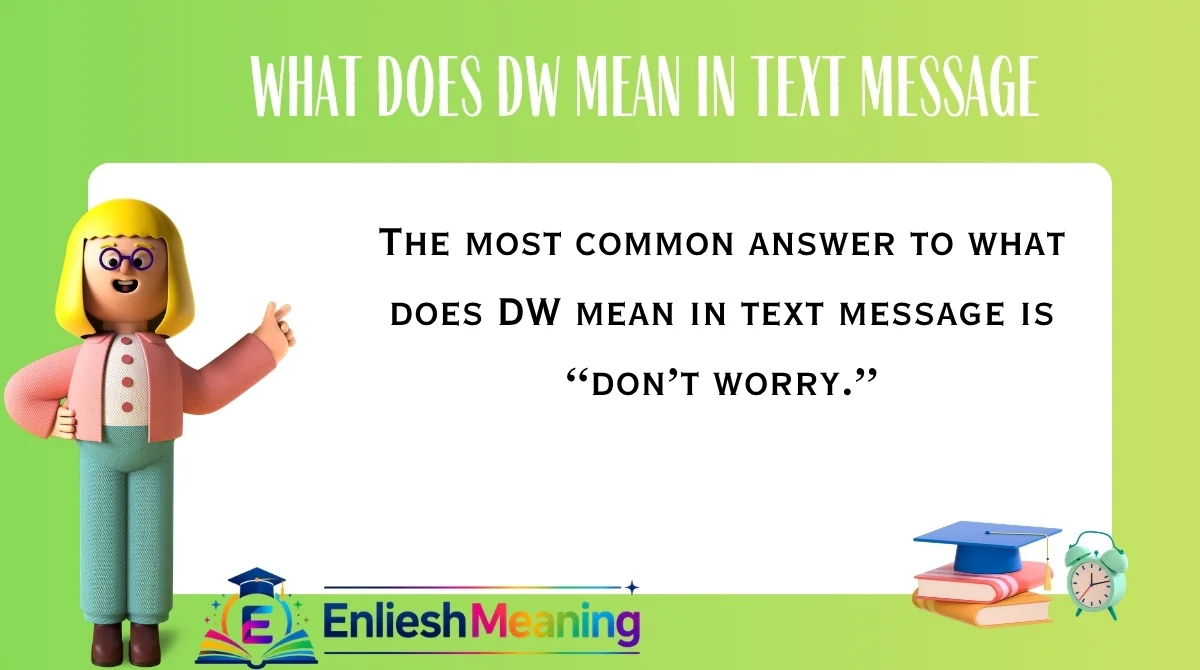
The most common answer to what does DW mean in text message is “don’t worry.”
It is generally used when someone wants to reassure another person. The expression can communicate that there is no need to feel concerned, apologetic, stressed, or uncomfortable about something.
For example:
- “Sorry, I forgot to call you.”
- “DW, it’s completely fine.”
Here, DW replaces “don’t worry” and makes the response shorter and more conversational.
Another example is:
“I might be five minutes late.”
“DW, I’m not in a hurry.”
In this situation, the sender is reassuring the other person that being late is not a problem.
The tone of DW can vary. Between close friends, it may sound casual and warm. In some situations, it can be neutral and reassuring. However, because text messages do not communicate facial expressions or voice tone, the exact feeling can depend on the rest of the message.
Someone might write:
- “DW 😊”
- “DW lol”
- “DW, you’re good.”
- “DW about it.”
- “DW, everything is handled.”
All of these generally communicate reassurance.
What Does DW Mean in Text Message Conversations?
When someone asks what does DW mean in text message, the simplest interpretation is:
DW = Don’t worry.
It is usually not necessary to interpret it as something complicated. The context should still be considered, especially when the conversation involves a professional, academic, technical, or specialized subject.
Why Do People Use DW?
The abbreviation saves time and makes digital communication more informal. Instead of typing “Don’t worry about it,” a person can simply type “DW.”
It can also make a conversation feel relaxed. Friends, family members, classmates, and online contacts may use it naturally because it is widely understood in casual texting.
Background of DW as a Text Abbreviation
Texting abbreviations became increasingly popular as digital communication developed. Early text messaging encouraged people to communicate using fewer characters, particularly when mobile phones had character limitations or inconvenient keyboards.
Abbreviations such as “LOL,” “BRB,” “OMG,” and “IDK” became part of everyday digital language. DW, meaning “don’t worry,” fits into this larger pattern of shortening common expressions.
The abbreviation is particularly practical because “don’t worry” is a phrase that people frequently use in ordinary conversations. Instead of writing the full expression every time, users can shorten it to two letters.
The rise of smartphones and social media did not eliminate these abbreviations. Instead, casual shortened expressions became common in direct messages, group chats, comments, gaming communities, and other online environments.
Today, people generally use DW for convenience rather than because they are trying to save characters. Typing “DW” can feel quicker and more natural in a casual conversation.
Is DW New Internet Slang?
DW is best understood as a common texting abbreviation rather than a highly specialized piece of internet slang. Its meaning is relatively straightforward, although abbreviations can change according to context.
The important point is that the meaning comes from how the letters are being used. If somebody writes “DW, I got it,” the intended meaning is almost certainly “don’t worry, I got it.”
If the same abbreviation appears in a technical document, however, it may represent something completely different.
How the Meaning Became Common
Digital communication encourages concise language. Users often remove unnecessary words while preserving the central meaning of a sentence.
“Don’t worry” is already a short phrase, but “DW” makes it even faster. As people encountered the abbreviation repeatedly, it became recognizable within casual online communication.
This is why someone familiar with texting language may immediately understand DW without needing an explanation.
Usage in Different Contexts
The meaning of DW can be understood most easily by looking at the context in which it appears.
Casual Text Messages
In ordinary texting, DW usually means “don’t worry.”
Example:
Person A: “I think I left my charger at your house.”
Person B: “DW, I’ll bring it tomorrow.”
The abbreviation reassures Person A that the situation is not a serious problem.
Friend-to-Friend Conversations
Friends frequently use DW to respond to apologies or concerns.
For example:
“Sorry for bothering you.”
“DW, you’re fine.”
Here, the sender is telling the other person not to feel bad.
Social Media
On platforms where users communicate through direct messages or comments, DW can have the same meaning.
Someone might write:
“DW, everything will work out.”
The phrase is informal and supportive.
Professional Communication
DW should be used more carefully in professional communication.
If you are messaging a close coworker through an informal workplace chat, “DW” might be acceptable depending on the company culture. However, in a formal email, business proposal, official report, or communication with a client, writing “Don’t worry” is generally clearer and more professional.
For example, instead of:
“DW, I’ll handle it.”
a formal message could say:
“Please don’t worry; I’ll take care of it.”
Academic Communication
Students may use DW casually with classmates, but it is not normally appropriate in formal academic writing.
The abbreviation is best reserved for informal digital conversations.
Meaning in Chat, WhatsApp, Instagram, and TikTok
One reason people search for what does DW mean in text message is that abbreviations frequently appear across several platforms.
The meaning of DW generally remains the same across popular social and messaging platforms when it is being used conversationally.
DW in Chat
In online chat, DW normally means “don’t worry.”
Example:
“DW, I understand.”
This tells the other person that there is no need to be concerned.
DW on WhatsApp
WhatsApp users often use short expressions because conversations can move quickly.
Example:
“Sorry, I replied late.”
“DW 😊”
The response means “Don’t worry.”
The emoji can make the message appear warmer and friendlier.
DW on Instagram
Instagram direct messages are generally informal, so DW can naturally appear in conversations between friends or followers.
Example:
“DW about what happened yesterday.”
Again, the likely meaning is “don’t worry.”
DW on TikTok
TikTok users may use abbreviations in comments and private messages. DW can still mean “don’t worry” when the surrounding conversation is about reassurance.
For example:
“DW, your video was actually good!”
The sender is reassuring the person.
Does the Platform Change the Meaning?
Usually, no. The platform itself does not automatically give DW a different meaning.
The surrounding words matter more than whether the message appears on WhatsApp, Instagram, TikTok, Snapchat, or another service.
If someone writes “DW, you’re okay”, the intended meaning is clear regardless of the platform.
DW in Physics, Medical, and Aircraft Terminology
Although what does DW mean in text message usually has a simple answer, DW can represent different things outside casual texting.
This is an important distinction because abbreviations are not universal.
DW in Physics
In physics and engineering, abbreviations can represent technical concepts, variables, measurements, or specialized terminology. The meaning of DW therefore depends on the specific subject, textbook, formula, or field.
It should not automatically be interpreted as “don’t worry” simply because the letters are familiar from texting.
For technical material, always examine the definitions provided by the source or course.
DW in Medical Contexts
Medical terminology contains many abbreviations. DW may have specialized meanings depending on the medical specialty, institution, document, or clinical context.
This means a medical abbreviation should never be interpreted solely based on its common texting meaning.
If you encounter DW in medical documentation, the surrounding information and official terminology should be checked before drawing a conclusion.
DW in Aircraft and Aviation
Aviation also uses numerous abbreviations and codes. In aviation-related documents, DW can potentially represent terminology different from the casual texting phrase.
For pilots, aviation professionals, students, and travelers reading technical documentation, context is essential.
Why Context Matters
The same two letters can have several meanings in different fields.
In a casual message:
“DW, I’m okay.”
DW almost certainly means “don’t worry.”
In a technical document, however, DW might be a field-specific abbreviation.
Therefore, the question what does DW mean in text message should be separated from questions about DW in science, medicine, engineering, or aviation.
Common Misconceptions About DW
There are several possible misunderstandings surrounding this abbreviation.
Misconception 1: DW Always Means “Don’t Worry”
In casual texting, “don’t worry” is by far the most common interpretation. However, abbreviations can have different meanings in specialized contexts.
Therefore, context should always be considered.
Misconception 2: DW Is Always Friendly
Although DW is often friendly and reassuring, the tone can change depending on the wording.
Compare:
“DW 😊”
with:
“DW.”
The first may feel warm and comforting. The second could feel brief or dismissive depending on the conversation.
Text lacks vocal tone, so punctuation and surrounding words can affect how the message is interpreted.
Misconception 3: DW Is Appropriate Everywhere
DW is primarily casual language. It is not necessarily appropriate for formal letters, professional reports, academic essays, or official documents.
When clarity and professionalism matter, spelling out “don’t worry” is usually preferable.
Misconception 4: DW Means the Person Does Not Care
This is another common misunderstanding.
When someone says “DW,” they are often trying to reassure you. It does not automatically mean they are uninterested or dismissive.
For example:
“DW, I’ll help you fix it.”
This actually communicates concern and willingness to help.
The tone must be judged from the entire conversation rather than the abbreviation alone.
How DW Is Used to Comfort Someone in a Text Conversation
In everyday digital communication, DW commonly stands for “don’t worry.” People use this abbreviation to reassure someone, reduce anxiety, or let them know that a situation is not as serious as it might seem. Because texting often lacks facial expressions and vocal tone, DW provides a quick way to communicate reassurance without writing a long response.
One of the most common situations where DW appears is when someone apologizes for a small mistake. For example, if a friend texts, “Sorry, I forgot to send you the picture,” you might reply, “DW, you can send it later.” This response tells the person that you are not upset and that they do not need to feel guilty about the delay.
DW is also useful when someone feels nervous about an upcoming event. A friend preparing for an interview might say, “I’m worried I’ll mess up tomorrow.” Responding with “DW, you’ve prepared really well!” offers encouragement and helps the conversation feel supportive. In this situation, the abbreviation introduces reassurance, while the rest of the message explains why the sender should feel more confident.
In conversations between romantic partners, DW can express care and consideration. If someone is concerned that they have disappointed their partner, a message such as “DW, we’re okay. We can talk about it later” may help ease their concerns. However, the meaning depends on the rest of the message and the relationship. DW by itself does not necessarily indicate romantic interest or deep emotional attachment.
The abbreviation is also common in group chats and on social media platforms such as Instagram, Snapchat, and WhatsApp. Someone might use it when a friend worries about missing a gathering, making a mistake, or misunderstanding a conversation. Since DW is short and widely recognizable, it works well in fast-moving chats where people prefer brief replies.
Although DW usually communicates reassurance, it can sometimes sound dismissive if the sender does not acknowledge the other person’s concerns. For example, responding only with “DW” to someone describing a serious problem may leave them feeling that their feelings are being overlooked. Adding a supportive sentence, such as “DW, I’m here if you want to talk,” can make the message feel more thoughtful.
It is also important to remember that not every problem can be solved with reassurance alone. If someone is facing a difficult situation, listening carefully and offering practical help may be more useful than simply telling them not to worry.
Overall, DW is an easy way to communicate comfort in casual texting. Its effectiveness depends on how it is used, what the other person is experiencing, and whether the rest of the message conveys genuine understanding.
When DW Can Be Misunderstood in Text Messages
Although DW usually means “don’t worry” in texting, its short format can sometimes create confusion. Like many abbreviations, it depends on context, tone, and the relationship between the people communicating. Understanding these factors can help you avoid interpreting a simple message incorrectly.
One common source of confusion is the difference between reassurance and dismissal. When someone shares a concern, receiving “DW” may feel comforting if the sender is trying to help. However, if the issue is serious or emotionally important, the same reply might seem as though the sender is minimizing the problem. A short abbreviation cannot always communicate the empathy that a longer response provides.
For example, imagine telling a friend that you are anxious about an important exam and receiving only “DW.” Your friend may genuinely want to reassure you, but you might still feel that your concern has not been fully acknowledged. A message such as “DW, you’ve studied hard, and I think you’ll do well” communicates the same general idea while providing more personal support.
Another potential misunderstanding involves sarcasm. In some conversations, people use DW casually or jokingly, especially when teasing friends about a minor mistake. Depending on the surrounding words, however, a reply like “DW about it 🙄” could sound impatient rather than reassuring. Emojis, punctuation, and previous messages can influence how the recipient interprets the tone.
DW can also cause confusion when people are unfamiliar with texting slang. Although the abbreviation is widely used online, not everyone recognizes it immediately. Someone who has not encountered the expression might not understand what the letters represent. In conversations with unfamiliar recipients, spelling out “don’t worry” is a simple way to make the message clearer.
The relationship between the sender and recipient matters as well. Close friends may understand a one-word response because they are familiar with each other’s communication styles. In a new friendship or professional conversation, the same brief reply may feel too informal or impersonal. Choosing wording that suits the relationship can help prevent unnecessary misunderstandings.
Another mistake is assuming that DW always means the sender believes everything is fine. Sometimes, the person is simply trying to be polite or end a discussion quickly. The abbreviation alone cannot reveal someone’s full intentions, so it is better to consider their other words and actions before drawing conclusions.
To use DW more effectively, think about the seriousness of the situation and whether the recipient needs more than a quick reassurance. In casual conversations, the abbreviation is often perfectly appropriate. When someone is upset, anxious, or discussing an important issue, adding a thoughtful explanation or offering help can make a meaningful difference.
Ultimately, DW works best when its intended message is clear and considerate. Paying attention to context and tone helps you understand whether the sender is offering genuine comfort, making a casual remark, or communicating something that needs further clarification.
Similar Terms and Alternatives
If you understand what does DW mean in text message, it is also useful to know expressions that communicate a similar idea.
“Don’t Worry”
This is the full version of DW.
Example:
“Don’t worry, everything is okay.”
It is clearer and more suitable for formal situations.
“No Worries”
“No worries” is another casual expression used to reassure someone or accept an apology.
Example:
“Sorry I forgot.”
“No worries!”
“It’s Okay”
This expression can reassure someone that their mistake or concern is not serious.
Example:
“It’s okay, you don’t need to apologize.”
“You’re Good”
“You’re good” is informal and commonly used to tell someone that everything is fine.
Example:
“Sorry about that.”
“You’re good!”
“All Good”
“All good” communicates that there is no problem.
Example:
“Are we still okay?”
“Yes, all good.”
“NP”
NP commonly means “no problem.” It is related to DW but is not exactly the same.
DW focuses more on telling someone not to worry, while NP generally means that something is not a problem.
How to Respond to DW
Knowing what does DW mean in text message is only part of understanding the conversation. You may also wonder how you should respond.
The best response depends on why the person said DW.
If You Apologized
You could simply say:
“Thanks, I appreciate it!”
or:
“Thanks for understanding.”
If You Were Worried
You might respond:
“Okay, thank you!”
or:
“That makes me feel better.”
If You Want to Continue the Conversation
You can use:
“Thanks! What are you up to?”
This acknowledges the reassurance while keeping the conversation moving.
If the Conversation Is Romantic
If someone you like says:
“DW ❤️”
you can respond naturally with:
“Thank you 😊”
or something more conversational based on your relationship.
If You Are Unsure About Their Meaning
If the abbreviation seems unclear because of the context, you can simply ask:
“Do you mean don’t worry?”
There is nothing wrong with asking for clarification when an abbreviation could have multiple interpretations.
Differences From Similar Words and Abbreviations
DW is sometimes confused with other short expressions. Understanding the differences makes online communication easier.
| Abbreviation or Phrase | Common Meaning | Main Purpose |
|---|---|---|
| DW | Don’t worry | Reassurance |
| NP | No problem | Saying something is not a problem |
| NVM | Never mind | Dropping or dismissing a previous point |
| IDK | I don’t know | Expressing uncertainty |
| IDC | I don’t care | Expressing lack of concern or interest |
| BRB | Be right back | Indicating temporary absence |
| LOL | Laughing out loud | Expressing amusement |
| OMG | Oh my God | Expressing surprise or excitement |
DW vs. NP
“DW” tells someone not to worry.
“NP” tells someone that something is not a problem.
They can sometimes appear in similar conversations, but they are not interchangeable in every situation.
DW vs. NVM
“NVM” means “never mind,” which is completely different.
For example:
“DW, I already fixed it.”
means there is no need to worry.
“NVM, I figured it out.”
means the speaker no longer needs the other person’s help or response.
DW vs. IDC
“IDC” usually means “I don’t care.” Depending on the context, it can sound blunt or dismissive.
DW, on the other hand, generally has a reassuring purpose.
Relevance in Online Conversations and Dating Apps
Short abbreviations are especially common in fast-moving online conversations, including dating apps.
If someone sends “DW” after you apologize, they are usually trying to make you feel comfortable.
For example:
You: “Sorry, I disappeared for a while. Work got really busy.”
Them: “DW, I understand.”
This is generally a reassuring response.
DW in Flirting
The abbreviation itself is not necessarily romantic or flirtatious. Its meaning comes from the broader conversation.
For example:
“DW, you can text me whenever 😊”
may sound warm or encouraging, but the romantic meaning comes from the overall message rather than DW itself.
DW After an Awkward Moment
Someone might use it to reduce tension:
“DW 😂 That was actually funny.”
Here, the abbreviation tells the other person not to feel embarrassed.
DW and Dating Communication
Because dating-app conversations are usually informal, abbreviations such as DW can make communication feel relaxed and natural.
However, you should avoid assuming that DW indicates romantic interest. It generally communicates reassurance, not attraction.
The best way to understand someone’s intentions is to consider their complete messages, consistency, and overall communication style.
Frequently Asked Questions
What does DW mean in text message?
DW most commonly means “don’t worry.” It is used to reassure someone that a situation is okay or not serious.
Is DW rude in texting?
Usually, no. DW is generally casual and reassuring. However, a very short message such as “DW.” can sometimes feel dismissive depending on the surrounding conversation.
What does DW mean on WhatsApp?
On WhatsApp, DW generally means “don’t worry.” It is commonly used in casual conversations to reassure another person.
What does DW mean on Instagram?
DW usually means “don’t worry” in Instagram direct messages and comments when the conversation is informal.
What should I reply when someone says DW?
You can reply with “Thanks,” “Thanks for understanding,” “Okay, I appreciate it,” or another response that fits the conversation.
Can DW have other meanings?
Yes. Although “don’t worry” is the common texting meaning, DW can represent different terms in technical, medical, scientific, aviation, or other specialized contexts. Context determines the intended meaning.
Conclusion
So, what does DW mean in text message? In most casual conversations, DW means “don’t worry.” It is a convenient abbreviation used to reassure someone, accept an apology, reduce concern, or communicate that everything is fine.
You may encounter DW in text messages, WhatsApp chats, Instagram direct messages, TikTok conversations, social media comments, and other informal online environments.
Its meaning is generally easy to recognize when the surrounding conversation involves an apology, concern, mistake, delay, or problem.
However, DW does not have one universal meaning in every situation. Specialized fields such as medicine, physics, engineering, and aviation may use the same letters for completely different terms. That is why context is always important.
For everyday texting, though, you can confidently understand DW as “don’t worry.” When responding, a simple “Thanks!” or “Thanks for understanding” is usually enough.