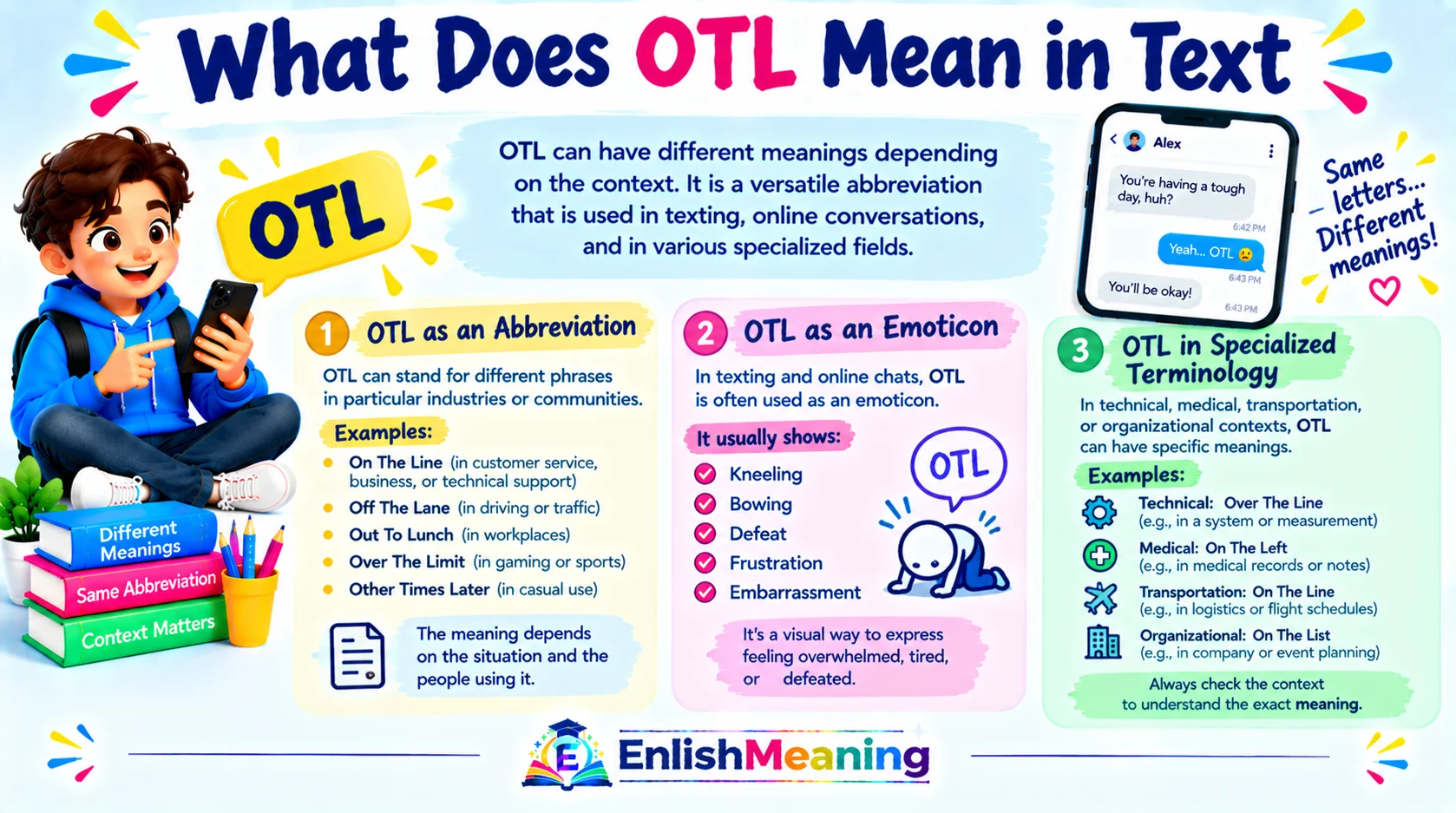
If you have seen “OTL” in a text message, social media post, or online conversation, you may wonder what it means. Unlike many common texting abbreviations, OTL can have more than one interpretation depending on the conversation and the platform where it appears.
One of its well-known internet uses is as an emoticon representing a person kneeling or bowing down, often expressing embarrassment, frustration, disappointment, exhaustion, or defeat.
In other situations, OTL may be used as an abbreviation for a phrase, organization, technical term, or specialized expression.
People commonly search for the meaning of OTL because short forms can be confusing without context.
Understanding the surrounding message is therefore important before deciding what the sender intended.
This guide explains the common meanings of OTL, how it is used in texting and social media, its possible meanings in technical fields, and how you can respond when someone sends it.
Meaning & Definition Of OLT
The meaning of OTL in text depends heavily on context. In casual internet communication, OTL is commonly used as a text emoticon showing someone kneeling, bowing, or being emotionally defeated. The letters can be viewed visually as a person: O represents the head, T represents the upper body and arms, and L represents the legs.
For example:
“I studied all night and still failed the test. OTL”
Here, OTL communicates a feeling of defeat or disappointment. It can have a humorous tone rather than indicating a serious emotional problem.
Another example is:
“I forgot to save my work before closing the computer. OTL”
In this situation, OTL can convey frustration, regret, or the feeling of being defeated by a mistake.
OTL can also appear as an abbreviation with a completely different meaning in specialized conversations. Therefore, it should not automatically be interpreted as the emoticon whenever it appears.
Common interpretations
- OTL as an abbreviation: May represent different phrases in particular industries or communities.
- OTL as an emoticon: Kneeling, bowing, defeat, frustration, or embarrassment.
- OTL in specialized terminology: Its meaning can change in technical, medical, transportation, or organizational contexts.
The safest way to interpret it is to consider the complete sentence, the relationship between the people communicating, and the subject being discussed.
Background
OTL developed within the broader culture of internet communication, where users often created shortcuts to communicate emotions and reactions without writing complete sentences. Before modern platforms offered extensive emoji libraries and reaction buttons, text-based emoticons were widely used to express feelings visually.
Unlike abbreviations such as “LOL” or “BRB,” OTL is particularly interesting because it can function as a visual representation rather than simply standing for a group of words. When viewed sideways, the characters resemble a person on their hands and knees or bowing toward the ground.
This visual style became associated with emotions such as defeat, exhaustion, disappointment, shame, or frustration. The exact emotion depends on the surrounding message.
For example:
“My favorite character lost again OTL”
The sender might be expressing disappointment.
Meanwhile:
“I finally finished that huge assignment OTL”
could suggest exhaustion or relief after completing something difficult.
Internet communities have historically created many similar combinations of letters and symbols. Some became widely recognized, while others remained popular only within particular communities, gaming groups, forums, or fandoms.
The meaning of OTL has therefore evolved alongside online communication. Someone who is familiar with older internet slang may immediately recognize it as an emoticon, while another person may assume that it is an abbreviation for a phrase.
This is why context matters so much. Digital language is flexible, and the same three letters can mean entirely different things in different conversations.
Usage in Different Contexts
OTL can appear in several types of online communication, but its meaning is not necessarily the same everywhere.
In casual chat
In personal conversations, OTL can communicate frustration, embarrassment, exhaustion, disappointment, or defeat.
“I accidentally sent the message to the wrong person. OTL”
The sender is probably expressing embarrassment or regret.
On social media
People may use OTL in captions, comments, or replies when reacting dramatically to something that happened. It can add humor to an otherwise frustrating situation.
For example:
“Three deadlines in one week. OTL”
The expression makes the statement feel playful and exaggerated.
In gaming communities
OTL can describe losing a match, making a mistake, missing an opportunity, or experiencing an unfortunate event.
“I lost the final round because I pressed the wrong button. OTL”
In professional fields
The interpretation can be completely different in professional or technical communication. If OTL appears in a business document, report, aviation discussion, medical record, or technical paper, it should be interpreted according to that field’s terminology rather than assumed to be internet slang.
This distinction is important because abbreviations are often reused across unrelated industries. A workplace abbreviation may have nothing to do with the emoticon commonly seen online.
Meaning in Chat, WhatsApp, Instagram, and TikTok
The meaning of OTL on messaging and social platforms usually depends on the tone of the conversation.
OTL in chat
In ordinary chats, OTL may represent someone who feels defeated, embarrassed, tired, or frustrated.
“I forgot my homework at home OTL”
Here, the sender is probably expressing frustration or embarrassment.
OTL on WhatsApp
WhatsApp users may use OTL in a casual conversation to react to bad luck or an awkward situation. Because WhatsApp supports emojis, however, many users may choose a standard emoji instead.
OTL on Instagram
On Instagram, OTL may appear in comments, captions, or direct messages. Its meaning can be humorous and exaggerated.
For example:
“That ending destroyed me OTL”
The sender is not necessarily being literal. They may simply mean that the ending was emotionally powerful or disappointing.
OTL on TikTok
TikTok conversations often involve exaggerated reactions. Someone might use OTL after watching an embarrassing, funny, surprising, or frustrating video.
For example:
“I cannot believe he actually did that OTL”
Here, OTL emphasizes the person’s reaction.
The important point is that OTL does not have one universal social-media definition. The surrounding words provide the strongest clue.
Meaning in Physics, Medical, and Aircraft Terminology
OTL can have specialized meanings outside internet slang. These meanings should be treated separately from the casual texting interpretation.
OTL in physics
Physics uses many abbreviations, symbols, and technical expressions. OTL is not a universally standard physics abbreviation with one fixed meaning across all areas of physics. If you encounter OTL in a physics paper, lecture, diagram, or laboratory document, the surrounding material should be checked for a definition.
It may represent a term specific to a particular experiment, model, organization, or technical document.
OTL in medical terminology
Medical communication contains a large number of abbreviations, but OTL does not have one universally applicable medical meaning. Its interpretation can vary according to the medical specialty, institution, or document.
When reading medical information, it is particularly important not to guess an abbreviation’s meaning because a mistaken interpretation could change the meaning of an instruction or clinical statement.
OTL in aircraft or aviation terminology
Aviation also uses specialized abbreviations for aircraft operations, navigation, procedures, and communication. OTL may appear in particular aviation contexts, but it should not automatically be interpreted as the texting emoticon.
If OTL occurs in an aviation document, the relevant glossary, manual, chart, or surrounding terminology should determine its meaning.
In short, the casual internet meaning and technical meanings of OTL are separate. Context should always determine which interpretation is appropriate.
Common Misconceptions
One common misconception is that OTL always stands for a particular phrase. In reality, its meaning can vary considerably.
Another misconception is that OTL always indicates sadness. As a text emoticon, it can communicate several related reactions, including embarrassment, exhaustion, frustration, defeat, regret, or humorous disbelief.
For example:
“I watched the entire series in one day OTL”
This could express exhaustion or playful self-criticism rather than genuine distress.
Some people also assume that OTL is interchangeable with every abbreviation expressing laughter or surprise. It is not. The expression generally communicates a dramatic reaction or sense of being defeated, rather than simply laughter.
Another mistake is interpreting OTL without considering the conversation. If someone writes:
“The project deadline was moved forward. OTL”
the expression probably communicates frustration.
But if OTL appears in a technical document, the internet-slang interpretation may be completely inappropriate.
Finally, people sometimes assume that every three-letter combination used online is an acronym. OTL demonstrates why this assumption can be misleading: in one of its common internet uses, the characters work visually as an emoticon.
Similar Terms & Alternatives
Several internet expressions can communicate feelings similar to OTL, although they are not identical.
Facepalm
“Facepalm” describes the reaction of covering one’s face with a hand because of embarrassment, frustration, or disbelief.
SMH
“SMH” commonly expresses disapproval, disappointment, disbelief, or frustration. It is closer to saying “shaking my head.”
OMG
“OMG” is commonly used to express surprise, shock, excitement, or disbelief.
Ugh
“Ugh” is a direct expression of annoyance, frustration, tiredness, or displeasure.
RIP
In casual online language, “RIP” can humorously indicate that something has failed, ended, or gone badly. It does not necessarily refer to an actual death.
T_T
“T_T” is an emoticon often associated with crying or sadness. It focuses more directly on tears than OTL.
The main distinction is that OTL visually represents a person in a defeated, kneeling, or bowing position, while these alternatives communicate different emotional reactions.
How to Respond to OTL
Your response should depend on what the sender appears to mean.
If someone uses OTL because they made a mistake, you could respond:
“Don’t worry, it happens!”
What Does OTL Mean in Text
“Yeah, that sounds frustrating.”
If they are joking about an embarrassing situation:
“😂 I know exactly what you mean.”
What Does OTL Mean in Text
“Better luck next round!”
“T_T” is an emoticon often associated with crying or sadness. It focuses more directly on tears than OTL.
“What do you mean by OTL?”
There is nothing wrong with asking for clarification, especially because OTL can have multiple meanings.
In a professional conversation, avoid assuming that OTL is internet slang. If the abbreviation appears in a work-related message, report, or technical document, ask the sender or consult the relevant terminology.
The best response is therefore based on context and tone, rather than treating OTL as having one fixed definition.
Differences From Similar Words
OTL differs from common expressions such as LOL, OMG, SMH, and BRB because it communicates a different type of reaction.
LOL is generally associated with laughter. If someone writes “LOL,” they are indicating that something is funny or amusing.
OMG expresses surprise, excitement, shock, or disbelief.
SMH commonly communicates disappointment, disapproval, or disbelief.
BRB indicates that the person will temporarily leave the conversation and return later.
OTL, when used as an emoticon, visually represents someone kneeling or bowing down. It can therefore suggest defeat, embarrassment, frustration, exhaustion, or regret.
For example:
- “That joke was hilarious LOL.”
- “OMG, I can’t believe that happened!”
- “He did it again, SMH.”
- “I need to go, BRB.”
- “I forgot my password again OTL.”
These examples show that each expression serves a different conversational purpose.
Relevance in Online Conversations & Dating Apps
OTL can occasionally appear in dating-app conversations, although it is less universal than common abbreviations such as LOL, IDK, or OMG.
A person might use it humorously after an awkward interaction:
“I accidentally liked an old photo while scrolling through your profile OTL.”
Here, OTL communicates embarrassment.
Someone might also use it after an unsuccessful date:
“I ordered the spiciest dish without realizing how hot it was OTL.”
In this case, the expression creates a playful tone.
On dating apps, context and interpersonal tone are particularly important. If someone sends “OTL” after making a joke or describing an awkward experience, they may simply be using it for humor. It does not automatically indicate sadness, rejection, or romantic interest.
If you are unfamiliar with the expression, responding naturally is usually better than trying to force a specific interpretation. You can acknowledge the situation or ask what they mean.
Because online communication lacks facial expressions and voice tone, text emoticons such as OTL can help communicate an emotional reaction that might otherwise be difficult to recognize.
Frequently Asked Questions
What does OTL mean in text?
In texting and online communication, OTL can have different meanings depending on the context. One common use is an emoticon representing a person kneeling or feeling defeated, disappointed, or exhausted.
What does OTL mean in texting slang?
As texting slang, OTL may be used to express frustration, embarrassment, disappointment, or defeat. The exact meaning depends on the conversation.
What does OTL mean on WhatsApp?
On WhatsApp, OTL can be used as an emoticon or abbreviation to show an emotional reaction, such as feeling defeated, tired, or disappointed.
What does OTL mean on Instagram?
On Instagram, OTL may appear in comments, captions, or direct messages to express an emotional reaction. Its meaning depends on the context in which it is used.
What does OTL mean on TikTok?
On TikTok, OTL can be used in comments or messages to express embarrassment, defeat, frustration, or exhaustion. It may also have a community-specific meaning.
Is OTL an emoticon?
Yes. OTL is commonly recognized as an emoticon in which the letters represent a person kneeling or bowing down. It can convey feelings such as defeat, frustration, or exhaustion.
What does OTL mean from a girl?
If a girl uses OTL, she may be expressing disappointment, embarrassment, tiredness, or defeat. The exact interpretation depends on what was being discussed.
What does OTL mean from a guy?
When a guy uses OTL, it may indicate that he feels defeated, frustrated, embarrassed, or exhausted. The surrounding conversation usually provides the clearest meaning.
Does OTL mean “on the low”?
OTL can sometimes be interpreted differently depending on the community or conversation, but it is commonly used online as an emoticon representing a person kneeling or bowing down. Context is important.
What does OTL mean in social media?
On social media, OTL is often used to express an emotional reaction, particularly disappointment, frustration, embarrassment, or defeat. It is generally informal internet language.
Is OTL a bad word?
No. OTL is not inherently a bad word or offensive term. It is generally used as an informal emoticon or abbreviation, although its exact meaning can vary by context.
What is the difference between OTL and LOL?
OTL and LOL have completely different meanings. OTL is commonly used to represent a person kneeling or feeling defeated, while LOL is commonly used to express laughter or amusement.
What is the difference between OTL and OMG?
OTL generally expresses defeat, disappointment, embarrassment, or exhaustion, while OMG is commonly used to express surprise, shock, excitement, or disbelief.
What should I reply when someone sends OTL?
Your response should depend on the situation. If the person is expressing disappointment or frustration, you can respond with something supportive such as “Are you okay?” or “What happened?”
Why do people use OTL in messages?
People use OTL as a quick visual way to express an emotional reaction without writing a long explanation. It can make a message feel more expressive and informal.
Does OTL have more than one meaning?
Yes. OTL can have multiple meanings depending on the platform and context. In casual internet communication, its emoticon meaning is common, but a specific conversation may give it another interpretation.
Conclusion
OTL in text is commonly used as an internet emoticon representing a person kneeling or bowing down, often expressing defeat, embarrassment, frustration, exhaustion, regret, or a humorous reaction. Its exact emotional meaning depends on the surrounding conversation.
OTL can appear in chats, WhatsApp messages, Instagram comments, TikTok discussions, gaming communities, and other online spaces.
At the same time, the abbreviation may have unrelated meanings in technical, medical, aviation, business, or specialized contexts. Therefore, context is essential when interpreting it.
If someone sends you OTL in a casual conversation, look at what they said immediately before it. Their message will usually reveal whether they are frustrated, embarrassed, joking, or feeling defeated. When the meaning is unclear, asking for clarification is the simplest approach.
Understanding expressions like OTL makes digital communication easier because online language often combines abbreviations, visual symbols, humor, and context in ways that traditional dictionaries cannot fully explain.