
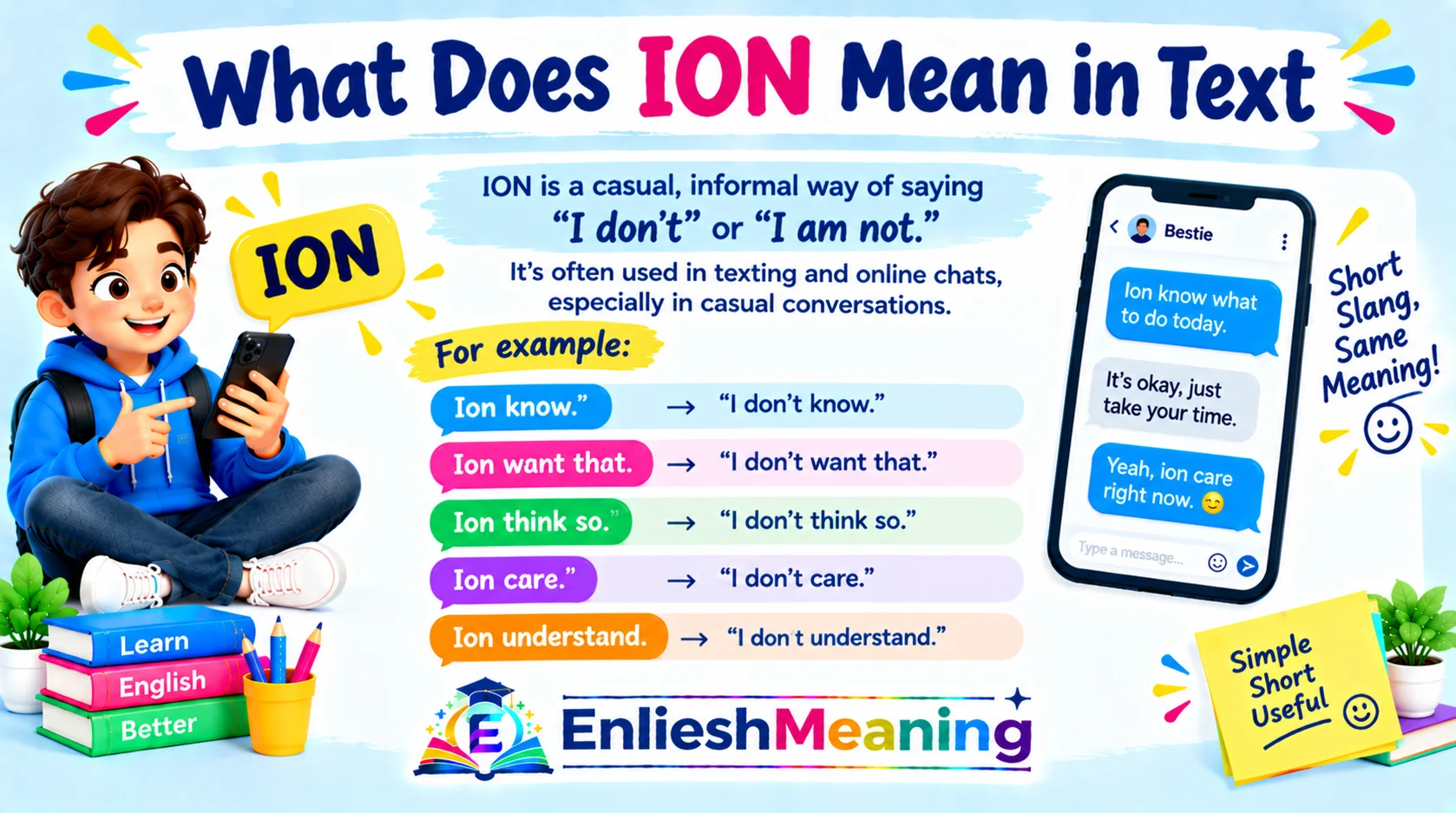
If you have received a message containing “ion” and wondered what the person meant, you are not alone. In texting and online conversations, ION commonly means “I don’t.” It is an informal shortened form often used in casual digital communication.
For example, someone might write, “Ion know what happened,” meaning “I don’t know what happened.”
This abbreviation is especially common in casual conversations, social media comments, direct messages, and text messages where people prefer quick and relaxed communication. The meaning is usually easy to understand from the surrounding sentence, but it can be confusing if you are seeing it for the first time.
People also search for the meaning of ION because the same combination of letters has completely different meanings in science and professional terminology.
In physics and chemistry, an ion is an electrically charged atom or molecule. Therefore, understanding the context is important when interpreting this term.
This article explains the different meanings, uses, examples, and possible interpretations of ION in simple language.
Meaning & Definition Of ION
In informal texting, ION usually means “I don’t.” It is a shortened expression used to make messages quicker and more conversational. The spelling is based on how “I don’t” may sound when spoken casually, particularly in certain varieties of informal English.
For example:
- “Ion know.” → “I don’t know.”
- “Ion want that.” → “I don’t want that.”
- “Ion think so.” → “I don’t think so.”
- “Ion care.” → “I don’t care.”
- “Ion understand.” → “I don’t understand.”
The exact meaning can sometimes depend on the complete sentence. Unlike standard English contractions such as “don’t,” ION is generally considered informal internet or texting language, rather than standard written English.
Someone might use it in a message because they are typing quickly, trying to sound natural, or communicating in the same style as their friends. It can also appear as part of a person’s usual online writing style.
It is important not to confuse this slang usage with the scientific word ion. In science, an ion refers to an atom or molecule that carries an electrical charge. Capitalization may provide a clue, but context is much more reliable.
For example, “Ion know what you mean” is likely texting slang, while “A sodium ion has a positive charge” is clearly a scientific statement.
Therefore, when you see ION in a casual message, the most likely interpretation is “I don’t.”
Background
The use of ION as a shortened form of “I don’t” developed through informal spoken and written communication rather than from a formal abbreviation system. Online language often changes as people look for faster and more expressive ways to communicate.
Texting, social media, messaging apps, and online communities have encouraged people to shorten words and phrases. Expressions such as “gonna,” “wanna,” “idk,” and “ion” can reflect the way people communicate casually rather than the rules normally expected in formal writing.
In the case of ION, the spelling represents a pronunciation associated with informal speech. Instead of writing the complete phrase “I don’t,” a person may write “ion” as a single word.
This type of internet language can become especially noticeable when users communicate with people who share similar speech patterns or online communities. It may also be influenced by regional language varieties and conversational styles.
It is worth remembering that slang does not always have one universal meaning. A term can develop different interpretations in different communities. That is why the surrounding words are important.
For example:
“Ion wanna go today.”
Here, the meaning is fairly clear: “I don’t want to go today.”
However, if someone simply sends:
“ION”
without any surrounding sentence, the intended meaning may not be immediately obvious. In another context, it could refer to the scientific term “ion” or another abbreviation.
The background of ION demonstrates how digital communication frequently transforms spoken expressions into written shorthand. These forms are generally suitable for casual conversations but are not normally appropriate for formal academic, business, or professional writing.
Usage in Different Contexts
The meaning and role of ION can change depending on where it appears. In casual texting, it most often means “I don’t.” On social media, however, people may use it as part of a particular conversational or cultural writing style.
In Casual Chat
Friends may use ION when talking about everyday activities, opinions, or feelings.
Example:
“Why didn’t you tell me?”
“Ion know you wanted to know.”
The second person means, “I don’t know you wanted to know.”
Another example is:
“Are you coming tonight?”
“Ion think I can.”
This means, “I don’t think I can.”
On Social Media
ION may appear in comments, captions, replies, and private messages. Because social media communication is generally informal, users often prefer shortened expressions.
Someone might write:
“Ion even understand this post.”
This means:
“I don’t even understand this post.”
In Professional Fields
ION has a very different role in professional and technical environments. In chemistry and physics, an ion is a scientifically defined charged particle. In business, medicine, aviation, or other professional settings, ION could also be part of an abbreviation or technical term.
Because of this, you should not automatically interpret every occurrence of ION as “I don’t.”
The surrounding vocabulary usually gives you the answer. Words such as “know,” “want,” “think,” “care,” or “need” strongly suggest the texting meaning. Scientific terms such as “charge,” “electron,” “atom,” or “molecule” point toward the scientific meaning.
Meaning in Chat, WhatsApp, Instagram, and TikTok
ION can appear across many popular communication platforms, including messaging apps and social media. Its meaning generally remains the same when it is used as slang.
ION in Chat
In ordinary online chat, ION commonly means “I don’t.”
Example:
“Why are you quiet?”
“Ion have anything to say.”
Meaning:
“I don’t have anything to say.”
ION on WhatsApp
On WhatsApp, friends may use ION in informal messages, group chats, or replies.
Example:
“Do you like this movie?”
“Ion really like it.”
Meaning:
“I don’t really like it.”
ION on Instagram
Instagram users may use ION in comments, DMs, or captions.
Example:
“Ion know why everyone likes this.”
Meaning:
“I don’t know why everyone likes this.”
ION on TikTok
TikTok comments and captions frequently contain informal language and shortened expressions. ION may therefore appear when someone is expressing an opinion or reaction.
For example:
“Ion even know what’s happening 😂”
This means:
“I don’t even know what’s happening.”
The tone can range from serious to humorous depending on the conversation.
One important point is that ION is generally casual language. If you are writing an academic assignment, professional email, résumé, application, or formal report, writing “I don’t” is clearer and more appropriate.
Meaning in Physics, Medical, and Aircraft Terminology
The word ion has important meanings outside internet slang. In scientific and technical contexts, it should not automatically be interpreted as “I don’t.”
ION in Physics
In physics and chemistry, an ion is an atom or molecule that has an electrical charge because it has gained or lost electrons.
For example, when an atom loses an electron, it can become positively charged. When it gains an electron, it can become negatively charged.
Therefore, in a sentence such as:
“The electric field affects the movement of ions.”
the word has its scientific meaning, not its texting meaning.
ION in Medical Contexts
Ions are also important in biology and medicine. Charged particles such as sodium, potassium, calcium, and chloride ions play important roles in biological processes.
For instance, ion movement across cell membranes is involved in processes related to nerve signaling and muscle activity.
Therefore, medical writing that discusses ion channels, ion concentration, or ions in body fluids is referring to the scientific concept.
ION in Aircraft Terminology
In aviation and aircraft-related material, “ion” may appear in technical discussions involving atmospheric electricity, electrically charged particles, or specialized technologies. It can also appear as part of an acronym or product-specific terminology.
The key point is that the meaning depends on the surrounding subject.
If someone writes:
“Ion know if I can make it.”
it is almost certainly texting slang.
If a technical document says:
“Positive ions are present in the surrounding environment.”
it is referring to electrically charged particles.
Context is therefore the most reliable way to distinguish the meanings.
Common Misconceptions
One common misconception is that ION always means “I don’t.” This is not true. Although this is a common interpretation in informal texting, the word has established meanings in science and can appear in other abbreviations or technical expressions.
Another misconception is that ION is a formal English abbreviation. Generally, “ion” meaning “I don’t” is informal internet slang, not standard English.
Some people may also assume that everyone understands ION in the same way. However, slang varies between communities, generations, regions, and online platforms. A person unfamiliar with the expression may interpret it differently.
Another issue is confusing ION with “IDK,” which means “I don’t know.” The two expressions are related in some sentences but are not identical.
For example:
“Ion know.” means “I don’t know.”
But:
“IDK.” directly means “I don’t know.”
Similarly, ION should not automatically be interpreted as a typo. In many informal messages, it is an intentional representation of casual pronunciation.
Finally, capitalization does not always solve the problem. Someone might type “ion,” “Ion,” or “ION” regardless of the intended meaning. The sentence and surrounding conversation provide much stronger clues.
Similar Terms & Alternatives
Several abbreviations and informal expressions can appear similar to ION because they are used to shorten common phrases.
| Term | Common Meaning |
|---|---|
| ION | I don’t |
| IDK | I don’t know |
| IDC | I don’t care |
| IDRC | I don’t really care |
| IMO | In my opinion |
| IK | I know |
| IKR | I know, right? |
| NGL | Not gonna lie |
| TBH | To be honest |
These terms are not interchangeable in every situation.
For example:
“Ion want to go.” means “I don’t want to go.”
“IDK if I want to go.” means “I don’t know if I want to go.”
“IDC where we go.” means “I don’t care where we go.”
The important difference is that ION generally functions as a shortened version of “I don’t,” while other abbreviations represent complete phrases.
There is also the standard contraction “don’t,” which is the appropriate form for normal written English. If clarity is more important than casual style, writing “I don’t” is usually preferable.
How to Respond to ION
How you should respond depends on what the person actually means and the context of the conversation. If ION appears naturally in a sentence, you can usually understand it as “I don’t” and respond normally.
For example:
Person: “Ion know what to do.”
Response: “That’s okay. We can figure it out together.”
If the message is unclear, asking for clarification is perfectly reasonable.
Person: “ION.”
Response: “What do you mean by ION?”
If you think the person means “I don’t,” you can respond based on the rest of their message.
Person: “Ion wanna go anymore.”
Response: “Okay, is everything alright?”
The appropriate response depends more on the actual message than on the abbreviation itself.
In casual conversations, there is generally no need to correct someone’s use of ION. Slang is part of informal communication, and people often use it intentionally.
However, if you are communicating professionally, it is better to use standard English rather than slang abbreviations. For example, write “I don’t have the information” instead of “Ion have the info.”
Differences From Similar Words
ION can be confused with several other short forms, particularly because online communication contains many abbreviations.
The clearest difference is between ION and IDK.
- ION = “I don’t”
- IDK = “I don’t know”
ION usually needs additional words to complete the thought:
“Ion want it.”
IDK can stand alone:
“IDK.”
ION is also different from the scientific term ion. The spelling may be identical, but the meaning is determined by context.
Compare:
“Ion wanna talk right now.”
Here, ION means “I don’t.”
“The sodium ion has a positive charge.”
Here, ion refers to a charged particle.
ION should also not be confused with “I own,” which can occasionally sound similar in speech but has a completely different meaning.
The difference between these expressions demonstrates why reading the entire sentence is important. Online slang cannot always be interpreted accurately from three letters alone.
Relevance in Online Conversations & Dating Apps
ION can be particularly noticeable in online conversations because people often use informal language when communicating through direct messages, dating apps, and social platforms.
On a dating app, someone might write:
“Ion usually message first 😂”
This means:
“I don’t usually message first.”
Another example could be:
“Ion know what you like yet.”
Meaning:
“I don’t know what you like yet.”
In these situations, ION can make a message sound more casual and conversational. It may simply reflect the person’s normal texting style rather than carrying a special hidden meaning.
However, you should avoid reading too much into the abbreviation itself. ION does not automatically indicate a particular emotion, relationship status, attitude, or intention. The surrounding message provides the relevant context.
If you are unsure what someone means, you can politely ask. For example:
“Sorry, what do you mean by ‘ion’ here?”
This is especially useful when the sentence could reasonably have more than one interpretation.
In online dating and social communication, understanding slang can make conversations easier, but individual writing habits differ. Someone who frequently uses ION may simply prefer informal digital language.
Frequently Asked Questions
What does ION mean in text?
In texting and online conversations, ION usually means “I don’t”. It is an informal abbreviation commonly used to make messages shorter and faster.
What does ION mean in texting slang?
As texting slang, ION is commonly used as a shortened form of “I don’t.” Its meaning can be understood from the sentence in which it appears.
What does ION mean in a text from a girl?
If a girl uses ION in a message, she most likely means “I don’t.” The abbreviation itself does not indicate a particular romantic or emotional meaning.
What does ION mean in a text from a guy?
When a guy uses ION, it generally means “I don’t.” The exact interpretation depends on the rest of his message and the conversation.
What does ION mean on Snapchat?
On Snapchat, ION commonly means “I don’t.” It is often used as casual internet slang in chats and messages.
What does ION mean on TikTok?
On TikTok, ION is commonly used as an abbreviation for “I don’t.” You may see it in comments, captions, or direct messages.
What does ION mean on Instagram?
On Instagram, ION generally means “I don’t” when used as texting slang. It can appear in comments, captions, and direct messages.
Is ION the same as “I don’t”?
Yes. In many informal texting situations, ION is a shortened way of writing “I don’t.” For example, “ION know” can mean “I don’t know.”
Is ION a slang word?
Yes. ION is commonly used as internet and texting slang. It is informal and is generally more appropriate for casual conversations than formal writing.
What does “ION know” mean in text?
“ION know” means “I don’t know.” It is a shortened version often used in casual texting and social media conversations.
What does “ION care” mean in text?
“ION care” means “I don’t care.” The expression can sound neutral, dismissive, or blunt depending on the surrounding conversation.
What does “ION wanna” mean in text?
“ION wanna” generally means “I don’t want to.” The phrase is an informal abbreviation commonly found in casual online communication.
How should I respond to ION in a text?
First, look at the complete sentence to understand what the person means. If ION means “I don’t,” respond to the message normally rather than treating ION as a separate emotional expression.
Is ION appropriate in formal writing?
Generally, no. ION is informal texting slang and is better suited to casual conversations, social media, and messaging. In professional or academic writing, it is better to write “I don’t” in full.
Does ION have other meanings?
Yes. ION can have different meanings outside texting, especially in scientific and technical contexts. In chemistry and physics, an ion is an electrically charged atom or molecule. Context determines which meaning applies.
What is the difference between ION and IDK?
ION means “I don’t,” while IDK means “I don’t know.” ION can be used as part of a larger sentence, whereas IDK directly expresses uncertainty or lack of knowledge.
What is the difference between ION and IDC?
ION generally means “I don’t,” while IDC means “I don’t care.” ION is therefore broader and usually needs additional words to complete the thought.
Can ION be used in a romantic conversation?
Yes. Someone can use ION in a romantic or dating conversation, but the abbreviation itself does not necessarily indicate flirting or affection. Its meaning comes from the complete message.
Why do people use ION in texts?
People use ION because it is quick, informal, and convenient. Like many texting abbreviations, it allows users to communicate casually without writing every word in full.
Conclusion
In texting and casual online communication, ION commonly means “I don’t.” It is an informal shortened expression that can appear in messages, social media posts, comments, group chats, and direct messages.
Examples include “Ion know,” meaning “I don’t know,” and “Ion want that,” meaning “I don’t want that.”
However, ION does not always have this meaning. In physics, chemistry, medicine, and other scientific contexts, an ion refers to an electrically charged atom or molecule. Context is therefore essential when interpreting the term.
If you see ION in a casual message, especially before words such as “know,” “want,” “think,” or “care,” it is likely being used to mean “I don’t.” For formal writing, however, the standard phrase “I don’t” is more appropriate.
Understanding the surrounding sentence will usually make the intended meaning clear and help you respond naturally.