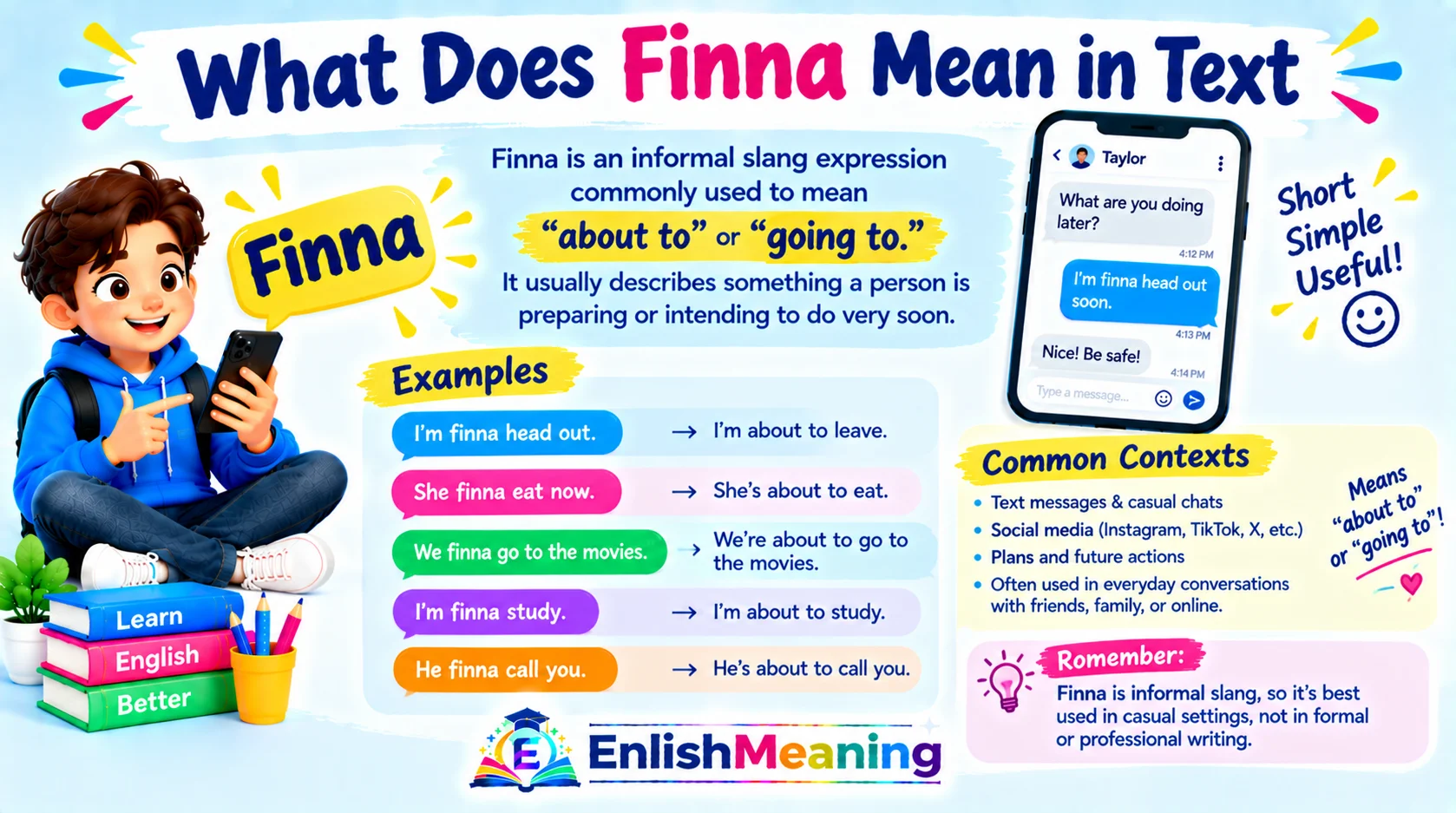
If you have seen “finna” in a text message, social media comment, song, or online conversation, you may wonder what it means. Finna is an informal slang expression commonly used to mean “about to” or “going to.” It usually describes something a person is preparing or intending to do very soon.
For example, if someone says, “I’m finna eat,” they generally mean, “I’m about to eat” or “I’m going to eat.” The expression is especially common in casual digital communication, including texting and social media.
People search for the meaning of finna because it may look unfamiliar if they have never encountered the expression before.
Its meaning can also depend slightly on the sentence and conversational context.
Understanding this slang can make online conversations easier to follow and help you recognize the informal style used by many English speakers.
Meaning & Definition Of Finna
Finna is an informal slang expression that generally means “about to,” “going to,” or “intending to do something soon.” It is normally followed by a verb.
For example:
- “I’m finna sleep.” → “I’m about to sleep.”
- “She finna leave.” → “She is about to leave.”
- “We finna watch a movie.” → “We are going to watch a movie.”
- “I’m finna call you.” → “I’m about to call you.”
The exact interpretation depends on the sentence, but the basic idea is an upcoming action or intention.
Unlike standard English expressions such as “I am going to,” finna is highly informal. It is generally associated with casual speech, texting, music, internet culture, and social media rather than formal writing.
It can sometimes communicate more than simple future intention. Depending on the context, it may suggest that an action is very close to happening. For instance, “I’m finna go” can sound like the speaker is getting ready to leave immediately.
The expression is usually written in lowercase, although capitalization can vary depending on the platform or the writer’s style.
Simple definition
Finna = about to / going to do something.
If someone texts:
“I’m finna eat.”
They are essentially saying:
“I’m about to eat.”
Therefore, when you encounter finna in a casual conversation, look at the verb that follows it. That usually makes its intended meaning clear.
Background
The expression finna developed within varieties of informal English and is strongly associated with African American English (AAE), although it is now widely recognized and used beyond that linguistic community. It is not simply a random internet abbreviation created for texting.
Finna is commonly understood as a shortened form related to “fixing to,” an expression used in some varieties of Southern American English to describe an action that is about to happen or is being planned. Over time, forms such as “fixing to” could be reduced in pronunciation, eventually producing forms like finna in certain speech communities.
This history is important because it shows that slang expressions can have genuine linguistic backgrounds. A word may look unusual in written English while still having a long history in spoken language.
The expression became increasingly visible through music, entertainment, online communities, memes, and social media. As internet communication became more informal, expressions from different speech communities spread more easily across geographic and cultural boundaries.
Today, finna can appear in tweets, captions, comments, text messages, lyrics, and casual conversations. However, its widespread recognition does not make it appropriate for every situation.
For example, saying:
- “I’m finna head home.”
can be perfectly natural in a casual conversation.
But in a formal report, academic assignment, business proposal, or professional email, a standard expression such as “I am going to head home” or “I am about to leave” would generally be more appropriate.
Understanding the background of the term also helps prevent the misconception that it is merely a misspelling. It represents a recognized informal linguistic form with a particular history and usage.
Usage in Different Contexts
The meaning of finna remains relatively consistent across informal contexts, but the way people use it can change depending on the platform and situation.
In casual chat
People commonly use finna when talking about something they are about to do.
Example:
“I’m finna make some coffee.”
Meaning:
“I’m about to make some coffee.”
It can make a message sound relaxed and conversational.
On social media
Finna frequently appears in captions, comments, jokes, memes, and short posts.
For example:
“Finna disappear for the weekend.”
This could mean:
“I’m about to disappear for the weekend.”
The phrase may also be used humorously or dramatically.
In entertainment and music
The expression can appear in lyrics, dialogue, and other forms of popular culture. In these settings, it often contributes to an informal or conversational tone.
In professional fields
Finna is generally not considered appropriate for formal professional communication. You may encounter it when employees communicate casually with friends or coworkers, but it would usually be avoided in official reports, business correspondence, academic writing, and formal presentations.
Instead of:
“I’m finna send the document.”
a professional message could say:
“I’m going to send the document.”
or:
“I’ll send the document shortly.”
The important point is that finna does not normally change the action itself; it changes the style of the sentence. It gives the statement a distinctly casual tone.
Meaning in Chat, WhatsApp, Instagram, and TikTok
On messaging and social media platforms, finna usually has the same basic meaning: “about to” or “going to.”
Finna in chat
If someone sends:
“Finna go to bed.”
they mean:
“I’m about to go to bed.”
The missing subject or informal grammar is common in casual messaging.
Finna on WhatsApp
A WhatsApp message might say:
“I’m finna leave now.”
This means:
“I’m about to leave now.”
The expression can make the message sound relaxed and natural between people who are comfortable with informal language.
Finna on Instagram
Instagram users may use the term in captions or comments.
For example:
“Finna post these pictures.”
This means:
“I’m about to post these pictures.”
Someone might also write:
“Finna have the best weekend.”
meaning:
“I’m going to have the best weekend.”
Finna on TikTok
TikTok uses a large amount of informal language, so finna can appear in captions, comments, spoken videos, and memes.
For example:
“Me finna spend all my money.”
The phrase may be humorous and could mean:
“Me about to spend all my money.”
The grammar may intentionally be informal because internet users often use slang for humor, personality, or emphasis.
The key is to consider the surrounding sentence. Whether you see the word on WhatsApp, Instagram, TikTok, or another platform, finna generally signals an upcoming action or intention.
Meaning in Physics, Medical, and Aircraft Terminology
When people search for finna, they may sometimes wonder whether it has a specialized meaning in technical fields such as physics, medicine, or aviation.
In ordinary English usage, finna is not a standard technical term in physics, medicine, or aircraft terminology. Its common meaning is slang related to an upcoming action.
In physics
There is no widely established standard physics definition of “finna” comparable to technical terms such as force, velocity, momentum, or acceleration. If you see the word in physics-related online content, it may simply be part of a casual sentence rather than a physics concept.
In medical contexts
Finna is not a standard medical abbreviation or diagnosis. Medical professionals generally use established terminology and abbreviations rather than slang expressions like this.
If you see “finna” in a medical discussion online, the surrounding sentence should be examined to determine whether it is simply being used informally.
In aircraft terminology
Finna is also not a commonly recognized standard aviation term. Aviation uses specialized vocabulary for aircraft operations, navigation, communication, safety, and procedures. A casual social-media post about flying might contain finna, but that does not give the word a technical aviation meaning.
This distinction is useful because many English expressions have different meanings in specialized fields. In the case of finna, however, its everyday slang meaning is much more relevant than any technical interpretation.
Common Misconceptions
Several misunderstandings can arise when people first encounter finna.
Misconception 1: Finna is simply a spelling mistake
It is not necessarily a mistake. Finna is an established informal linguistic form used in certain varieties of English and widely recognized in casual communication.
Misconception 2: Finna always means “want to”
Finna can communicate intention, but it most directly corresponds to ideas such as “about to” or “going to.”
For example:
“I’m finna eat.”
focuses on an upcoming action rather than simply expressing a desire to eat.
Misconception 3: It is appropriate in formal writing
Although widely understood, finna is still informal. Using it in an academic essay, formal business email, legal document, or professional report may make the writing sound unnecessarily casual.
Misconception 4: It always means something will happen immediately
Finna often suggests that an action is coming soon, but context matters. The expression can also communicate a general intention.
For example:
“I’m finna start exercising more.”
may describe an intention rather than something happening within the next few minutes.
Misconception 5: Everyone uses it in exactly the same way
Slang varies between communities, regions, generations, and online groups. Some people use finna frequently, while others may rarely or never use it.
Understanding the general meaning is useful, but the exact tone should always be interpreted from the conversation.
Similar Terms & Alternatives
Several English expressions can communicate a meaning similar to finna.
“About to”
This is one of the closest standard-English alternatives.
Finna leave.
→ About to leave.
It usually suggests that something will happen soon.
“Going to”
“Going to” can describe a future intention.
I’m finna call her.
→ I’m going to call her.
This is more standard and appropriate in a wider range of situations.
“Gonna”
“Gonna” is another informal form of “going to.”
I’m gonna eat.
It is informal but extremely common in everyday English.
“Planning to”
“Planning to” emphasizes intention rather than immediate action.
I’m planning to visit tomorrow.
“About to”
This often suggests greater immediacy.
I’m about to leave.
Quick comparison
| Expression | General meaning | Style |
|---|---|---|
| Finna | About to / going to | Very informal |
| About to | Something will happen soon | Standard |
| Going to | Future intention | Standard |
| Gonna | Going to | Informal |
| Planning to | Intending to do something | Standard |
Choosing between these expressions depends mainly on the situation and the tone you want to create.
How to Respond to “Finna”
You normally do not need a special response when someone uses finna. Simply understand it as an informal statement about what they intend to do or are about to do.
For example:
Person A: “I’m finna go grab some food.”
Person B: “Okay, what are you getting?”
Or:
Person A: “Finna watch a movie.”
Person B: “Which one?”
If someone says:
“I’m finna sleep.”
you could respond:
- “Okay, good night!”
- “Sleep well!”
- “Talk to you tomorrow.”
- “Alright, take care.”
The appropriate response depends on the conversation rather than the slang itself.
If you are unsure what the person means, you can ask naturally:
“You mean you’re about to do it?”
However, this is rarely necessary when the sentence is clear from context.
When chatting with someone who regularly uses informal slang, you can also use casual English yourself if it feels natural. There is no requirement to copy their language style.
Differences From Similar Words
Although finna, gonna, about to, and planning to can overlap, they are not always identical in tone or emphasis.
Finna is strongly informal and often sounds conversational. It can indicate an upcoming action or intention.
Gonna is an informal pronunciation/spelling of “going to” and is extremely common in everyday speech.
About to often emphasizes that something is expected to happen very soon.
Planning to focuses more strongly on intention and does not necessarily suggest immediate action.
Consider these examples:
“I’m finna leave.”
Casual statement about an upcoming departure.
“I’m gonna leave.”
Informal statement of future intention.
“I’m about to leave.”
Suggests departure is very near.
“I’m planning to leave tomorrow.”
Clearly describes a plan for the future.
Another important difference is formality. “About to,” “going to,” and “planning to” can be used in standard communication, while finna is generally better suited to informal contexts.
The surrounding conversation also matters. A person may choose finna intentionally to sound relaxed, humorous, expressive, or culturally familiar.
Relevance in Online Conversations & Dating Apps
Slang such as finna is particularly common in informal online communication because dating apps and social platforms often encourage short, conversational messages.
For example, someone might write:
“I’m finna grab coffee, wanna come?”
The meaning is:
“I’m about to grab coffee; do you want to come?”
On a dating app, the expression can make a message feel casual rather than formal.
Another example could be:
“I’m finna watch a movie tonight.”
A conversation partner might respond:
“Which movie?”
The slang itself does not necessarily communicate romantic interest. Its meaning is primarily about the person’s upcoming action or intention. Any romantic meaning comes from the broader conversation and relationship between the people involved.
For example:
“I’m finna call you later.”
generally means the person intends to call later. It does not automatically mean that the person is flirting.
Similarly:
“Finna go out tonight.”
simply communicates an upcoming plan.
When interpreting messages on dating apps, it is therefore important not to assign additional meaning to slang without considering the surrounding context. Tone, previous messages, punctuation, and the relationship between the speakers can all influence how a statement is understood.
Frequently Asked Questions
What does finna mean in text?
Finna is an informal slang term that generally means “going to” or “about to.” It is commonly used in casual texting and online conversations to describe something a person intends to do soon.
What does finna mean in texting?
In texting, finna usually indicates that someone is planning or preparing to do something. For example, “I’m finna eat” means “I’m about to eat” or “I’m going to eat.”
Is finna the same as gonna?
They can have similar meanings, but they are not exactly the same in every situation. Gonna is an informal form of “going to,” while finna commonly expresses an immediate intention or something someone is about to do.
What does finna mean on WhatsApp?
On WhatsApp, finna is generally used as casual slang meaning “about to” or “going to.” Its meaning is usually clear from the sentence around it.
What does finna mean on Instagram?
On Instagram, finna is commonly used in captions, comments, and direct messages to express an upcoming action or intention in an informal way.
What does finna mean on TikTok?
On TikTok, finna is frequently used in casual captions, comments, videos, and conversations. It generally means “about to” or “going to.”
What does finna mean from a girl?
If a girl uses finna in a text, it usually has the same basic meaning: “about to” or “going to.” The word itself does not indicate a particular romantic meaning.
What does finna mean from a guy?
When a guy says finna, he is generally expressing an intention to do something soon. For example, “I’m finna leave” means “I’m about to leave.”
Is finna slang?
Yes. Finna is an informal slang expression used mainly in casual speech, texting, social media, and online communication. It is generally not appropriate for formal writing.
Is finna a real word?
Finna is an established informal slang expression, although it is not normally used in formal standard English. It has a recognized history in varieties of English and is widely used in contemporary informal communication.
What does “I’m finna” mean?
“I’m finna” means that the speaker is about to do something or intends to do something soon. For example, “I’m finna go home” means “I’m about to go home.”
What does “finna do” mean?
“Finna do” means “about to do” or “going to do.” For example, “What you finna do?” means “What are you going to do?”
What does “What you finna do?” mean?
“What you finna do?” is an informal way of asking “What are you going to do?” or “What are you about to do?”
Can I use finna in formal writing?
It is generally better to avoid finna in formal writing such as academic assignments, professional reports, business emails, and official documents. More standard alternatives include “going to,” “about to,” or “planning to.”
What is another word for finna?
Depending on the sentence, alternatives include “going to,” “about to,” “planning to,” and “intending to.” The best alternative depends on whether the action is immediate or simply planned.
How should I respond when someone says finna?
You can respond naturally based on what the person says. For example, if someone says, “I’m finna eat,” you could reply, “What are you having?” or “Enjoy your meal!”
Does finna mean right now?
Not always. Finna often suggests that something is about to happen soon, but it does not necessarily mean the action is happening at that exact moment.
Is finna rude?
No. Finna is not inherently rude. It is simply an informal expression. Whether a message sounds rude depends on the complete sentence and the context.
Where does finna come from?
Finna developed within African American English and is related to earlier forms such as “fixing to,” an expression meaning preparing or intending to do something. It later became widely recognizable through music, social media, texting, and internet culture.
Conclusion
Finna is an informal slang expression that generally means “about to,” “going to,” or “intending to do something.”
It is commonly found in casual conversations, text messages, social media posts, memes, entertainment, and other forms of informal communication.
For example, “I’m finna eat” usually means “I’m about to eat.” The expression is associated with varieties of English that have influenced modern American slang and has become widely recognizable through everyday speech and popular online culture.
Although its meaning is straightforward, its tone is important. Finna is casual rather than formal, so expressions such as “going to,” “about to,” or “planning to” are generally more suitable for professional and academic writing.
When you encounter the word online, focus on the surrounding sentence. In most ordinary conversations, it simply indicates that someone is preparing or intending to do something.