
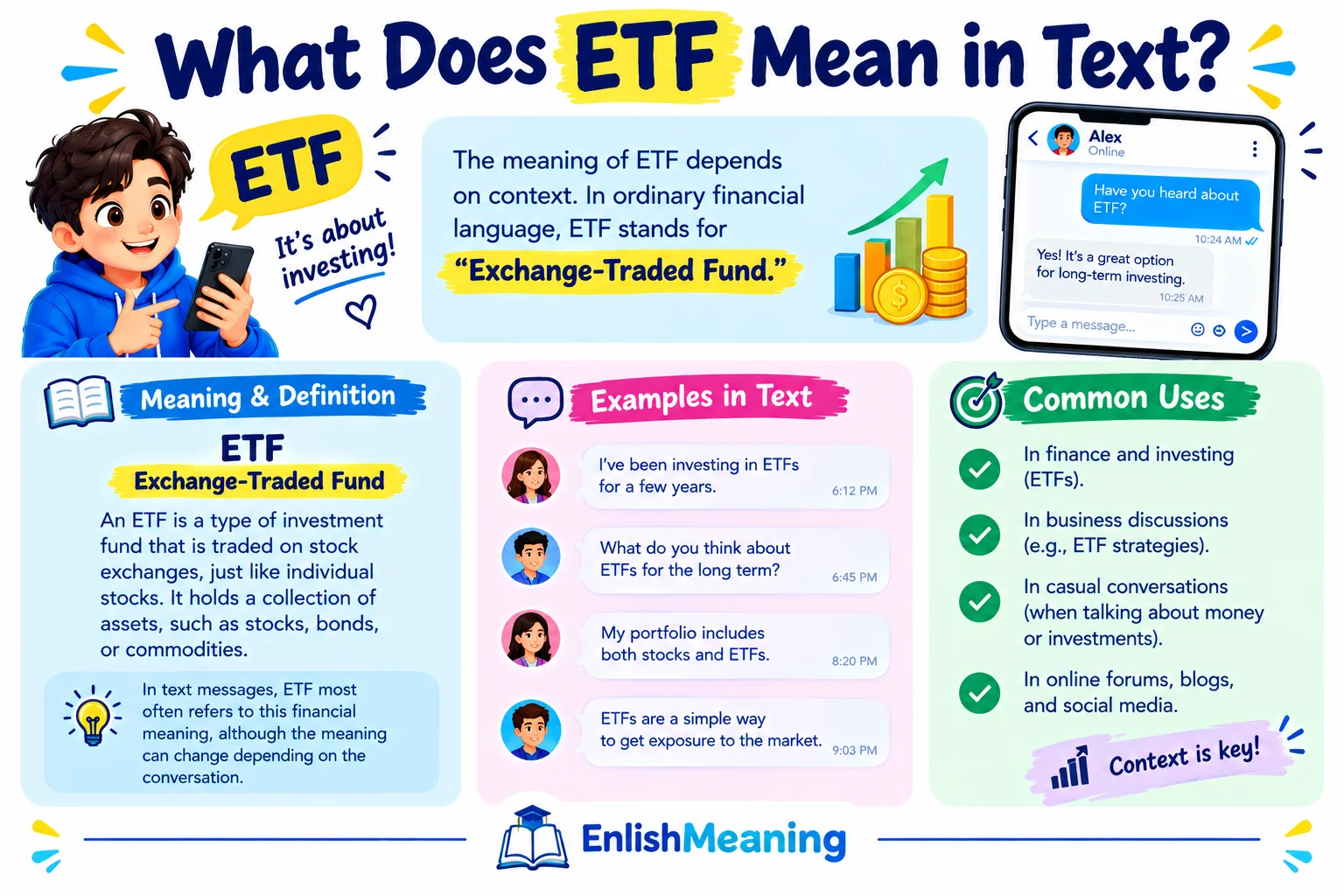
If someone sends you “ETF” in a message, social-media comment, or online conversation, you may wonder what the abbreviation means. The difficulty is that ETF does not have one universal meaning in texting.
Its interpretation depends heavily on the conversation, the people involved, and the subject being discussed.
In everyday financial discussions, ETF most commonly means Exchange-Traded Fund, a type of investment that can be bought and sold on a financial market.
However, when the same three letters appear in casual messaging, gaming, workplace communication, technical discussions, or social media, the intended meaning can be completely different.
People search for what does ETF mean in text because abbreviations can be confusing when there is little context.
A short message may contain initials that have several possible interpretations, and understanding the surrounding conversation is usually the best way to determine the intended one.
This guide explains the possible meanings of ETF, how the abbreviation can appear in different environments, how to respond when someone uses it, and how to avoid confusing it with similar abbreviations.
Meaning & Definition Of ETF
What does ETF mean in text?
The meaning of ETF depends on context. In ordinary financial language, ETF stands for Exchange-Traded Fund. An exchange-traded fund is an investment product that generally holds a collection of assets, such as stocks, bonds, commodities, or other investments, and whose shares can be traded on a market.
For example, someone discussing investments might write:
“I started investing in an ETF this month.”
Here, ETF almost certainly refers to an Exchange-Traded Fund.
However, a casual text containing “ETF” should not automatically be interpreted as a financial reference. Abbreviations often develop informal meanings within particular communities, workplaces, games, or conversations. In some contexts, people may use ETF as shorthand for a phrase specific to their group.
That is why the answer to what does ETF mean in text cannot always be reduced to a single definition.
ETF as an investment abbreviation
The financial meaning is by far the most established and recognizable meaning of ETF. Unlike a single company’s stock, an ETF can provide exposure to a group or category of assets through one traded investment.
You might encounter phrases such as:
- “stock ETF”
- “bond ETF”
- “index ETF”
- “commodity ETF”
- “international ETF”
In these examples, the abbreviation is clearly connected with investing or financial markets.
ETF in informal communication
When ETF appears in a personal message without financial context, you should consider the surrounding words before deciding what it means. The sender may be using an uncommon abbreviation, an industry-specific expression, or an abbreviation understood only within their social group.
Therefore, context is more important than simply memorizing one definition.
Background
Where did the abbreviation ETF come from?
The most widely recognized expansion of ETF is Exchange-Traded Fund. The term describes an investment fund whose shares are traded on an exchange, making the abbreviation particularly common in financial news, investing communities, business discussions, and personal-finance conversations.
As online communication became increasingly dependent on short forms, acronyms and abbreviations became common across many different communities. People use shortened expressions to save time, fit messages into limited spaces, or communicate concepts familiar to a particular group.
ETF is an interesting example because its most established meaning comes from finance rather than ordinary texting. Consequently, someone who encounters the abbreviation in a message may assume it has a slang definition when the sender is actually talking about investments.
Why can abbreviations have multiple meanings?
Language changes according to context. The same letters can represent completely different phrases in medicine, technology, aviation, business, education, or social media.
For example, an abbreviation used by an investment professional may be completely unfamiliar to someone discussing a personal matter. Similarly, an abbreviation used inside a gaming community may have no relevance outside that community.
This is why understanding what does ETF mean in text requires more than looking at the letters themselves. You should examine the sentence, the subject being discussed, and the relationship between the people communicating.
The importance of context
Consider two messages:
“This ETF has performed well.”
and
“Why did you send me ETF?”
The first clearly sounds financial. The second does not provide enough information to determine a specific meaning.
When an abbreviation is ambiguous, the safest approach is to ask the sender what they mean rather than confidently choosing an interpretation that may be incorrect.
Usage in Different Contexts
ETF in casual chat
In ordinary conversations, ETF may appear when people are discussing money, savings, investments, markets, or financial goals. In that situation, the Exchange-Traded Fund definition is usually the most logical interpretation.
For example:
“I’m comparing different ETFs before investing.”
The subject of the conversation provides the necessary clue.
In contrast, if two friends are talking about travel, relationships, food, or entertainment and one suddenly writes “ETF,” there may not be enough information to determine what they intended.
ETF on social media
On platforms such as Instagram, TikTok, Facebook, X, and Reddit, ETF may occur in posts or comments about investing. Financial creators frequently use abbreviations because their audiences are familiar with investment terminology.
A finance-related post might contain phrases such as “ETF portfolio,” “ETF investing,” or “ETF strategy.” In those situations, the meaning is straightforward.
However, social-media communities can also create their own shorthand. A creator or group may use ETF differently, so readers should consider the specific community before assuming the standard financial meaning.
ETF in professional communication
The subject of the conversation provides the necessary clue.
In finance, ETF almost certainly refers to Exchange-Traded Fund when discussing investment products. In another profession, however, the same letters may have an entirely different technical interpretation.
Professional messages usually provide additional context:
“The ETF has a lower expense ratio.”
or
“Our portfolio includes several ETFs.”
These statements strongly indicate the investment meaning.
ETF in workplace messaging
A finance-related post might contain phrases such as “ETF portfolio,” “ETF investing,” or “ETF strategy.” In those situations, the meaning is straightforward.
If the topic is unrelated to finance, it is reasonable to ask for clarification.
Meaning in Chat, WhatsApp, Instagram, and TikTok
ETF in text messages
There is no single universally accepted texting definition of ETF comparable to extremely common abbreviations such as LOL, BRB, or IDK.
Therefore, if someone sends:
“ETF?”
you should not automatically assume that it has one fixed slang meaning.
The sender may be referring to an Exchange-Traded Fund, using a specialized abbreviation, or relying on a meaning that has already been established in your conversation.
ETF on WhatsApp
WhatsApp conversations frequently mix formal language, slang, abbreviations, and regional expressions. ETF could therefore mean different things to different users.
If the chat concerns money or investing, the financial definition is highly likely. If the conversation is personal or unrelated to finance, additional context is necessary.
A simple response such as:
“What do you mean by ETF?”
is often the clearest solution.
ETF on Instagram
Instagram users may encounter ETF in captions, comments, reels, or direct messages. Finance-focused accounts commonly use ETF to discuss investment funds.
For example:
“Here are three ETFs beginners should research.”
The subject makes the meaning obvious.
A comment containing only “ETF” may be more difficult to interpret because social-media comments often lack enough context.
ETF on TikTok
TikTok has many specialized communities, including personal finance and investing. Within those communities, ETF almost always refers to an Exchange-Traded Fund when the discussion concerns investments.
Outside finance-related content, however, the meaning may be less obvious. TikTok users also create temporary slang and community-specific abbreviations, so the surrounding video, caption, and comments can provide useful clues.
Meaning in Physics, Medical, and Aircraft Terminology
ETF in physics
ETF is not a single universally standardized physics abbreviation. Its meaning can depend on the specific subfield, publication, institution, or technical context.
This is important because technical abbreviations are often created for specialized concepts. A physicist may understand an abbreviation from a particular research area that would be unfamiliar to the general public.
Therefore, if ETF appears in a physics paper, lecture, laboratory document, or technical discussion, it should be interpreted from the terminology surrounding it rather than automatically translated into the financial meaning.
ETF in medical terminology
Medical abbreviations require particular caution because the same abbreviation can have different meanings in different medical settings.
ETF is not a universally fixed medical texting abbreviation. If you encounter it in medical notes, research, hospital communication, or health-related documentation, the surrounding terminology and the source’s abbreviation list should be checked.
A person should not rely on an internet-style abbreviation interpretation when understanding important medical information. If the abbreviation occurs in a patient’s medical documentation, asking the relevant healthcare professional is the safest approach.
ETF in aircraft and aviation terminology
Aviation also uses a large number of specialized abbreviations. ETF may occur in technical, operational, maintenance, or engineering material depending on the organization and context.
There is not one universal aviation definition of ETF that should automatically replace all other meanings. The exact document, aircraft system, manual, or operational context matters.
This illustrates an important principle: an abbreviation can be standard within one field without being universally standard everywhere.
Why technical context matters
When ETF appears in a specialized field, identify:
- The subject of the document.
- The sentence surrounding the abbreviation.
- Any glossary or abbreviation list.
- The industry or profession involved.
- Whether the abbreviation is defined earlier in the document.
These clues can usually reveal the intended meaning much more reliably than guessing.
Common Misconceptions
Misconception 1: ETF always means one thing
The biggest misunderstanding is assuming that every occurrence of ETF has exactly the same definition.
The most established meaning is Exchange-Traded Fund, but abbreviations can be reused across different industries and communities.
Misconception 2: ETF is always texting slang
ETF is not necessarily internet slang. In financial discussions, it is a standard abbreviation for a recognized investment product.
Therefore, seeing ETF in a message does not automatically mean that the sender is using modern texting slang.
Misconception 3: Context does not matter
Context is extremely important. If someone says, “I bought an ETF,” the investment meaning is obvious. If they simply type “ETF” in an unrelated conversation, guessing becomes much less reliable.
Misconception 4: Every abbreviation has a dictionary-style answer
Some abbreviations have several legitimate interpretations. Their meanings can change according to industry, country, organization, online community, or conversation.
That is why searching for what does ETF mean in text may produce different answers depending on the context being considered.
Misconception 5: You should pretend to understand
If you do not know what the sender means, asking is better than guessing.
A short clarification can prevent an unnecessary misunderstanding:
“Do you mean Exchange-Traded Fund?”
or:
“What does ETF mean here?”
Similar Terms & Alternatives
ETF vs. stock
An ETF and an individual stock are not identical. A stock generally represents ownership in a particular company, whereas an ETF can provide exposure to a collection of assets.
Someone discussing both may say:
“I own stocks and ETFs.”
Here, the distinction is clear.
ETF vs. mutual fund
ETFs and mutual funds are both types of pooled investment products, but they have different structures and trading characteristics.
The term ETF specifically identifies an Exchange-Traded Fund, while a mutual fund is a different investment structure.
ETF vs. index fund
An index fund is designed to track a particular market index. An ETF can also track an index, but not every ETF is simply interchangeable with the general term “index fund.”
This distinction becomes important when discussing personal finance.
ETF vs. acronym and abbreviation
An acronym or abbreviation is a shortened form of a longer expression. ETF is an abbreviation formed from Exchange-Traded Fund.
In everyday communication, people often use “acronym” and “abbreviation” interchangeably, although technically they can describe different linguistic structures.
Other possible meanings
If ETF appears outside finance, it may represent a specialized phrase specific to an organization or technical field. Such interpretations should be verified from the relevant context instead of treated as universal texting definitions.
How to Respond to ETF
When ETF clearly means Exchange-Traded Fund
If someone writes:
“Do you invest in ETFs?”
you can respond directly:
“Yes, I’m interested in learning more about them.”
or:
“Not yet. I’m still researching different investment options.”
The appropriate response depends on the conversation.
When you are unsure
If the meaning is unclear, the best response is simple:
“What do you mean by ETF?”
You can also ask:
“Do you mean Exchange-Traded Fund?”
This is especially useful when the conversation contains no financial context.
When someone uses ETF in a professional conversation
Avoid assuming that every professional use refers to investing. If your colleague works in another specialized field, ask for clarification if necessary.
When responding on social media
If ETF appears in a finance-related comment, you can usually interpret it as Exchange-Traded Fund. If the comment is unrelated to finance, check the surrounding discussion before replying.
The goal is not to memorize every possible abbreviation but to understand how context determines meaning.
Differences From Similar Words
ETF vs. EFT
One of the easiest mistakes is confusing ETF with EFT.
ETF commonly means Exchange-Traded Fund in finance.
EFT commonly means Electronic Funds Transfer, referring to electronically moving money from one account or financial institution to another.
Although the letters look similar, their meanings are different.
ETF vs. FTF
FTF is often used to mean face-to-face in informal communication. It is therefore very different from ETF.
For example:
“Can we meet FTF?”
means that the person wants to meet in person.
ETF vs. FYI
FYI means for your information. It is frequently used in workplace and casual messages.
ETF does not normally carry that meaning.
ETF vs. ETA
ETA is commonly used for estimated time of arrival.
For example:
“What’s your ETA?”
asks when someone expects to arrive.
ETF should not automatically be interpreted as ETA or another familiar abbreviation simply because the letters look similar.
Why these distinctions matter
A single letter can completely change an abbreviation’s meaning. When reading fast-moving online conversations, carefully checking the exact letters can prevent confusion.
Relevance in Online Conversations & Dating Apps
ETF in online conversations
Online communication encourages short forms because people often want to communicate quickly. Abbreviations are especially common in comments, direct messages, group chats, gaming communities, and professional messaging platforms.
ETF may appear naturally when people discuss finance:
“I’m looking at ETFs for my portfolio.”
But if the discussion is about relationships, entertainment, travel, or everyday life, there may be no obvious meaning.
ETF in dating apps
Dating apps contain highly informal conversations, so abbreviations can be especially confusing. If someone sends “ETF” without explanation, you should not assume that it has a universal dating-related definition.
The best approach is to consider the conversation.
For example, if the person has just mentioned investing, money, savings, or financial goals, ETF probably refers to an Exchange-Traded Fund.
If the conversation has nothing to do with finance, ask what they mean.
Why clarification is useful
Dating conversations depend heavily on tone and interpretation. Misunderstanding an abbreviation can make a response appear strange or irrelevant.
Instead of guessing, you can keep the conversation natural:
“Wait, what does ETF mean here? 😄”
This sounds friendly while giving the other person an opportunity to explain.
ETF and online communities
Different online communities can develop their own vocabulary. A term may be common inside a particular group but unfamiliar outside it.
Therefore, the safest rule is:
Context first, abbreviation second.
Frequently Asked Questions
What does ETF mean in text?
ETF most commonly means Exchange-Traded Fund, especially when the conversation involves investing or financial markets. In other contexts, its meaning may vary.
Is ETF a texting slang term?
Not necessarily. ETF is primarily a well-established abbreviation for Exchange-Traded Fund. Other meanings may exist in specialized or community-specific conversations.
What does ETF mean on WhatsApp?
On WhatsApp, ETF can mean Exchange-Traded Fund if the discussion concerns money or investing. If the topic is unrelated, ask the sender for clarification.
What does ETF mean on Instagram?
On Instagram, ETF commonly refers to Exchange-Traded Fund in finance-related posts, reels, and comments. The exact meaning depends on the content and surrounding conversation.
Is ETF the same as EFT?
No. ETF usually means Exchange-Traded Fund, while EFT commonly means Electronic Funds Transfer. They describe different concepts.
How should I respond when someone says ETF?
If the meaning is unclear, simply ask, “What do you mean by ETF?” If the conversation is clearly about investing, you can interpret ETF as Exchange-Traded Fund and respond accordingly.
Conclusion
Understanding what does ETF mean in text requires attention to context. The most widely recognized meaning of ETF is Exchange-Traded Fund, particularly in conversations about investing, financial markets, portfolios, and personal finance.
However, the abbreviation can appear in specialized environments where its meaning may be different.
In WhatsApp messages, Instagram comments, TikTok discussions, workplace chats, and dating-app conversations, the surrounding words are often the most useful clue.
If the subject is financial, ETF is very likely referring to an Exchange-Traded Fund. If there is no financial context, it is better not to assume that one interpretation is automatically correct.
ETF can also appear in technical, medical, physics, or aviation-related material, where specialized terminology may determine its meaning.
When an abbreviation is unclear, asking the sender or checking the relevant glossary is the most reliable approach.
Ultimately, abbreviations are shortcuts, not complete explanations. Understanding the conversation around ETF will help you interpret it accurately and respond naturally.