
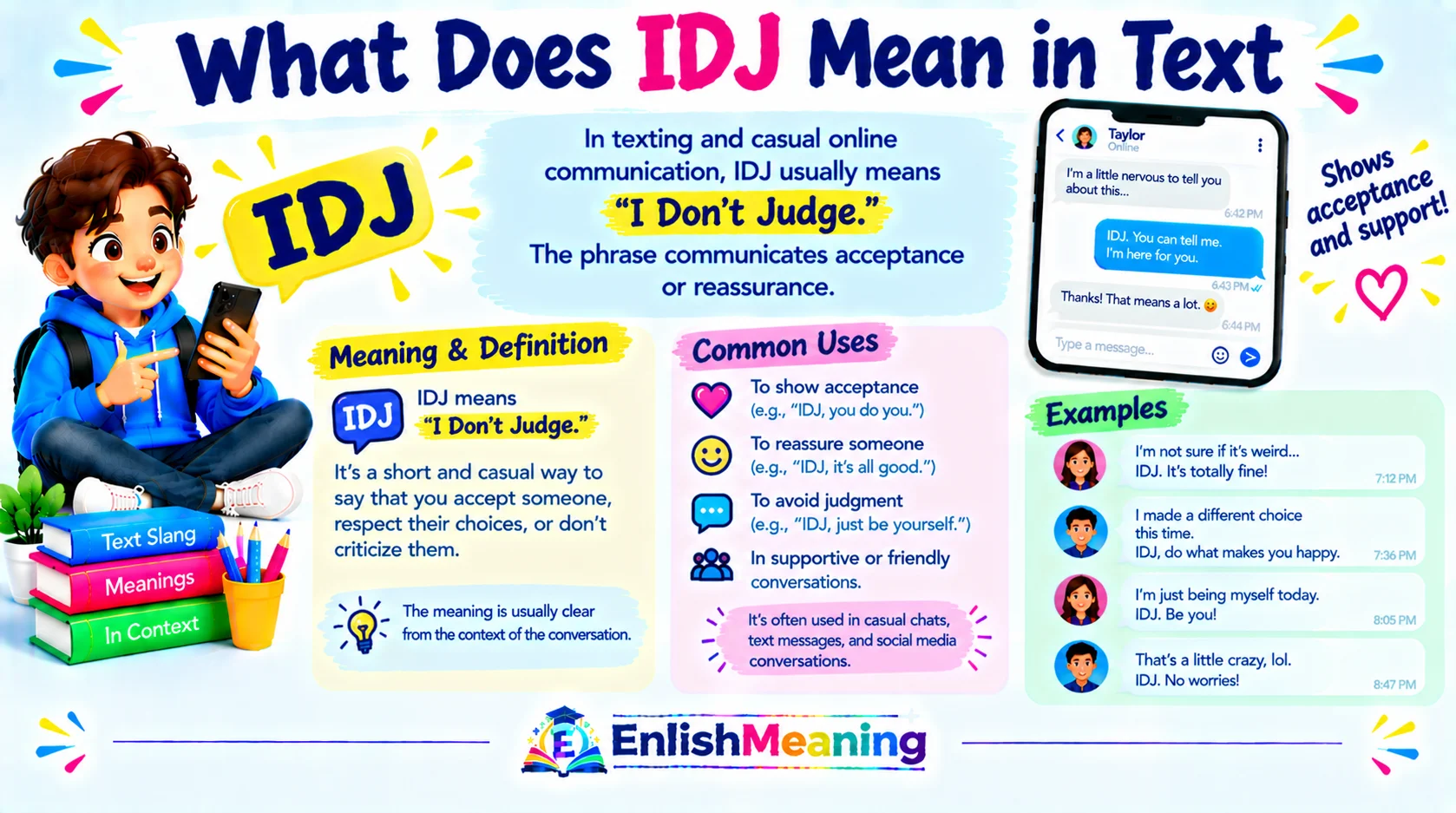
If you have received a message containing “IDJ”, you may wonder what the abbreviation means and why someone chose to use it instead of writing the full phrase. In casual texting, IDJ commonly means “I Don’t Judge.”
It is used to reassure someone that their opinion, choice, behavior, or personal situation will not be criticized by the person responding.
People often search for the meaning of IDJ because internet slang can change depending on the conversation, platform, or group of people using it.
Unlike standard English words, abbreviations may have several interpretations, so understanding the surrounding message is important.
IDJ is especially useful in informal conversations where people discuss personal preferences, relationships, embarrassing experiences, or unusual opinions.
Learning its meaning can make online communication easier and help you understand the tone behind a short message.
This article explains what IDJ means, where it is used, how to respond to it, and how it differs from similar expressions.
Meaning & Definition Of IDJ
In texting and casual online communication, IDJ usually means “I Don’t Judge.” The phrase communicates acceptance or reassurance. When someone says “IDJ,” they are generally telling another person that they are not going to criticize them for what they have shared.
For example:
“I sometimes watch really old movies. IDJ.”
Here, the speaker is essentially saying, “I don’t judge you for that.”
The abbreviation can also appear as part of a longer sentence:
“IDJ, everyone has different interests.”
In this context, the person is expressing an accepting attitude toward another person’s preference.
The exact emotional meaning depends on the conversation. Sometimes IDJ is genuinely supportive, while in other situations it may be playful or humorous. Friends might use it after someone admits something unusual, embarrassing, or unexpected.
Simple definition
IDJ = I Don’t Judge
It is primarily an informal abbreviation and is more appropriate for casual digital communication than formal writing.
Because text abbreviations are often created for convenience, capitalization can vary. You might see IDJ, idj, or occasionally the abbreviation mixed into a sentence. The meaning generally remains the same when the surrounding context indicates acceptance.
Understanding the phrase also requires paying attention to punctuation and tone. “IDJ 😂” may sound playful, while “IDJ, honestly” may sound more sincere and reassuring.
Background
The expression “I don’t judge” has been used in everyday English for a long time. People commonly say it when someone reveals a personal preference, habit, decision, or experience that might normally invite criticism.
As texting and instant messaging became more popular, users began shortening frequently used expressions. Abbreviations save time and allow people to communicate quickly, particularly on platforms where short messages are common.
IDJ follows this general pattern. Rather than typing “I don’t judge,” a person can simply write three letters. The abbreviation is particularly convenient when the intended audience already understands common internet slang.
Unlike some abbreviations that have one universally recognized definition, IDJ can occasionally have other meanings in specialized environments. Therefore, context remains important.
For example, a conversation between two friends may make the meaning immediately obvious:
Friend: “I still sleep with my childhood blanket.”
You: “IDJ 😂”
The response means that the speaker accepts the friend’s habit and is not criticizing them.
However, abbreviations can develop different meanings in particular communities. Someone unfamiliar with texting slang might interpret IDJ differently, especially if the conversation involves a technical subject.
The growth of social media has also contributed to the spread of short expressions like IDJ. People frequently communicate using abbreviations, emojis, shortened words, and informal phrases. As a result, understanding common digital language has become useful for interpreting messages accurately.
Usage in Different Contexts
In casual chat
IDJ is most naturally used between friends, family members, classmates, or other people having informal conversations. It can indicate acceptance after someone shares something personal.
Example:
“I don’t like going to parties.”
“IDJ. I’m more of a homebody too.”
On social media
People may use IDJ in comments, direct messages, captions, or replies. It can be used humorously or sincerely depending on the post.
Example:
“I eat breakfast food for dinner all the time.”
“IDJ 😂”
In relationships
Someone may use IDJ to make a partner or potential partner feel comfortable discussing personal preferences.
Example:
“I have a strange obsession with collecting old books.”
“IDJ. I actually think that’s interesting.”
In professional fields
IDJ is generally not appropriate for formal professional communication. Emails, business reports, applications, academic assignments, and official documents should normally use complete phrases rather than casual texting abbreviations.
For instance, instead of writing:
“IDJ your decision.”
a professional message could say:
“I respect your decision and do not intend to judge it.”
The difference is mainly one of tone and setting. IDJ belongs primarily to informal digital communication.
Meaning in Chat, WhatsApp, Instagram, and TikTok
The meaning of IDJ generally remains “I Don’t Judge” across casual social platforms, including messaging and social-media conversations.
IDJ in chat
In ordinary texting, IDJ is usually used to reassure another person.
“You still play that old game?”
“Yeah.”
“IDJ.”
The response indicates that the speaker is not criticizing the person’s interest.
IDJ on WhatsApp
WhatsApp conversations are often informal, so abbreviations such as IDJ can appear naturally in private chats and group messages.
“I ordered pizza again tonight.”
“IDJ, pizza is always a good choice.”
IDJ on Instagram
On Instagram, IDJ may appear in comments or direct messages. Its tone can be supportive, teasing, or friendly depending on the context.
“Everyone thinks my music taste is weird.”
“IDJ. Listen to whatever you enjoy.”
IDJ on TikTok
TikTok conversations often involve humor and personal preferences. Someone may comment “IDJ” after a creator or another user shares an unusual opinion or behavior.
Because TikTok language can be highly trend-driven, context should always be considered before assuming that an abbreviation has only one meaning.
Meaning in Physics, Medical, and Aircraft Terminology
IDJ is primarily recognized as an informal texting abbreviation, but users sometimes encounter the same letters in technical material and wonder whether they have a specialized meaning.
Physics
In physics, IDJ is not a standard, universally recognized abbreviation that carries the ordinary texting meaning “I Don’t Judge.” Technical abbreviations can vary between textbooks, research papers, equations, laboratories, and specialized fields.
If IDJ appears in a physics document, its meaning should be determined from the surrounding definitions or notation rather than assumed to be internet slang.
Medical terminology
In medical settings, abbreviations can be highly specialized. IDJ is not generally understood in ordinary texting as a standard medical abbreviation. If the letters appear in medical notes, research, or clinical documentation, the surrounding terminology should be checked carefully.
Medical abbreviations can be institution-specific, so guessing their meaning can create confusion.
Aircraft and aviation terminology
Aviation also uses numerous standardized codes and abbreviations. IDJ may potentially appear as part of a particular identifier, document, system, or organizational terminology, but that does not change its normal texting meaning.
Therefore, if you see IDJ in a casual message, “I Don’t Judge” is the relevant interpretation. If you see the same letters in a technical aviation document, use the document’s specific context to determine what they represent.
Common Misconceptions
One common misconception is that IDJ always has exactly the same meaning everywhere. In casual texting, “I Don’t Judge” is a common interpretation, but abbreviations can have different meanings in specialized communities.
Another misconception is that IDJ always communicates serious emotional support. Sometimes people use it jokingly. For example:
“I put ketchup on almost everything.”
“IDJ 😂”
The speaker may genuinely be accepting the preference, but the laughing emoji suggests a playful tone.
A third misconception is that IDJ is suitable for every type of communication. It is generally informal. Using it in a formal business email, academic paper, or official communication may make the message sound unnecessarily casual.
It is also important not to assume that IDJ automatically means approval. Saying “I don’t judge” can mean that someone accepts your right to make your own choice without necessarily agreeing with that choice.
For example:
“I don’t like your decision, but IDJ.”
In this case, the person may be separating acceptance from agreement.
Finally, context matters. If the conversation does not clearly involve judgment, preference, or personal behavior, another interpretation may be possible.
Similar Terms & Alternatives
Several expressions can communicate an idea similar to IDJ.
“No judgment”
This is perhaps the closest alternative. It tells someone that they can share something without expecting criticism.
“No judgment, but why did you do that?”
“I won’t judge”
This has almost exactly the same meaning as IDJ but uses the complete phrase.
“It’s okay”
This can reassure someone, although it does not specifically mention judgment.
“I understand”
This indicates empathy or recognition rather than directly promising not to judge.
“Do what makes you happy”
This communicates acceptance of someone’s personal choice.
“Fair enough”
This can indicate that the speaker accepts another person’s viewpoint, although it may not necessarily communicate emotional support.
The best alternative depends on the situation. IDJ is short and casual, while phrases such as “I understand” or “I respect your choice” can sound more thoughtful and explicit.
How to Respond to IDJ
Your response depends on why the other person used IDJ.
If they are reassuring you after you shared something personal, you can simply say:
“Thanks, I appreciate that.”
If the conversation is playful, you can respond humorously:
“Good, because I have more weird opinions 😂”
This communicates acceptance of someone’s personal choice.
“Thanks! What do you think about it?”
In casual texting, TP can sometimes refer to “toilet paper,” “talking points,” or another phrase understood from the surrounding context. A simple acknowledgment can keep the conversation natural.
For example:
IDJ on WhatsApp
WhatsApp conversations are often informal, so abbreviations such as IDJ can appear naturally in private chats and group messages.
“I ordered pizza again tonight.”
“IDJ, pizza is always a good choice.”
In dating conversations, a warmer response might be:
“I appreciate that. I feel comfortable being honest with you.”
The important thing is to consider the tone. An IDJ accompanied by laughing emojis may invite a playful response, while a serious conversation may call for a more sincere answer.
Differences From Similar Words
IDJ is sometimes confused with other short expressions because several abbreviations can communicate acceptance or understanding.
| Expression | Meaning | Typical tone |
|---|---|---|
| IDJ | I Don’t Judge | Casual, accepting |
| IDC | I Don’t Care | Indifferent or dismissive |
| IDK | I Don’t Know | Uncertain |
| IMO | In My Opinion | Opinion-based |
| IKR | I Know, Right? | Agreement |
| NBD | No Big Deal | Reassuring or casual |
The difference between IDJ and IDC is especially important.
If someone says “IDC,” they usually mean that something does not matter to them. If someone says “IDJ,” they are specifically communicating that they are not criticizing or condemning someone.
For example:
“I like watching reality shows.”
“IDJ.”
This means the person is not judging that preference.
By contrast:
“I like watching reality shows.”
“IDC.”
This suggests that the speaker simply does not care about the subject.
Thus, replacing IDJ with IDC can change the emotional tone of the conversation significantly.
Relevance in Online Conversations & Dating Apps
IDJ can be particularly useful in online conversations because people often share personal information with people they have never met in person. A short phrase such as “I Don’t Judge” can make a conversation feel more relaxed.
On dating apps, people may discuss hobbies, lifestyle choices, unusual interests, past experiences, or personal preferences. Someone might use IDJ to signal that they are comfortable hearing something outside their own preferences.
For example:
“I know this is unusual, but I collect vintage toys.”
“IDJ. That’s actually pretty cool.”
Here, IDJ helps create an accepting conversational atmosphere.
However, users should not automatically interpret IDJ as a sign of romantic interest. The phrase primarily communicates acceptance or lack of judgment. Its meaning does not by itself indicate attraction, commitment, or emotional intimacy.
Tone also matters. A person who writes “IDJ 😂” may be joking, while “IDJ, you can tell me anything” carries a more supportive tone.
When communicating online, it is therefore useful to consider the complete message, previous conversation, punctuation, emojis, and relationship between the people involved.
Frequently Asked Questions
What does IDJ mean in text?
In texting, IDJ commonly means “I Don’t Judge.” It is used to reassure someone that the sender is not judging them for their opinion, behavior, choice, or situation.
What does IDJ mean in texting slang?
IDJ is an informal texting abbreviation for “I Don’t Judge.” It is mainly used in casual conversations, chats, and social media messages.
What does IDJ mean on WhatsApp?
On WhatsApp, IDJ can mean “I Don’t Judge.” Someone may use it after discussing a personal choice or opinion to show that they are being accepting rather than critical.
What does IDJ mean on Instagram?
On Instagram, IDJ may be used to mean “I Don’t Judge,” particularly in direct messages or comments. The exact meaning can depend on the surrounding conversation.
What does IDJ mean on TikTok?
On TikTok, IDJ can be used as casual internet slang meaning “I Don’t Judge.” It may appear in comments, captions, or private messages.
What does IDJ mean from a girl?
If a girl texts IDJ, she may be saying “I Don’t Judge” to reassure you that she accepts your opinion, decision, or situation without criticizing you.
What does IDJ mean from a guy?
If a guy uses IDJ, it can mean “I Don’t Judge.” He may be telling you that he is not criticizing you or your choices.
Is IDJ a slang word?
Yes. IDJ is an informal texting abbreviation, rather than a standard word. It is generally used in casual digital communication.
Is IDJ the same as “I don’t care”?
No. IDJ does not normally mean “I don’t care.” “I Don’t Judge” communicates acceptance or a lack of criticism, while “I don’t care” expresses indifference.
What does IDJ mean in a relationship?
In a relationship or personal conversation, IDJ can mean “I Don’t Judge.” It may be used to make someone feel comfortable sharing their thoughts, experiences, or choices.
What does IDJ mean in a conversation?
During a conversation, IDJ usually means “I Don’t Judge.” It can be used after someone shares something personal, unusual, or potentially controversial.
How should I respond to IDJ in a text?
If someone says IDJ, you can continue the conversation normally. You might reply with “Thanks, I appreciate that” or explain more about what you were discussing.
Can IDJ have other meanings?
Yes. Like many abbreviations, IDJ can have different meanings in specialized contexts. However, in casual texting, “I Don’t Judge” is a common interpretation when the surrounding conversation supports it.
Is IDJ used in professional messages?
IDJ is generally not recommended for formal professional communication. In emails, reports, and workplace messages, writing “I don’t judge” in full is clearer when that meaning is actually intended.
What is the difference between IDJ and IDC?
IDJ means “I Don’t Judge,” while IDC commonly means “I Don’t Care.” IDJ communicates non-judgment or acceptance, whereas IDC generally communicates that something does not matter to the sender.
Conclusion
IDJ in text usually means “I Don’t Judge.” It is an informal abbreviation used to express acceptance and reassure someone that their choices, opinions, habits, or personal information will not be criticized.
The expression is especially common in casual chats and social-media conversations where short forms are convenient. It can appear in messages, comments, group conversations, and dating-app chats.
Although its basic meaning generally remains the same, the tone can range from sincere and supportive to playful or humorous.
IDJ should not normally be confused with “IDC,” because the two expressions communicate different ideas. IDJ focuses on avoiding judgment, while IDC generally communicates indifference.
As with many internet abbreviations, context is important. If the letters appear in a technical field such as medicine, physics, or aviation, their meaning may be different and should be determined from the relevant context. In everyday texting, however, “I Don’t Judge” is the most useful interpretation.