If you have received a message containing “IDK”, you may have wondered what the abbreviation means and how you should understand it in the conversation. In texting and online communication, IDK means “I don’t know.”
It is one of the most common informal abbreviations used when someone is unsure about something, does not have an answer, or simply does not want to give a definite response.
People frequently use IDK in text messages, WhatsApp conversations, social media comments, Instagram DMs, TikTok messages, and other casual online interactions.
Because it is short and easy to type, it has become a convenient alternative to writing the complete phrase.
The exact tone of IDK depends on the surrounding conversation. It can express genuine uncertainty, confusion, hesitation, indifference, or sometimes mild annoyance.
Understanding the context is therefore important when interpreting it, particularly in conversations between friends, romantic partners, or people who are getting to know each other.
Meaning & Definition Of IDK
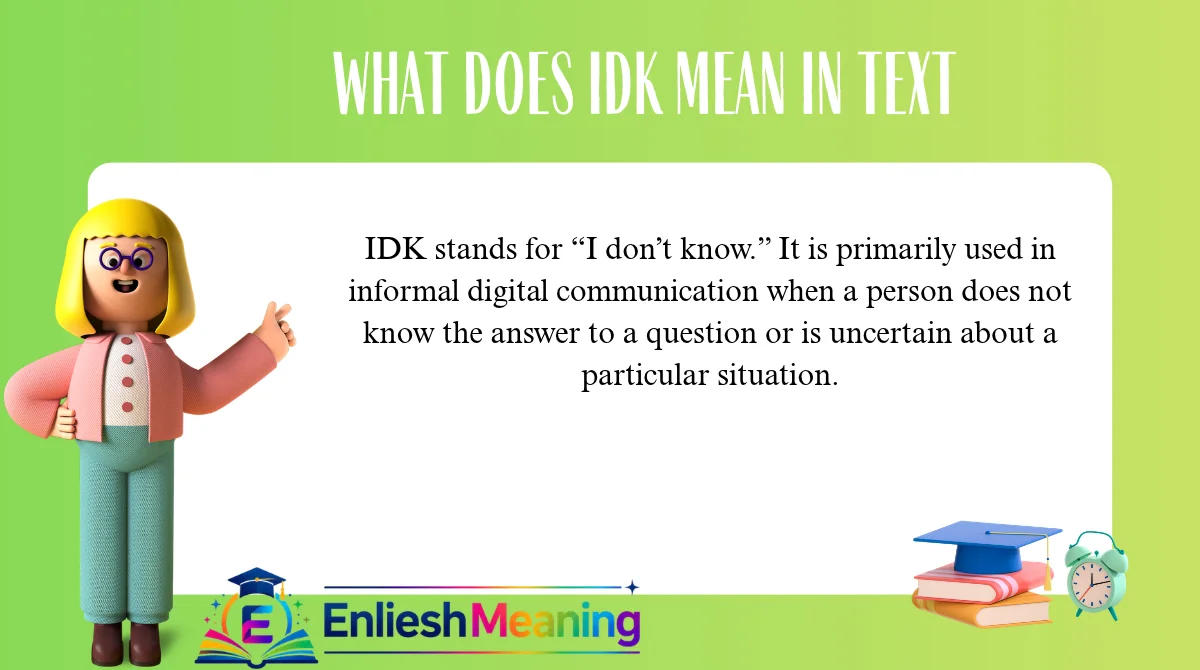
IDK stands for “I don’t know.” It is primarily used in informal digital communication when a person does not know the answer to a question or is uncertain about a particular situation.
For example:
- “What time is the party?” — “IDK.”
- “Are they coming tonight?” — “IDK, maybe.”
- “Why did he leave?” — “IDK.”
- “What should we watch?” — “IDK, you choose.”
In each example, the abbreviation communicates uncertainty or a lack of information.
However, IDK does not always mean that the sender literally has no knowledge of the subject. Sometimes people use it as a casual conversational expression. Someone might say “IDK what to eat” even when they have several choices in mind but cannot decide.
The meaning can also depend on punctuation and accompanying words. “IDK.” may sound more abrupt than “idk lol” or “idk, maybe.” Similarly, “IDKKK” can be a playful or exaggerated version used to emphasize uncertainty.
Capitalization generally does not change the meaning. People may write IDK, idk, or Idk depending on their typing habits.
In most everyday situations, there is no complicated interpretation: IDK simply means “I don’t know.” The surrounding message determines whether it sounds neutral, casual, uncertain, playful, or dismissive.
Background
IDK developed as part of the broader culture of internet and mobile messaging. As online conversations became faster and more informal, people began shortening frequently used phrases into compact abbreviations.
The phrase “I don’t know” is naturally suited to abbreviation because it contains three common words. Taking the first letter of each word produces IDK. Similar patterns can be seen in abbreviations such as IMO (“in my opinion”), TBH (“to be honest”), and BTW (“by the way”).
The popularity of IDK grew alongside instant messaging, texting, online forums, social networks, and mobile phones. Rather than typing a complete sentence, users could communicate the same basic idea with three letters.
Today, IDK is familiar to many internet users and is not limited to one particular platform. It can appear in private messages, group chats, comments, captions, gaming conversations, and casual discussions.
Another reason the abbreviation remains popular is that it can communicate more than simple lack of knowledge. For example, someone might respond:
“IDK 😭”
This could suggest that the person genuinely does not know while also expressing frustration or confusion.
Likewise:
“idk tbh”
means approximately “I don’t know, to be honest.”
The abbreviation has therefore become more flexible than its literal expansion. Although its fundamental meaning remains “I don’t know,” its emotional tone is shaped by context, punctuation, emojis, and the rest of the message.
Usage in Different Contexts
The meaning of IDK remains relatively consistent across different forms of communication, but its tone can change depending on the situation.
In Casual Chats
Friends commonly use IDK when discussing plans, opinions, people, entertainment, or everyday situations.
Example:
“Are you going out tonight?”
“IDK yet.”
Here, the person simply has not decided.
On Social Media
IDK can appear in comments, direct messages, posts, and replies.
Example:
“IDK why this video is so funny 😂”
In this case, the person is not necessarily asking for an answer. The abbreviation can simply introduce an informal observation.
In Group Conversations
Someone may use IDK when another person asks a question that nobody has answered yet.
Example:
“Who is bringing food?”
“IDK. Did anyone ask Sarah?”
In Professional Fields
IDK is generally considered informal. It may occasionally appear in relaxed workplace chats, but it is usually inappropriate for formal emails, reports, official documents, academic writing, or professional correspondence.
Instead of writing “IDK,” a professional communicator might say:
- “I’m not sure.”
- “I don’t have that information.”
- “I’ll need to check.”
- “I’m unsure at the moment.”
Thus, the abbreviation is mainly associated with casual digital communication rather than formal writing.
Meaning in Chat, WhatsApp, Instagram, and TikTok
On messaging and social media platforms, IDK generally has the same meaning: “I don’t know.” The platform itself usually does not create a different definition.
IDK in Chat
In ordinary texting, IDK is often a quick response to a question.
“Where is Mike?”
“IDK.”
It can also be incorporated into longer messages:
“IDK if I can come tonight.”
This means the person is uncertain about attending.
IDK on WhatsApp
WhatsApp users frequently use IDK in individual and group conversations. It can be combined with emojis, punctuation, or other abbreviations.
“IDK 😂 maybe ask him.”
The emoji makes the response feel more relaxed and conversational.
IDK on Instagram
Instagram users may use IDK in comments and DMs.
“IDK why I posted this 😭.”
Here, the phrase can express playful embarrassment rather than literal uncertainty.
IDK on TikTok
TikTok comments often use informal language and abbreviations. Someone might comment:
“IDK why but this made me laugh.”
The meaning remains “I don’t know,” but the expression is often part of a humorous or emotional reaction.
Therefore, whether you encounter IDK on WhatsApp, Instagram, TikTok, or another platform, start with its standard meaning and then consider the surrounding conversation to understand the intended tone.
Meaning in Physics, Medical, and Aircraft Terminology
Unlike some abbreviations, IDK is not primarily a standard technical abbreviation in physics, medicine, or aviation. Its overwhelmingly common meaning in ordinary digital communication is “I don’t know.”
In Physics
A physics textbook or scientific paper would not normally use IDK as a formal technical abbreviation for “I don’t know.” Scientific writing generally requires precise terminology rather than conversational shorthand.
If you encounter IDK in a physics-related online discussion, it is much more likely to be ordinary texting language.
In Medical Contexts
Medical professionals use many specialized abbreviations, but IDK is not generally recognized as a standard substitute for a medical diagnosis or clinical phrase. A medical message containing IDK may simply be an informal statement that the sender does not know something.
For example:
“IDK what caused the pain.”
Here, IDK means exactly what it normally means: “I don’t know.”
In Aircraft or Aviation Terminology
Aviation has its own extensive collection of standardized abbreviations and codes. IDK should not automatically be interpreted as an aviation-specific term merely because it appears in an aircraft-related discussion.
If you see IDK in a casual conversation about flights, it may still simply mean “I don’t know.”
The important distinction is between informal internet shorthand and official technical terminology. Context and the source of the abbreviation matter.
Common Misconceptions
One common misconception is that IDK always indicates that someone is being rude. That is not necessarily true. A person may use it simply because they genuinely do not know the answer.
For example:
“Do you know when she will arrive?”
“IDK.”
There is nothing inherently rude about this response.
Another misconception is that IDK always means the person does not care. Sometimes it can suggest indifference, but that interpretation depends on the context.
Compare:
“IDK, I haven’t checked yet.”
with:
“IDK. Whatever.”
The first sounds neutral, while the second may sound dismissive.
Some people also assume that capitalization changes the meaning. Usually, IDK, idk, and Idk mean the same thing. The difference is primarily stylistic.
Another misconception is that IDK must always be interpreted literally. In casual conversations, people sometimes use it for emphasis or humor.
For example:
“IDK why I’m crying over this movie 😂.”
The speaker may actually know why they are emotional. The abbreviation simply contributes to the conversational style.
Finally, IDK should not automatically be treated as a technical abbreviation when it appears in a specialized discussion. Its surrounding context should always be examined before assigning a specialized meaning.
Similar Terms & Alternatives
Several expressions can communicate an idea similar to IDK, although their tone and exact meaning may differ.
I’m Not Sure
This is a direct alternative and often sounds slightly more polite or careful.
“I’m not sure when they are arriving.”
Not Sure
A shorter informal version:
“Not sure, maybe later.”
No Idea
This can express stronger uncertainty.
“No idea where he went.”
I Have No Idea
This is more emphatic and can sometimes sound surprised or frustrated.
“I have no idea what happened.”
Unsure
This is concise but somewhat more formal.
“I’m unsure about the schedule.”
Dunno
“Dunno” is an informal shortened form of “don’t know.”
“Dunno, what do you think?”
Maybe
“Maybe” is not exactly equivalent to IDK, because it usually expresses possibility rather than lack of knowledge.
For example:
“Are they coming?”
“Maybe.”
This suggests uncertainty about what will happen, whereas “IDK” directly communicates that the speaker does not know.
How to Respond to IDK
How you respond depends on what the person means and how important the question is.
If someone genuinely does not know, you can simply provide more information or ask someone else.
You: “Do you know what time the movie starts?”
Them: “IDK.”
You: “No worries, I’ll check.”
If you need an answer, you can politely ask whether they can find out.
“Could you check and let me know?”
If the person seems uncertain about a decision, you can help by offering options.
Them: “IDK what I should wear.”
You: “Go with the black outfit. It would work well.”
If IDK appears to be dismissive, avoid immediately assuming bad intentions. Look at the rest of the conversation first.
For example, “IDK lol” is usually much more relaxed than “IDK. Stop asking.”
In a romantic or dating conversation, you may want to clarify rather than interpret the abbreviation yourself.
“Do you mean you’re not sure, or you don’t want to answer?”
This gives the other person an opportunity to explain their meaning.
The best response is therefore based on context. IDK is a short expression, but the conversation surrounding it provides the information needed to understand its tone.
Differences From Similar Words
Although several phrases resemble IDK, they are not always interchangeable.
| Expression | Basic Meaning | Typical Tone |
|---|---|---|
| IDK | I don’t know | Casual |
| Not sure | I am uncertain | Neutral |
| No idea | I have no knowledge of it | Casual/emphatic |
| Maybe | It is possible | Uncertain |
| Dunno | Don’t know | Very informal |
| I’m unsure | I lack certainty | More formal |
| I guess | This is my tentative opinion | Uncertain |
| Whatever | It does not matter to me | Potentially dismissive |
The distinction can be important.
For instance, if someone says “IDK,” they are usually saying they lack the answer. If they say “maybe,” they may have an opinion about what could happen but are not confident.
Similarly, “I guess” can communicate a tentative belief rather than complete uncertainty.
Example:
“Will she come?”
- “IDK.” → I don’t know.
- “Maybe.” → It is possible.
- “I guess.” → I tentatively think so.
- “No idea.” → I have no information.
Understanding these differences can make online conversations easier to interpret.
Relevance in Online Conversations & Dating Apps
IDK is especially common in fast-moving online conversations because people often want to respond quickly without writing a complete sentence.
On dating apps, someone might use it while discussing plans:
“Are you free this weekend?”
“IDK yet.”
This does not necessarily indicate rejection. It may simply mean the person has not decided their schedule.
However, repeated vague responses can make a conversation difficult to interpret. For example:
“Do you want to meet?”
“IDK.”
The sender may genuinely be undecided, or they may be avoiding a direct answer. The abbreviation alone cannot establish which interpretation is correct.
The best approach is to consider the broader communication pattern. Look at whether the person continues the conversation, asks questions, suggests alternatives, or provides additional information.
In online dating, tone can also be difficult to determine because text lacks facial expressions and vocal cues. “IDK 😊” may feel different from “IDK.”, even though the literal meaning remains identical.
Therefore, when IDK appears in a dating conversation, avoid assigning a definite emotional meaning based on the abbreviation alone. The surrounding words and behavior provide much more useful context.
FAQs About IDK
1. What does IDK mean in text?
IDK means “I don’t know.” It is a common informal abbreviation used in texting and online conversations.
2. What does IDK mean from a girl?
If a girl sends “IDK,” it normally means “I don’t know.” Its emotional tone depends on the conversation and surrounding messages.
3. What does IDK mean from a guy?
If a guy uses IDK, it generally means “I don’t know.” It does not automatically indicate a particular feeling or intention.
4. Is IDK rude?
Not necessarily. IDK can be completely neutral. It may sound dismissive in certain contexts, but the surrounding conversation determines the tone.
5. What does lowercase idk mean?
Lowercase “idk” has the same meaning as uppercase “IDK.” The difference is usually just a typing or stylistic preference.
6. What does IDK mean on Instagram?
On Instagram, IDK normally means “I don’t know.” It can appear in comments, DMs, captions, and replies.
7. What does IDK mean on WhatsApp?
On WhatsApp, IDK means “I don’t know.” People commonly use it as a quick response in private or group chats.
8. What does IDK mean on TikTok?
On TikTok, IDK generally means “I don’t know.” It is often used casually in comments or messages.
9. Is IDK a slang word?
IDK is better described as an informal abbreviation or texting shorthand rather than a traditional slang word.
10. What should I reply to IDK?
You can respond according to the situation. Try “No worries,” “Can you find out?”, or ask a follow-up question if you need clarification.
11. What does IDK LOL mean?
“IDK LOL” means “I don’t know, haha.” The “LOL” usually makes the response sound more playful or relaxed.
12. What does IDK mean in dating?
In dating conversations, IDK still literally means “I don’t know.” Its deeper meaning should be determined from the context rather than the abbreviation alone.
Conclusion
IDK means “I don’t know” in text and online communication. It is a simple, widely used abbreviation that allows people to express uncertainty, lack of information, hesitation, or sometimes playful confusion quickly.
You may encounter it in text messages, WhatsApp chats, Instagram DMs, TikTok comments, group conversations, and dating-app messages.
Although its basic definition stays the same, its tone can change depending on punctuation, emojis, accompanying words, and the overall situation.
IDK is mainly an informal expression, so it is appropriate for casual digital conversations but generally not ideal for formal emails, academic writing, official documents, or professional reports.
When someone sends IDK, it is best to consider the complete conversation before deciding whether they are simply uncertain or being dismissive.
Understanding these small abbreviations makes online communication easier and helps you respond naturally without overinterpreting a short message.