
Last updated on September 23rd, 2026 at 09:21 am
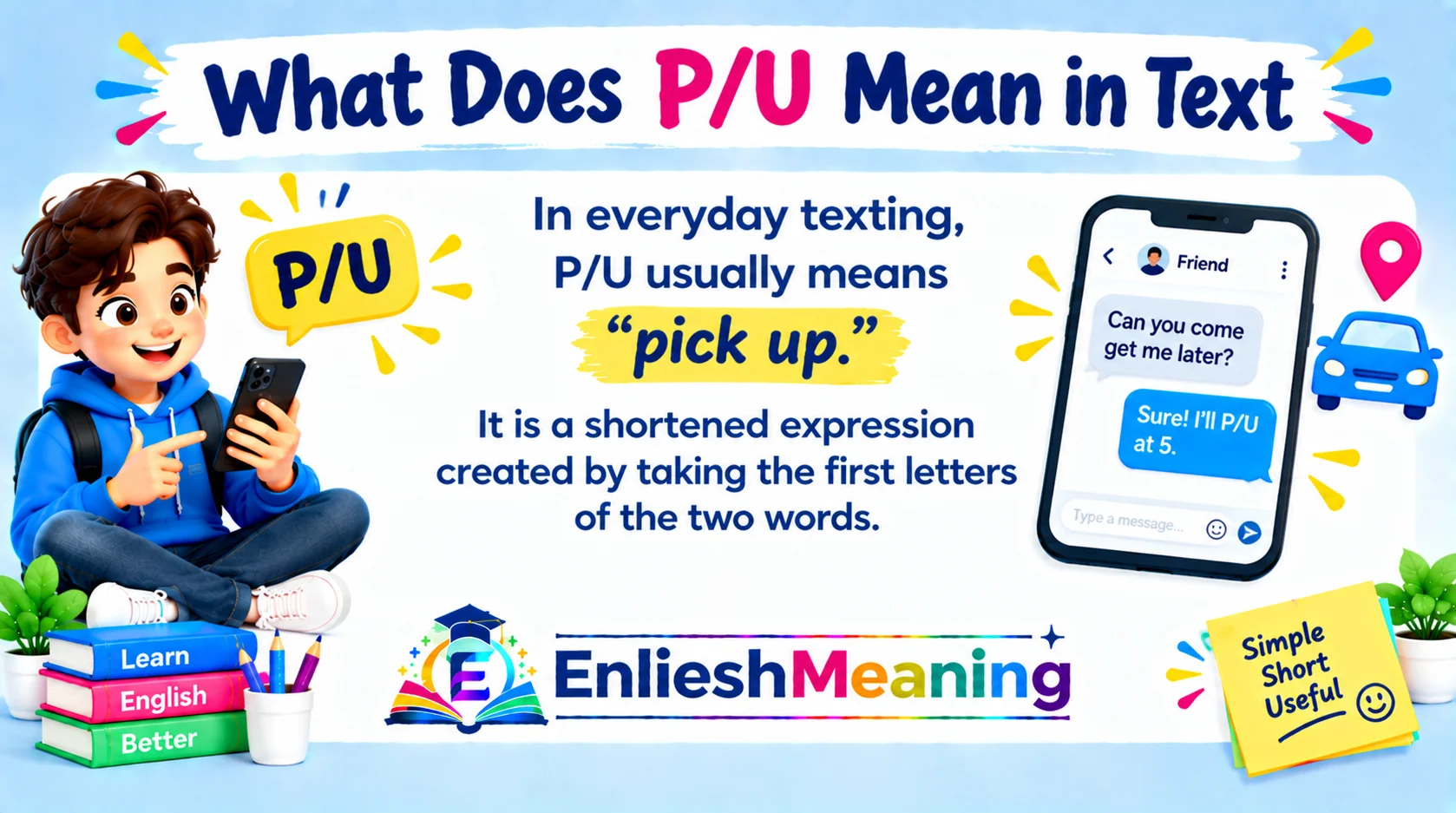
If you have received a message containing “P/U”, you may wonder what the abbreviation means. In texting and casual online communication, P/U most commonly means “pick up.”
People often use it when talking about collecting someone, answering a phone call, picking up an item, or understanding an implied request depending on the conversation.
For example, someone might text, “Can you p/u the package?” meaning “Can you pick up the package?” Similarly, “P/U at 7?” can mean “Pick me up at 7?”
The exact meaning depends on the words surrounding the abbreviation and the relationship between the people communicating.
People search for the meaning of P/U in text because abbreviations can be confusing, especially when they appear without context.
Unlike standard dictionary words, texting shortcuts can have different meanings in different communities or situations. Understanding the context helps you interpret the intended message correctly.
Meaning & Definition Of P/U
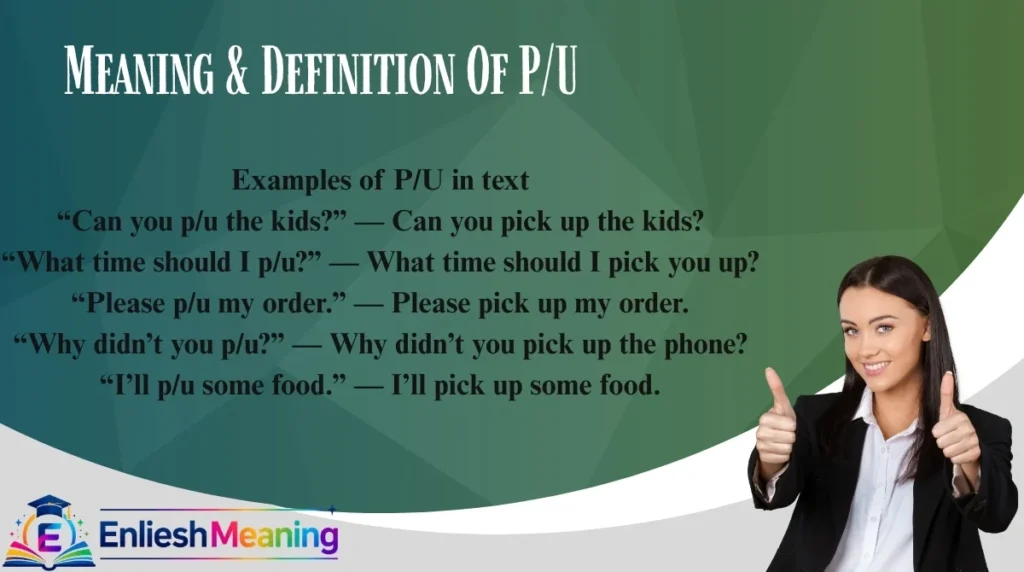
In everyday texting, P/U usually means “pick up.” It is a shortened expression created by taking the first letters of the two words. Because text messages are designed for quick communication, people frequently shorten common phrases to save time and typing effort.
The phrase “pick up” itself can have several meanings. It may refer to physically collecting a person or object, answering a telephone call, learning something, or noticing an idea. Therefore, the intended meaning of P/U depends heavily on the surrounding conversation.
Examples of P/U in text
- “Can you p/u the kids?” — Can you pick up the kids?
- “What time should I p/u?” — What time should I pick you up?
- “Please p/u my order.” — Please pick up my order.
- “Why didn’t you p/u?” — Why didn’t you pick up the phone?
- “I’ll p/u some food.” — I’ll pick up some food.
In some conversations, the abbreviation may also be used as part of a longer expression. Someone might write “P/U location” when discussing where a person or item should be collected.
It is important not to assume that P/U always has one fixed meaning. Texting language is informal, and people sometimes create their own abbreviations. If the surrounding message does not make the meaning clear, asking the sender can prevent misunderstanding.
Overall, when P/U appears in an ordinary text message, “pick up” is generally the most natural interpretation.
Background
Abbreviations have been part of informal communication for a long time, but their use became especially common with mobile phones, instant messaging, and social media. People began shortening frequently used words and phrases because typing on small keyboards was slower than writing by hand.
Expressions such as “see you,” “be right back,” and “talk to you later” developed shortened forms that became familiar in digital communication. P/U fits into this broader pattern of reducing common phrases to a few characters.
The abbreviation is particularly practical because “pick up” is a phrase used in many everyday situations. People may need to pick up friends, family members, food, packages, prescriptions, documents, or other items. They may also ask whether somebody picked up a phone call.
The slash in P/U helps distinguish the two parts of the phrase. Similar slash-based abbreviations can appear in notes, schedules, workplace messages, delivery instructions, and informal communication.
However, texting abbreviations are not always standardized. One person may use P/U to mean “pick up,” while another person may understand it differently based on a particular field or conversation. This is why context remains more important than the abbreviation itself.
Over time, many texting shortcuts have moved beyond SMS messages and into social media, messaging applications, online communities, and workplace chats. Some abbreviations become widely recognized, while others remain personal or industry-specific.
P/U continues to be useful because it is short and easy to understand when the context is obvious. In a message such as “P/U at 6?”, most readers can understand that the sender is talking about picking someone up. In a less obvious message, however, clarification may be necessary.
Usage in Different Contexts: Chat, Social Media, and Professional Fields
The meaning of P/U can change slightly according to the setting in which it appears.
In casual chat
In everyday conversation, P/U most often refers to “pick up.” A friend might say, “Can you p/u after work?” Here, the sender is asking whether the other person can collect them after work.
It can also refer to objects:
“Can you p/u the groceries?”
In this example, P/U means collecting or retrieving something.
On social media
On platforms where people communicate quickly, abbreviations can be used in captions, comments, direct messages, or private conversations. P/U may still mean “pick up,” particularly when people are discussing transportation or collecting an item.
However, social media users sometimes create personal shorthand. Therefore, a user should consider the entire message rather than interpreting P/U automatically.
In professional communication
P/U may appear in informal workplace messages, particularly when employees are discussing deliveries, transportation, orders, or collection arrangements.
For example:
- “P/U scheduled for 3 PM.”
- “Customer requested p/u.”
- “Can you arrange the p/u?”
In these examples, P/U generally refers to pickup or pick-up.
For formal documents, however, writing “pickup,” “pick-up,” or “collection” is usually clearer than using an abbreviation. Professional readers may not know an unfamiliar shorthand, especially when communication crosses industries.
The key difference is that casual communication prioritizes speed, while professional communication often prioritizes clarity. P/U can be perfectly understandable in a quick workplace chat but less appropriate in a formal report or customer-facing document.
Meaning in Chat, WhatsApp, Instagram, and TikTok
On messaging and social platforms, P/U is usually interpreted from the immediate context.
P/U in chat
If someone writes:
“Can you p/u at 8?”
they may mean “Can you pick me up at 8?”
If someone writes:
“Why didn’t you p/u?”
the phrase could mean “Why didn’t you pick up?”, particularly if a phone call was involved.
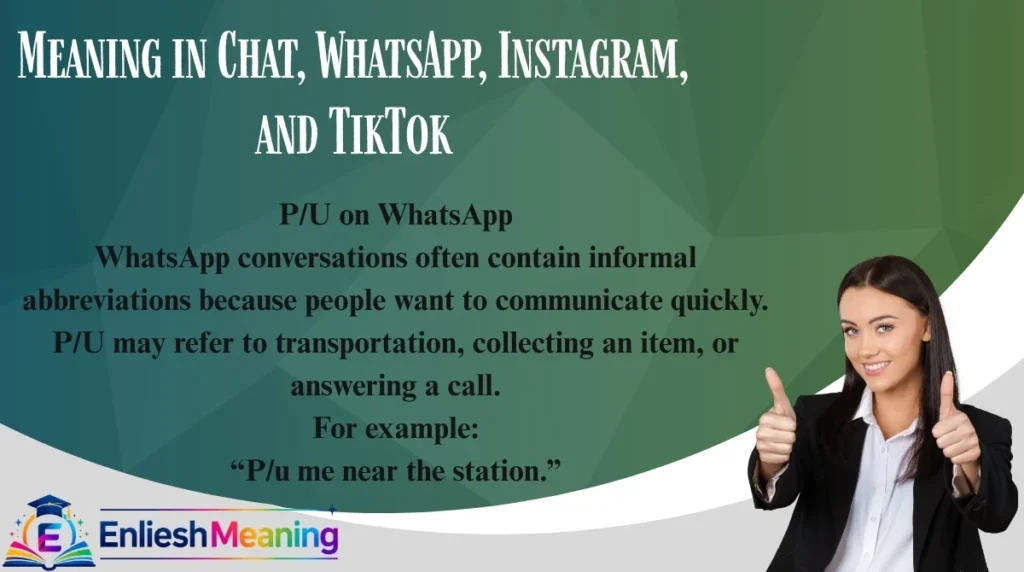
P/U on WhatsApp
WhatsApp conversations often contain informal abbreviations because people want to communicate quickly. P/U may refer to transportation, collecting an item, or answering a call.
For example:
“P/u me near the station.”
This means the sender wants the other person to pick them up near the station.
P/U on Instagram
Instagram does not give P/U one universal meaning. In a direct message, its interpretation depends on what the people are discussing. If two people are arranging transportation, P/U probably means “pick up.”
P/U on TikTok
TikTok comments and direct messages can contain highly informal language. P/U may appear when users discuss meeting arrangements, collecting something, or other everyday activities. However, it should not automatically be treated as a TikTok-specific abbreviation.
The most reliable approach across all these platforms is to examine the complete sentence. The same abbreviation can have different meanings when the subject of the conversation changes.
Meaning in Physics, Medical, and Aircraft Terminology
Outside everyday texting, P/U can have specialized meanings, and there is no single universal definition across physics, medicine, and aviation.
P/U in physics
In physics-related writing, abbreviations depend on the textbook, research field, equation, or notation system being used. PU should not automatically be interpreted as “pick up” in a physics context. A symbol or abbreviation may represent a particular quantity, unit, or concept defined by the author.
If P/U appears in a physics equation or technical document, the surrounding definitions should be checked before assigning a meaning.
P/U in medical terminology
Medical abbreviations are especially context-dependent. P/U may be used differently in clinical notes, administrative records, laboratory documentation, or other healthcare settings. Because unclear abbreviations can create confusion, medical terminology should always be interpreted according to the specific document and established terminology used by the relevant organization.
Therefore, a person should not assume that medical P/U means “pick up.”
P/U in aircraft or aviation terminology
Aviation uses many specialized abbreviations, and their meanings can vary according to operational documents, aircraft systems, manuals, and procedures. P/U may therefore have a technical interpretation in a particular aviation context rather than its everyday texting meaning.
If you encounter P/U in an aircraft manual, flight document, technical diagram, or aviation record, use the document’s abbreviation list or glossary when available.
The important point is simple: P/U in ordinary texting and P/U in a specialized technical field should not automatically be treated as the same abbreviation.
Common Misconceptions
One common misconception is that P/U always means exactly the same thing. In reality, abbreviations depend on context.
Another misconception is that every person who uses P/U expects everyone else to understand it. Informal abbreviations are not universal. A sender may be familiar with a particular shortcut while the recipient is not.
People may also assume that P/U always refers to transportation. Although “pick up” commonly means collecting a person, it can also refer to collecting an object, receiving an order, or answering a call.
For example:
- “P/U my brother” — collect a person.
- “P/U the package” — collect an item.
- “Why didn’t you p/u?” — answer a call.
Another misunderstanding occurs when capitalization is treated as meaningful. P/U, p/u, and PU may be intended to represent the same phrase in casual communication, although formatting can vary from person to person.
It is also incorrect to assume that every abbreviation found online has an official definition. Many shortcuts develop naturally among users rather than being formally established.
Finally, people sometimes interpret an abbreviation without reading the complete sentence. This can produce unnecessary confusion. When a message seems ambiguous, the safest approach is to consider the surrounding words or simply ask what the sender meant.
Similar Terms & Alternatives
Several expressions can communicate an idea similar to P/U, although they are not always interchangeable.
Pick up
This is the full phrase and the clearest alternative in ordinary conversation.
“Can you pick me up?”
Pickup
“Pickup” can describe the act or arrangement of collecting someone or something.
“The pickup is at 5 PM.”
Collect
“Collect” can be used when retrieving an item or person, depending on the situation.
“Please collect the package.”
Retrieve
“Retrieve” is more formal and often refers to obtaining something.
“Please retrieve the documents.”
Answer
When P/U refers to a telephone call, “answer” may communicate the intended meaning more clearly.
“Why didn’t you answer the phone?”
Come get me
In transportation-related conversations, “come get me” can express the idea more naturally than an abbreviation.
“Can you come get me after class?”
These alternatives demonstrate why context matters. P/U is convenient, but the complete phrase often provides greater clarity.
How to Respond to P/U
Your response should depend on what the sender means by P/U.
If someone asks:
“Can you p/u at 7?”
and they are asking for transportation, you could respond:
“Sure, I’ll pick you up at 7.”
If you are unavailable:
“Sorry, I can’t pick you up at 7. Could we do 8 instead?”
If the sender says:
“Can you p/u the package?”
you can answer:
“Yes, I’ll pick it up this afternoon.”
If you are unsure about the abbreviation, there is nothing wrong with asking for clarification:
“What do you mean by P/U?”
or:
“Do you mean pick up?”
In casual conversations, a short response is usually enough. You do not need to use the abbreviation yourself just because the other person did. Using the full phrase can actually make your response easier to understand.
If P/U appears in a professional or technical message and its meaning is unclear, clarification is particularly important. Rather than guessing, ask the sender what the abbreviation means.
Differences From Similar Words
P/U can be confused with several expressions because they involve similar ideas.
Both can refer to obtaining something, but “collect” may sound more formal or may be preferred in particular situations.
Both can refer to obtaining something, but “collect” may sound more formal or may be preferred in particular situations. The exact grammatical use depends on the sentence.
P/U vs. Collect:
Both can refer to obtaining something, but “collect” may sound more formal or may be preferred in particular situations.
P/U vs. Answer:
When P/U refers to a phone call, “answer” can be the clearer word. However, “pick up” and “answer” are not identical in every context.
P/U vs. Meet:
Someone asking you to “p/u” generally wants you to collect them, while “meet” simply means to come together at a location.
These distinctions become important when the message is short. A few surrounding words can completely change the intended interpretation.
Relevance in Online Conversations & Dating Apps
P/U can occasionally appear in dating-app conversations, particularly when people are discussing plans to meet. For example, one person might write:
“Want me to p/u?”
In that context, the sender is likely asking whether they should pick the other person up.
Another example might be:
“I can p/u around 8.”
This could mean the person is offering to collect their date around 8 o’clock.
However, dating apps contain a wide variety of informal language, and P/U does not have a special universal dating meaning. The safest interpretation comes from the conversation itself.
For example, if the discussion is about transportation, P/U likely refers to picking someone up. If the conversation is about an item, it may refer to collecting something.
Because short abbreviations can sometimes be misunderstood, especially between people who have not met before, using clear language is often helpful when making plans.
If someone sends “P/U?” without any additional information, you can respond with:
“Do you mean pick me up?”
This confirms the meaning before making arrangements.
In online conversations, clarity is especially useful when discussing locations, times, transportation, or meeting plans. A simple clarification can prevent both people from making different assumptions.
Frequently Asked Questions
What does P/U mean in text?
P/U usually means “pick up” in texting. It can refer to picking someone up from a location or collecting something.
What does P/U mean in a text message?
In a text message, P/U commonly means “pick up.” For example, “Can you P/U me at 7?” means “Can you pick me up at 7?”
What does P/U mean from a girl?
If a girl uses P/U, it usually means “pick up,” especially when discussing transportation or collecting something. The exact meaning depends on the conversation.
What does P/U mean from a guy?
When a guy texts P/U, it can mean “pick up.” For example, “I’ll P/U the food” means “I’ll pick up the food.”
What does P/U mean on WhatsApp?
On WhatsApp, P/U can commonly stand for “pick up.” It is an informal abbreviation used to save time while texting.
What does P/U mean on Instagram?
On Instagram messages, P/U may mean “pick up,” particularly when someone is discussing meeting arrangements or collecting something.
What does P/U mean in chat?
In casual chat, P/U most often means “pick up.” The surrounding words can help determine whether it refers to picking up a person, item, phone call, or another task.
Does P/U have other meanings?
Yes. P/U can have different meanings depending on the context. In some conversations, it may represent another phrase or abbreviation, so the complete message should be considered.
What does “P/U” mean when talking about a person?
When talking about a person, P/U usually means “pick up” someone from a particular place. For example, “I can P/U Sarah” means “I can pick up Sarah.”
What does “P/U” mean when talking about food?
When discussing food, P/U can mean “pick up.” For example, “I’ll P/U dinner” means “I’ll pick up dinner.”
How should I respond to P/U in a text?
If someone says “P/U?”, you can respond by confirming the pickup details. For example, you could say, “Sure, what time?” or “Yes, I’ll pick you up at 7.”
Is P/U a formal abbreviation?
No. P/U is generally an informal texting abbreviation. In professional or formal writing, it is usually better to write “pick up” in full.
Is P/U the same as “pick up”?
In many texting situations, yes. P/U is a shortened form of “pick up.” However, context should always be checked because abbreviations can have multiple meanings.
What is the difference between P/U and PU?
P/U and PU can sometimes refer to the same phrase, “pick up,” but the slash in P/U makes the abbreviation clearer. In other contexts, PU may have completely different meanings.
Can P/U mean “pick up the phone”?
Yes. Depending on the conversation, P/U can refer to picking up a phone call or answering the phone. The surrounding message usually makes the intended meaning clear.
Conclusion
P/U in text most commonly means “pick up.” It is an informal abbreviation used in messages when people want to communicate quickly.
Depending on the context, it may refer to picking up a person, collecting an item, receiving an order, or even picking up a phone call.
The abbreviation can appear in ordinary chats, WhatsApp messages, Instagram DMs, TikTok conversations, workplace chats, and other digital communication. However, its meaning is not universal.
In physics, medicine, aviation, or another specialized field, P/U may have a completely different interpretation.
The best way to understand an abbreviation is to examine the complete message and the situation in which it appears. If the meaning remains unclear, asking the sender is better than guessing.
In casual texting, therefore, when you see P/U, the first interpretation to consider is “pick up.” Context ultimately determines what the sender intended.