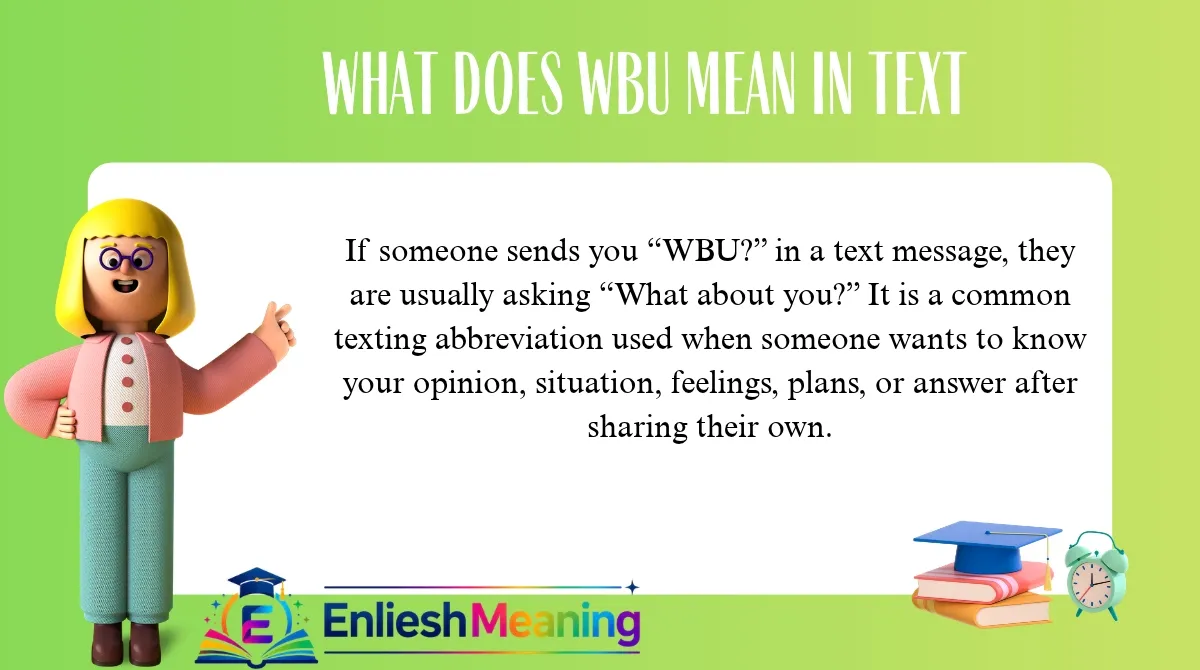
If someone sends you “WBU?” in a text message, they are usually asking “What about you?” It is a common texting abbreviation used when someone wants to know your opinion, situation, feelings, plans, or answer after sharing their own.
For example, if a person says, “I’m doing great, WBU?” they simply mean, “I’m doing great. What about you?”
People often search for the meaning of WBU because texting abbreviations can be confusing, especially when they appear without context. The abbreviation is popular because it makes conversations quicker and more casual.
You may encounter it in text messages, social media comments, group chats, dating apps, and other online conversations.
Although WBU generally has a straightforward meaning, the exact purpose of the question depends on the conversation.
It can be friendly, casual, curious, or even slightly flirty depending on who sends it and what they have been discussing.
Meaning & Definition Of WBU

WBU stands for “What about you?” It is primarily used in informal digital communication when someone wants to return a question to another person.
For example:
- “I’m from Lahore. WBU?” → “I’m from Lahore. What about you?”
- “I love watching movies. WBU?” → “I love watching movies. What about you?”
- “I’m free this weekend. WBU?” → “I’m free this weekend. What about you?”
The abbreviation usually appears after the sender has already provided their own answer or information. Instead of writing the complete phrase, they use three letters to keep the conversation short and convenient.
WBU does not normally represent a completely different phrase in ordinary texting. However, context always matters when interpreting abbreviations. If you see it in a specialized document, technical discussion, or unusual setting, its meaning could potentially be different.
In everyday messaging, though, “What about you?” is the standard interpretation.
The phrase can also help maintain the flow of a conversation. Rather than simply answering a question, a person may add WBU to show that they are interested in hearing your response as well. This makes it particularly useful when discussing preferences, experiences, locations, hobbies, plans, or feelings.
Background
The rise of texting abbreviations is closely connected with the development of instant messaging and online communication. People began shortening frequently used phrases because typing fewer characters made conversations faster and more convenient.
Expressions such as “what about you?” are naturally suited to abbreviation because they occur frequently in everyday conversations. WBU provides a compact way to ask the same question without changing its basic meaning.
Unlike some slang expressions that may have complicated origins or changing interpretations, WBU is relatively easy to understand. Its letters correspond directly to the first letters of What, About, You.
The abbreviation became especially useful as people began communicating through mobile phones, messaging platforms, social networks, and online communities. Informal digital conversations often favor speed and simplicity over traditional sentence structure. As a result, abbreviations such as WBU became familiar to many internet users.
Its continued use also reflects the conversational nature of online communication. People frequently type messages as if they were speaking aloud, and WBU functions much like the spoken question “What about you?”
The abbreviation is generally considered casual rather than formal. It works naturally between friends, family members, classmates, coworkers in informal chats, and people getting to know each other online.
However, the level of familiarity between two people can affect whether it feels appropriate. Someone writing a formal business email would normally use the complete phrase or restructure the sentence instead of using WBU.
Usage in Different Contexts
WBU can appear in several types of informal communication, but its basic purpose remains the same: asking another person to share their corresponding information or opinion.
In casual chats
A person might say:
“I’m staying home tonight. WBU?”
Here, WBU asks about the other person’s plans.
In conversations about preferences
Someone might write:
“I prefer coffee over tea. WBU?”
The sender is asking for your preference.
On social media
WBU may appear in comments, direct messages, or replies. Someone could write:
“This is my favorite song. WBU?”
The person wants to know whether you have a similar opinion.
In professional communication
WBU is less appropriate in formal workplace communication. In an informal team chat, however, colleagues may use it when discussing schedules or preferences.
For example:
“I can join the meeting at 3 PM. WBU?”
In a formal email, it would be better to write:
“I can join the meeting at 3 PM. What time works for you?”
The important point is that WBU is primarily a casual communication abbreviation. Its meaning does not normally change simply because the conversation takes place on a different platform.
Meaning in Chat, WhatsApp, Instagram, and TikTok
On messaging and social media platforms, WBU almost always means “What about you?”
WBU in chat
In ordinary texting, WBU is commonly used to return a question.
Example:
“I’m watching a movie right now. WBU?”
Meaning:
“I’m watching a movie right now. What about you?”
WBU on WhatsApp
WhatsApp users often use abbreviations to make conversations faster. WBU can be used when discussing work, school, food, plans, hobbies, or everyday activities.
Example:
“I’m free tomorrow. WBU?”
WBU on Instagram
On Instagram, it may appear in direct messages or comments when someone wants your opinion or personal response.
Example:
“I like this outfit. WBU?”
WBU on TikTok
TikTok users may use WBU in comments or messages, especially when discussing videos, trends, creators, music, or personal preferences.
Example:
“I’ve watched this trend so many times 😂 WBU?”
The platform does not normally change the meaning. Whether it appears on WhatsApp, Instagram, TikTok, Snapchat, or another messaging service, the standard interpretation remains “What about you?”
Meaning in Physics, Medical, and Aircraft Terminology
WBU is not primarily a physics, medical, or aircraft abbreviation in ordinary texting. Its standard texting meaning is “What about you?”
However, specialized industries can use the same combinations of letters as abbreviations for completely different terms. Technical abbreviations depend heavily on the field, organization, document, and surrounding terminology.
Physics
In a physics-related context, WBU should not automatically be interpreted as “What about you?” If it appears in a technical formula, research paper, laboratory document, or specialized discussion, the surrounding information should be examined before assigning a meaning.
Medical terminology
Medical professionals use numerous abbreviations, and some combinations of letters can have specialized meanings. Therefore, WBU in a medical record or healthcare document should be interpreted according to the specific documentation system and context rather than assuming it refers to texting slang.
Aircraft and aviation
Aviation also uses many standardized abbreviations and codes. If WBU appears in an aviation document, flight-related system, technical manual, or operational communication, its meaning may depend on the particular aviation context.
The key distinction is simple: in casual texting, WBU means “What about you?”; in specialized fields, context must determine whether the letters represent something else.
Common Misconceptions
One common misconception is that WBU has a hidden or complicated meaning. In normal texting, it is generally straightforward and simply means “What about you?”
Another misunderstanding is that WBU is automatically romantic or flirtatious. It is not. A friend, family member, classmate, coworker, or stranger can use it. The abbreviation itself does not indicate romantic interest.
For example:
“I’m studying tonight. WBU?”
This is simply a question about your plans.
Another misconception is that WBU is rude because it is abbreviated. In informal messaging, abbreviations are common and usually do not indicate disrespect. However, using texting slang in a formal setting could appear overly casual.
Some people also assume that WBU means exactly the same thing emotionally in every conversation. While the literal meaning stays the same, the intention can change. Someone asking “WBU?” after discussing weekend plans is seeking practical information, while someone asking it after “I miss you” may be inviting a more personal response.
Therefore, it is useful to consider the entire conversation, not just the abbreviation.
Similar Terms & Alternatives
Several expressions can perform a similar conversational function.
WBU
WBU = What about you?
This is the direct and common abbreviation.
HBU
HBU = How about you?
HBU is extremely similar to WBU and can often be used in the same situations.
Example:
“I’m doing good. HBU?”
This means:
“I’m doing good. How about you?”
And you?
This is the full conversational alternative and is very natural in everyday speech.
Example:
“I’m tired. And you?”
What about yourself?
This is another alternative, although it may sound more formal or deliberate depending on the situation.
You?
Sometimes people simply write “You?” after answering a question.
For example:
“I’m from Karachi. You?”
The meaning is essentially similar to WBU.
The choice between these expressions usually depends on personal texting style, familiarity, and the platform being used.
How to Respond to WBU
The best way to respond to WBU is to answer the question that came before it. Since WBU means “What about you?”, your response should provide information about yourself.
If someone says:
“I’m feeling good today. WBU?”
You could respond:
“I’m doing good too!”
If they ask:
“I’m going out tonight. WBU?”
You might say:
“I’m staying home tonight.”
If the conversation is about preferences:
“I love pizza. WBU?”
You could answer:
“Same! Pizza is one of my favorites.”
You can also use the opportunity to continue the conversation by giving a little more information.
For example:
“I’m free this weekend too. Maybe we could hang out.”
If the person is someone you are interested in, your response can naturally reflect the tone of the conversation. However, there is no special response required simply because they used WBU.
A short answer is perfectly acceptable when the conversation is casual. The important thing is to understand that they are asking you to share your corresponding answer, opinion, feeling, or situation.
Differences From Similar Words
The main abbreviation commonly compared with WBU is HBU.
Both expressions are used to ask another person for their corresponding answer, but they use slightly different wording.
| Expression | Meaning | Typical Use |
|---|---|---|
| WBU | What about you? | Asking for the other person’s response |
| HBU | How about you? | Asking for the other person’s response |
| And you? | And you? | Casual or neutral follow-up |
| You? | What about you? | Very short informal reply |
| What about yourself? | What about you? | More complete wording |
In many conversations, WBU and HBU are practically interchangeable. The difference is mainly in phrasing rather than meaning.
For example:
“I like football. WBU?”
and
“I like football. HBU?”
Both ask the other person to state whether they like football or to share their own preference.
The choice may depend on the sender’s personal habits. Some people naturally use WBU, while others prefer HBU or simply “you?”
Relevance in Online Conversations & Dating Apps
WBU can be particularly useful in online conversations because it helps keep an exchange balanced. When two people are getting to know each other, one person may answer a question and then use WBU to invite the other person to respond.
For example:
“I’m a big fan of traveling. WBU?”
This could encourage the other person to talk about their travel interests.
On dating apps, WBU may appear when people discuss hobbies, locations, occupations, favorite foods, weekend plans, or relationship preferences. However, WBU itself does not indicate romantic interest. Its meaning is simply “What about you?”
The surrounding conversation provides the additional context.
For example:
“I’m looking for something serious. WBU?”
Here, the topic makes the question more personal.
In another conversation:
“I usually watch movies on weekends. WBU?”
The subject is simply entertainment.
Therefore, when interpreting WBU on a dating app, focus on what was discussed before the abbreviation and how the person communicates overall, rather than treating WBU as a romantic signal by itself.
FAQs
What does WBU mean in text?
WBU usually means “What about you?” It is used to ask another person for their answer, opinion, feelings, plans, or situation.
What does WBU mean on WhatsApp?
On WhatsApp, WBU normally means “What about you?” It is a casual abbreviation used to keep conversations short.
Is WBU a slang word?
WBU is better described as a texting abbreviation rather than traditional slang. It is a shortened form of “What about you?”
What is the difference between WBU and HBU?
WBU means “What about you?”, while HBU means “How about you?” They are often interchangeable in casual conversations.
Does WBU mean something romantic?
Not by itself. WBU is a general conversational abbreviation. Its tone depends on the surrounding conversation and relationship between the people communicating.
How should I reply to WBU?
Simply answer the question being returned to you. For example, if someone says, “I’m tired, WBU?” you can reply, “I’m tired too,” or explain how you are feeling.
Can WBU be used in professional communication?
It can appear in informal workplace chats, but the full phrase “What about you?” or another complete sentence is generally more suitable for formal emails and professional documents.
Is WBU rude?
No. WBU is normally a neutral, casual abbreviation. Whether a message sounds rude depends more on its wording and context than on the abbreviation itself.
Conclusion
WBU means “What about you?” and is one of the straightforward abbreviations commonly used in casual digital conversations.
People use it after sharing their own information, opinion, feeling, preference, or plans when they want the other person to respond with something similar.
You may see WBU in text messages, WhatsApp chats, Instagram DMs, TikTok conversations, dating apps, and other informal online spaces.
Its basic meaning remains consistent across these platforms, although the tone can vary depending on the subject and relationship between the people communicating.
WBU is not inherently romantic, rude, or formal. Understanding the message surrounding it is the best way to determine the sender’s intention.
In most everyday situations, a simple answer about yourself is the appropriate response.