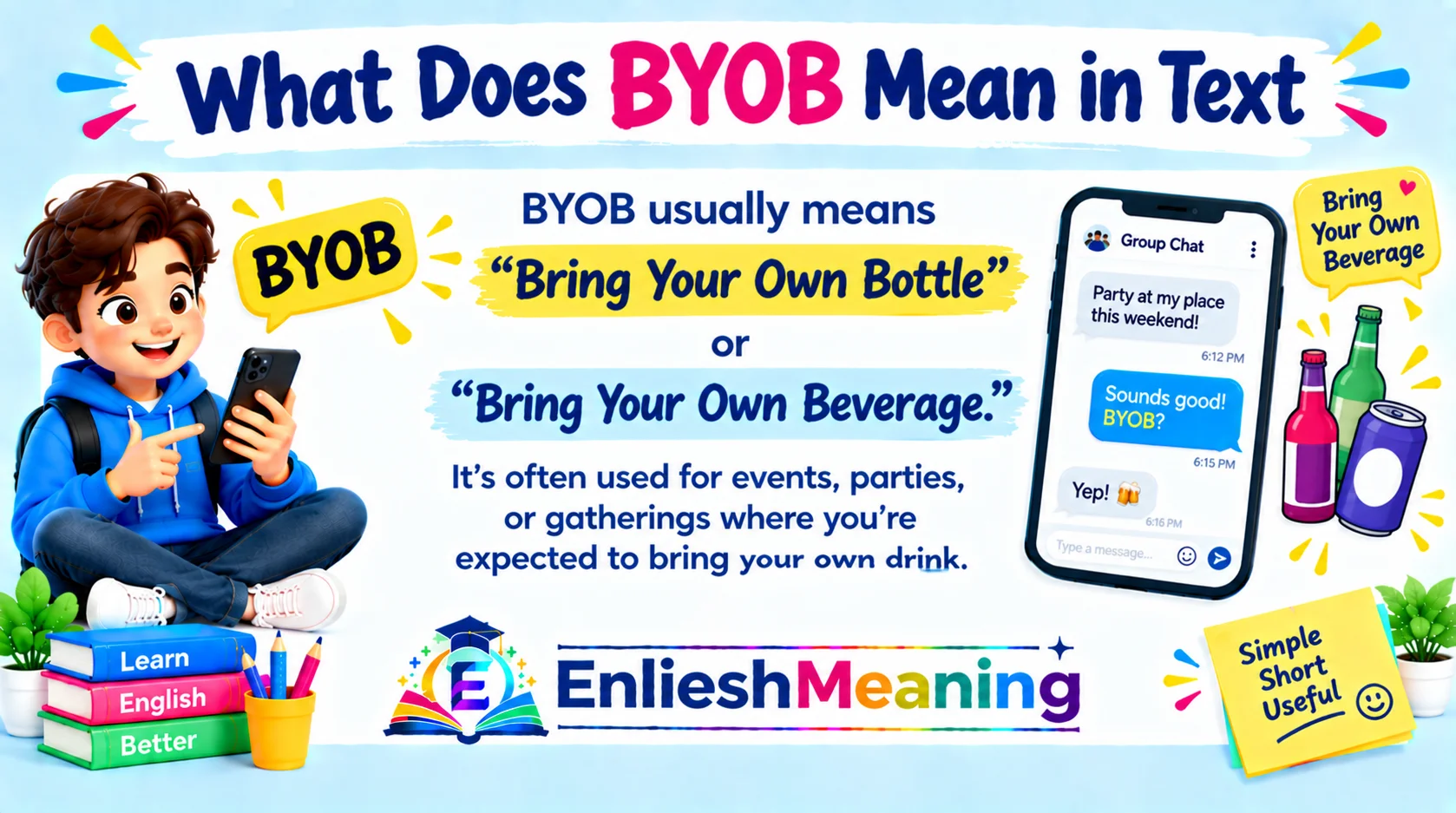
If you have seen BYOB in a text message, social media post, invitation, or online conversation, you may wonder what these four letters mean. In most casual situations, BYOB means “Bring Your Own Bottle” or “Bring Your Own Beverage.”
It is commonly used when people are invited to a party, picnic, dinner, gathering, or other event and are expected to bring their own drink.
The exact meaning can depend on the situation. For example, a friend might write “BYOB tonight” to tell you to bring your preferred beverage, while an event invitation may use BYOB as a simple instruction for guests.
People often search for the meaning because abbreviations can have different interpretations across conversations and platforms.
Understanding the surrounding context helps you determine what the sender intended. This guide explains what BYOB means in text, where it comes from, how it is used online, and how you can respond naturally when someone sends it.
Meaning & Definition Of BYOB
BYOB usually means “Bring Your Own Bottle” or “Bring Your Own Beverage.” It is an informal abbreviation used to tell someone that they should bring their own drink to an event or gathering.
The abbreviation is particularly common in casual invitations. Someone might text, “We’re having a small party Saturday, BYOB,” meaning that guests should bring a beverage for themselves. Depending on the event, the beverage could be an alcoholic drink, soft drink, juice, water, or another preferred beverage.
The meaning is generally understood from the context. If someone sends “BYOB” while discussing a party, dinner, barbecue, picnic, or celebration, they are probably referring to bringing a drink.
Examples in Text Messages
- “Party starts at 8. BYOB.”
This means guests should bring their own beverage.- “We’re having a barbecue tomorrow, BYOB if you want something specific.”
The sender is suggesting that people bring their preferred drinks.- “Is it BYOB?”
The person is asking whether they need to bring their own beverage.
BYOB is usually not a complicated expression. It works as a short instruction that saves space in digital communication.
It can also appear in event descriptions and invitations. In those situations, it may be written in capital letters because it is an abbreviation. However, the meaning remains essentially the same.
One important point is that BYOB does not automatically mean alcohol. Although the expression is frequently associated with alcoholic beverages at parties, the surrounding context determines what type of drink is intended.
Background
The expression BYOB developed as a convenient shortened form of an instruction telling guests to bring their own drinks. Over time, it became widely recognized in informal invitations, restaurants, parties, social gatherings, and personal messages.
The abbreviation is useful because a short four-letter expression can communicate an entire instruction. Instead of writing “Please bring your own beverage,” someone can simply write “BYOB.”
The first part, “bring your own,” is straightforward. The final letter can represent different words depending on the context, most commonly “bottle” or “beverage.” This flexibility explains why you may see slightly different expansions of the abbreviation.
For example, an invitation might say:
“BYOB — drinks are not provided.”
In this case, the organizer is making it clear that guests should arrange their own beverages.
In another situation, someone could write:
“BYOB and snacks!”
Here, the abbreviation functions as a quick reminder rather than a formal instruction.
The phrase became especially useful in social settings where hosts wanted guests to bring drinks according to their own preferences. It can also reduce the cost and effort involved in providing beverages for a large group.
Today, BYOB is familiar in many forms of digital communication. It can appear in text messages, group chats, event descriptions, social media captions, invitations, and informal announcements.
Although the abbreviation has a long history of casual use, its meaning remains simple. It generally communicates that the person attending should bring a beverage rather than expecting the host or organizer to provide one.
Because abbreviations can evolve, context still matters. If you are unsure whether the organizer means alcoholic drinks, non-alcoholic drinks, or a particular type of beverage, asking for clarification is the safest approach.
Usage in Different Contexts
BYOB can appear in several different communication settings, but its basic purpose remains similar. It tells people to bring something for themselves rather than expecting it to be supplied.
In Casual Chats
Friends may use BYOB when organizing parties, movie nights, picnics, or dinners.
Example:
“Come over around 7. BYOB!”
The message means the sender wants you to bring your own beverage.
At Parties
BYOB is particularly common in party-related conversations.
Example:
“House party Saturday. BYOB.”
Here, guests are being reminded that drinks will not necessarily be supplied by the host.
On Social Media
A person organizing a gathering may include BYOB in a post or caption.
Example:
“Game night this Friday! BYOB and bring your favorite snacks.”
The abbreviation makes the announcement short and easy to understand.
In Event Invitations
BYOB can be included on informal invitations to birthdays, barbecues, celebrations, and other gatherings.
In Professional or Workplace Settings
BYOB may occasionally appear in workplace social-event communication, especially for informal gatherings outside normal working hours. However, professional communication should make the expectations clear because not everyone interprets abbreviations the same way.
For example:
“Team picnic at 5 PM. BYOB. Please bring any non-alcoholic drinks you prefer.”
This is clearer than simply writing “BYOB.”
In professional settings, the abbreviation should therefore be used carefully. A formal event invitation may benefit from spelling out the instruction instead.
Meaning in Chat, WhatsApp, Instagram, and TikTok
On messaging and social platforms, BYOB generally retains its ordinary meaning: bring your own bottle or beverage.
BYOB in Chat
In a private conversation, someone may write:
“Are you coming tonight? BYOB.”
They are likely telling you to bring your own drink.
BYOB on WhatsApp
WhatsApp group chats often contain short event-planning messages. For example:
“Everyone bring snacks. BYOB.”
The abbreviation works well because group messages tend to favor quick and familiar expressions.
BYOB on Instagram
Instagram users may use BYOB in event announcements, Stories, captions, or messages.
For example:
“Birthday dinner tonight! BYOB 🍹”
The emoji may provide additional context, but the abbreviation itself still indicates that guests should bring their own beverage.
BYOB on TikTok
On TikTok, BYOB may appear in captions, comments, or videos about parties and gatherings. Its meaning generally remains unchanged.
The important thing is not to assume that every occurrence has exactly the same expansion. “Bottle” and “beverage” are common interpretations, and context determines what the writer intends.
If someone simply comments “BYOB” under a video unrelated to parties or gatherings, the surrounding conversation should be considered before deciding what they mean.
When you encounter an unfamiliar abbreviation online, look at the words around it. The topic of the conversation usually provides enough information to understand the intended meaning.
Meaning in Physics, Medical, and Aircraft Terminology
BYOB is primarily a casual abbreviation rather than a standard technical term in physics, medicine, or aviation.
In Physics
There is no widely recognized general physics meaning of BYOB comparable to standard scientific abbreviations. If you encounter these letters in a physics-related document, they may represent a specialized term, project name, notation, or organization-specific abbreviation.
Therefore, the surrounding material should be examined rather than automatically interpreting it as “bring your own beverage.”
In Medical Contexts
BYOB is not normally used as a universal medical abbreviation. Medical terminology often contains abbreviations that can have multiple meanings, so interpreting an unfamiliar abbreviation without context can be risky.
If BYOB appears in medical documentation, the correct interpretation should come from the document, healthcare professional, or institution rather than from casual texting usage.
In Aircraft or Aviation Terminology
BYOB is likewise not a standard general aviation term. Aviation has its own extensive collection of technical abbreviations, and the meaning of an abbreviation can depend on the specific airline, airport, aircraft system, or operational document.
If you see BYOB in an aviation-related context, do not automatically assume it means “bring your own bottle.” Check the specific context in which it appears.
This distinction is important because abbreviations can have completely different meanings in specialized industries. A phrase that is common in social communication may not have the same meaning in a technical field.
Common Misconceptions
One common misconception is that BYOB always means “Bring Your Own Beer.” While people sometimes use the abbreviation in situations involving beer or other alcoholic drinks, the letters do not necessarily specify beer.
Depending on the context, BYOB may mean:
- Bring Your Own Bottle
- Bring Your Own Beverage
- Bring Your Own Booze
The intended interpretation depends on the event and the people involved.
Another misconception is that BYOB always means alcohol is allowed. That is not necessarily true. An organizer may use BYOB simply to tell guests to bring whatever beverage they want.
For example, at a family picnic, BYOB could refer to water, soda, juice, tea, or another non-alcoholic drink.
A third misconception is that BYOB is appropriate for every situation. It is mainly informal and is most natural in casual communication. A formal business invitation might be clearer if it directly states what guests should bring.
People may also assume that BYOB means the host will provide everything else. That is not necessarily the case. BYOB specifically communicates something about beverages; other event requirements should be clarified separately.
Finally, some readers may assume that BYOB has one fixed expansion. In reality, the final “B” can be interpreted differently according to context. “Bottle” and “beverage” are among the most common interpretations.
When there is uncertainty, asking a simple question such as “What should I bring?” or “Does BYOB mean I should bring my own drinks?” can prevent misunderstandings.
Similar Terms & Alternatives
Several expressions can communicate an idea similar to BYOB, although they are not always exact replacements.
Bring Your Own Drink
This is a straightforward alternative. It clearly tells guests to bring their preferred beverage.
Bring Your Own Beverage
This wording is more explicit than the abbreviation and works well when clarity is important.
Bring Your Own Bottle
This is another common expansion of BYOB and may be appropriate when the event specifically involves bottled drinks.
Drinks Not Provided
This phrase focuses on what the host will not provide rather than instructing guests directly.
Please Bring a Drink
This is friendly and easy to understand, especially when communicating with people who may not know common abbreviations.
Potluck
A potluck is different from BYOB. A potluck generally refers to guests bringing food to share, whereas BYOB relates specifically to beverages.
Self-Service
Self-service can describe an arrangement where guests serve themselves, but it does not necessarily mean they must bring their own drinks.
The best alternative depends on the audience. Among friends, BYOB is short and familiar. For formal invitations or mixed audiences, spelling out the instruction can make the message clearer.
How to Respond to BYOB
Your response depends on what the sender is asking and whether you understand the event arrangements.
If someone simply tells you that an event is BYOB, you can acknowledge the instruction:
“Sure, I’ll bring my own drink.”
If you want to know what type of beverage is appropriate, you can ask:
“Sure! What kind of drinks should we bring?”
If you are unsure whether alcohol is involved, ask directly:
“Does BYOB mean alcoholic drinks, or should we bring any beverage we like?”
If you are asking whether you need to bring something, you could say:
“Is it BYOB, or will drinks be provided?”
For a casual conversation, a short response is perfectly natural:
- “Got it!”
- “Sure, I’ll bring something.”
- “Sounds good!”
- “No problem.”
- “What should I bring?”
If the message comes from a professional or unfamiliar person, a more specific response can avoid confusion.
For example:
“Thanks for letting me know. Could you clarify what beverages guests are expected to bring?”
The goal is simply to make sure you understand the organizer’s expectations before attending.
Differences From Similar Words
BYOB is sometimes confused with other event-related expressions, but the meanings are different.
| Term | Meaning |
|---|---|
| BYOB | Bring your own bottle/beverage |
| Potluck | Guests bring food, usually to share |
| Open bar | Drinks are provided under the event’s arrangement |
| Cash bar | Guests generally purchase their own drinks |
| Bring a drink | Direct instruction to bring a beverage |
| Self-service | Guests serve themselves; it does not necessarily mean they supplied the drinks |
The main difference is that BYOB specifically places responsibility for bringing a beverage on the guest.
For example, if an invitation says “BYOB,” you should not automatically assume drinks will be waiting for you when you arrive.
A potluck is broader because it normally concerns food. Someone could have a potluck and also make the event BYOB, meaning guests bring both food and their own beverages.
An open bar is essentially a different arrangement because the event organizer has made drinks available to guests under the stated arrangement.
A cash bar also differs from BYOB because guests buy drinks rather than necessarily bringing them from home.
Understanding these differences helps prevent confusion when reading invitations, group-chat messages, and event announcements.
Relevance in Online Conversations & Dating Apps
BYOB can occasionally appear in conversations about social plans, including conversations between people who meet through dating apps.
For example, after arranging a casual date at someone’s home, one person might say:
“I’ll handle dinner, BYOB.”
In this context, the person is likely asking the other individual to bring their preferred beverage.
However, dating-app conversations can be less predictable than ordinary event invitations. Abbreviations may sometimes be used humorously, creatively, or with a meaning specific to the conversation. Therefore, context is especially important.
If someone uses BYOB while discussing a restaurant, picnic, house gathering, or casual meetup, the ordinary beverage-related meaning is usually relevant.
If the conversation does not involve drinks or an event, it is reasonable to ask what they mean.
A simple response such as:
“By BYOB, do you mean bring your own drink?”
can resolve the issue immediately.
It is also useful to remember that an abbreviation does not provide all the details about a plan. If you are meeting someone for the first time, you may still need to clarify the location, time, event expectations, and what is being provided.
In online communication, short abbreviations are convenient, but they can sometimes create ambiguity. Asking for clarification is better than making an assumption.
Frequently Asked Questions
What does BYOB mean in text?
BYOB usually means “Bring Your Own Beverage” or “Bring Your Own Booze.” It is commonly used when guests are expected to bring their own drinks to a party or gathering.
What does BYOB mean in a text message?
In a text message, BYOB generally means that you should bring your own drinks to an event, party, dinner, or social gathering.
What does BYOB mean at a party?
At a party, BYOB means “Bring Your Own Beverage” or “Bring Your Own Booze.” It tells guests that drinks may not be provided, so they should bring their own.
Is BYOB only used for alcohol?
No. BYOB can refer to beverages generally, although it is often associated with alcoholic drinks. The intended meaning depends on the context of the invitation or conversation.
What does BYOB mean on an invitation?
On an invitation, BYOB usually tells guests to bring their own drinks. The host may provide food, entertainment, or other arrangements while guests bring beverages for themselves.
What does BYOB mean on WhatsApp?
On WhatsApp, BYOB generally has the same meaning: bring your own beverage or drinks. It may appear in group chats when someone is organizing a party, dinner, picnic, or other gathering.
What does BYOB mean on social media?
On social media, BYOB usually refers to bringing your own drinks to an event. The exact interpretation depends on the post and the type of event being discussed.
Does BYOB mean Bring Your Own Beer?
Sometimes people informally interpret BYOB as “Bring Your Own Beer,” particularly when discussing a party. However, BYOB can refer to beverages more generally.
Does BYOB mean Bring Your Own Bottle?
In some situations, BYOB can be understood as “Bring Your Own Bottle.” The exact expansion varies according to the context and what guests are expected to bring.
What does BYOB mean at a restaurant?
At a restaurant, BYOB commonly means customers can bring their own alcoholic beverages, where permitted. Some BYOB restaurants may have their own rules, fees, or restrictions.
What does BYOB mean in dating?
In a dating or casual social context, BYOB usually means bring your own beverage or drinks if someone is inviting you to a gathering. It does not have a special romantic meaning by itself.
Is BYOB a slang word?
BYOB is an abbreviation rather than a traditional slang word. It is widely used in informal communication, invitations, event planning, restaurants, and social conversations.
What should I bring if someone says BYOB?
If someone says BYOB, you should generally bring the type of beverage you would like to drink. If it is unclear whether alcohol is expected or allowed, check the event details or ask the host.
What is the opposite of BYOB?
There is no single standard opposite abbreviation for BYOB. If the host provides the drinks, the invitation may simply state that beverages will be provided or that guests do not need to bring their own.
Can BYOB have other meanings?
Yes. BYOB can have different meanings in specialized contexts, although “Bring Your Own Beverage” and “Bring Your Own Booze” are among its most common uses in social situations. Context determines the intended meaning.
Conclusion
BYOB generally means “Bring Your Own Bottle” or “Bring Your Own Beverage.” It is a common informal abbreviation used in texts, group chats, invitations, social media posts, and conversations about parties or gatherings.
The expression usually tells guests that they should bring their own drink instead of expecting the host to provide one.
Although BYOB is often associated with alcohol, it does not necessarily refer to alcoholic beverages.
The exact meaning depends on the context, and it can include any beverage the organizer or sender has in mind.
In specialized areas such as physics, medicine, and aviation, BYOB is not generally a universal technical abbreviation, so context should be checked carefully.
If someone sends you “BYOB,” a simple acknowledgment or clarification is enough. Understanding common abbreviations like this makes online conversations easier and helps prevent misunderstandings when making social plans.